


Chinese entrepreneur Frank Gao used to spend long hours running his social media accounts but now outsources the chore to artificial intelligence (AI) agent tool OpenClaw, which is taking China by storm despite official warnings over cybersecurity.
OpenClaw, created in November by an Austrian coder, differs from bots such as ChatGPT because it can execute real-life tasks such as sending e-mails, organizing files or even booking flight tickets.
“Since January, I’ve spent hours on the lobster every day,” Gao said in an interview, referring to OpenClaw’s red crustacean mascot. “We’re family.”
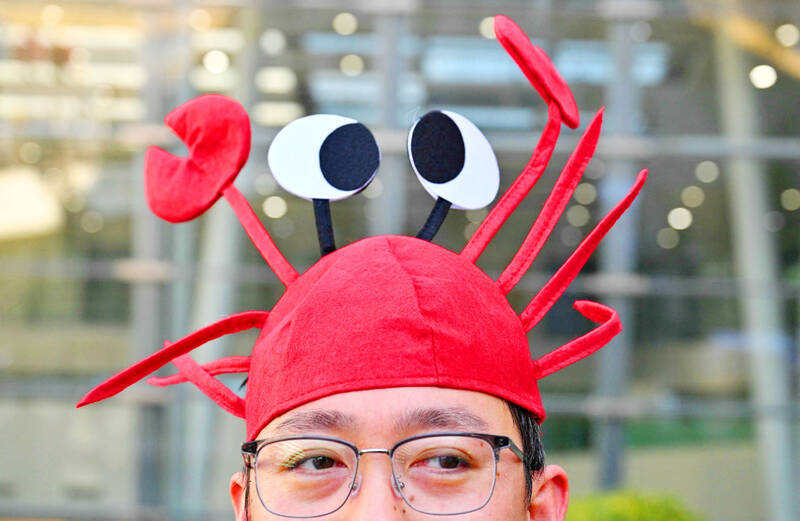
Photo: AFP
After downloading OpenClaw, users connect it to artificial intelligence models of their choice, then give it simple instructions through instant messaging apps, as if to a friend or colleague.
The tool has fascinated tech circles worldwide but particularly in China, gripping tech-savvy companies and individuals keen to keep up with the next big thing in AI.
Hundreds of people queued at tech giant Baidu’s Beijing headquarters this week for an OpenClaw event where engineers helped attendees set up their “little lobsters.”
It was one of many similar meetups, which are drawing crowds from Shanghai to Shenzhen.
Some municipalities, including the eastern cities of Wuxi and Hangzhou, have pledged hundreds of thousands of dollars to support the adoption and development of OpenClaw and other AI agents.
“Lobster fever” has sparked security concerns.
“What’s truly scary about agents like OpenClaw is this: once they have your digital keys, they can theoretically access all the services you’ve authorized, and can autonomously decide when to activate them,” Gao said. “The attacker effectively gains a ‘master key’ to your digital identity,” said the engineer, who has named his OpenClaw agent “Q” after his business name QLab.
Chinese national cybersecurity authorities and Beijing’s ministry of industry and IT have warned of the risks of OpenClaw hacks.
“Use intelligent agents such as ‘lobster’ with caution,” national IT research institute expert Wei Liang advised government agencies, public institutions, companies and individuals on state media.
The mixed signals of rolling out policy incentives while issuing warnings “reflects the authorities’ cautious tolerance toward ‘lobster fever,’” said Zhang Yi, founder of tech consultancy iiMedia.
Austrian programmer Peter Steinberger, who built OpenClaw to help organise his life, was hired by OpenAI last month.
Meanwhile, a separate team of coders that made Moltbook, a Reddit-like pseudo social network where OpenClaw agents converse, are joining Meta.
Top Chinese tech companies have been quick to get involved.
AI companies big and small have launched their own competing agent tools, such as ByteDance’s ArkClaw, Tencent’s WorkBuddy and Zhipu AI’s AutoClaw.
The relatively low cost for cloud deployment of OpenClaw in China, subsidised by big tech firms, is one factor behind its popularity, said Gao Rui, a senior product manager at Baidu AI Cloud.
“For most people, it’s likely just the price of a cup of coffee... which is why people will probably be keen to give it a try,” she said.
Fear of missing out, often shortened to FOMO, is a big driver behind OpenClaw’s success in China, said Chen Yunfei, an AI developer who created a popular online guide for using the tool.
“Most Chinese people are quite studious and forward-looking, so when confronted with new things, they might have stronger feelings” of so-called FOMO, he said.
Xie Manrui, a programmer whose latest project is a visualized system for managing OpenClaw agents, said the tool had arrived “at the right moment” to change perceptions in China of what AI can do.
“For many, AI is merely a clever chatbot that talks all the time but cannot act,” he said.
Either way, it has piqued the curiosity of many young users.
At the Baidu event in Beijing, 24-year-old college student Zheng Huimin was waiting patiently in line with her friends.
“I’d like to give it a go to see what tasks it can actually help me accomplish,” she said.

After several years flying high as Asia’s best Nvidia Corp proxy, Taiwan Semiconductor Manufacturing Co (TSMC, 台積電) is increasingly vying with other artificial intelligence (AI) stocks for investor attention. Stock traders are chasing a wider array of beneficiaries as mainstream usage of AI creates demand for hardware beyond the most-advanced chips TSMC makes for Nvidia. Subthemes from the deepening memory crunch to advances in robotics are also luring bids. At the same time, investment caps on single stocks are pushing funds to diversify, while retail investors long familiar with TSMC through its US depositary receipts are being offered a broader set of

UNDER MICROSCOPE: Taiwan detained three people who allegedly conspired to buy servers in Taiwan and export them using fraudulent documentation, prosecutors said Nvidia Corp chief executive officer Jensen Huang (黃仁勳) on Saturday urged Super Micro Computer Inc to tighten up on compliance after Taiwan detained three people this week for allegedly making fraudulent declarations about artificial intelligence (AI) servers made by its US partner. The development marked the nation’s first crackdown on semiconductor smuggling, which grew after the US slapped restrictions on exports of high-end chips such as Nvidia AI accelerators to China. Nvidia is “rigorous” in explaining regulations to all of its partners, Huang told reporters after arriving in Taipei. “Ultimately Super Micro has to run their own company,” he said in response to

TECH RELIANCE: Growth is increasingly reflecting an unequal K-shaped distribution, where technology sectors outperform and other industries struggle, an expert said Standard Chartered Bank has significantly raised its forecast for Taiwan’s economic growth to 9.5 percent this year, up from 7.6 percent previously, citing surging artificial intelligence (AI) demand driving exports, semiconductor production and investment. The upgrade reflects a sustained AI supercycle that continues to fuel demand for advanced chips and technology infrastructure, which form the backbone of Taiwan’s exports, the bank said in a report this week. “We raise our 2026 growth forecast to reflect a much stronger-than-expected first-quarter GDP figure,” Standard Chartered senior economist for greater China and Asia Tommy Wu (胡東安) said in the report. Driven largely by a 35.3 percent

Two of Taiwan’s international carriers, Starlux Airlines Co (星宇航空) and EVA Airways Corp (長榮航空), have retained the five-star airline rating awarded by international airline review organization Skytrax. Starlux was awarded the distinction for a second consecutive year, while EVA Air received it for the 11th straight year, Skytrax said in statements released yesterday and on Thursday last week, respectively. The five-star rating is considered one of the airline industry's highest honors and is awarded following professional audits of airline product and frontline service standards, Skytrax said. The ratings are based on in-depth assessments using unified global quality standards rather than customer review scores


 RSS
RSS