


Hon Hai Precision Industry Co (鴻海精密), which assembles server racks for Nvidia Corp and iPhones for Apple Inc, yesterday said it aims to grow revenue by a double-digit percentage this year, thanks to a boom in artificial intelligence (AI)-related devices and a pickup in consumer electronics demand.
If there are no major external disruptions, this year should be “quite a good year,” supported by better-than-expected demand for consumer electronics and continued expansion in AI infrastructure investment, Hon Hai chairman Young Liu (劉揚偉) told reporters.
Demand for smartphones and other end devices remains stable, and the broader industry outlook should continue to improve, Liu said.
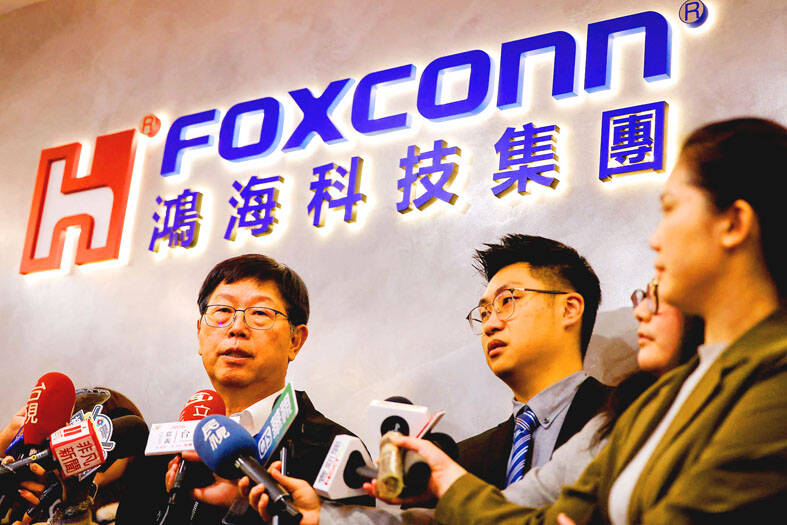
Photo: Ann Wang, Reuters
In the AI server segment, Hon Hai has deepened cooperation with customers in the past few years, participating not only in AI server system assembly, but also strengthening vertical integration in key components such as mechanical parts, thermal solutions and power systems, he said.
As its participation across the AI supply chain deepens, Hon Hai would gain an advantage in the next-generation AI server platform, Nvidia’s Vera Rubin AI server platform, he said.
Through stronger vertical integration with supply chain partners, Hon Hai’s overall deployment is expected to better position it for the Vera Rubin platform, he said.
Liu said he is optimistic about order share and shipments for the new platform, with results gradually materializing this year.
At the Nvidia AI global conference in California from March 16 to 19, Hon Hai plans to showcase solutions related to the new platform, including full server racks and key components such as cooling and power modules, demonstrating the company’s integrated capabilities in the AI server sector, he said.
On consumer electronics, smartphones remain one of the company’s key product lines, he said.
The company will continue to develop new products with major clients, including foldable smartphones that have drawn significant market attention, he said.
Development is ongoing, but launch timing would depend on product maturity to meet customers’ high design and quality standards, he said.
Foldable smartphones face higher technical barriers in design and manufacturing, including mechanical structure, durability and overall quality requirements, resulting in longer development cycles, Liu said, adding that the company could launch such phones depending on market demand.
Meanwhile, geopolitics and energy prices will continue to affect global economic conditions, he said.
Escalating tensions in the Middle East, for example, could push up oil prices and raise raw material costs, although the direct impact on contract manufacturers would be relatively limited, Liu said.
The bigger risk would arise if higher material costs weaken end-market demand, he said.
However, as most of Hon Hai’s customers are major global technology companies that continue to expand investments and product deployment, near-term demand momentum remains stable, he said.

NEW IDENTITY: Known for its software, India has expanded into hardware, with its semiconductor industry growing from US$38bn in 2023 to US$45bn to US$50bn India on Saturday inaugurated its first semiconductor assembly and test facility, a milestone in the government’s push to reduce dependence on foreign chipmakers and stake a claim in a sector dominated by China. Indian Prime Minister Narendra Modi opened US firm Micron Technology Inc’s semiconductor assembly, test and packaging unit in his home state of Gujarat, hailing the “dawn of a new era” for India’s technology ambitions. “When young Indians look back in the future, they will see this decade as the turning point in our tech future,” Modi told the event, which was broadcast on his YouTube channel. The plant would convert

Nanya Technology Corp (南亞科技) yesterday said the DRAM supply crunch could extend through 2028, as the artificial intelligence (AI) boom has led the world’s major memory makers to dramatically reduce production of standard DRAM and allocate a significant portion of their capacity for high-bandwidth memory (HBM) chips. The most severe supply constraints would stretch to the first half of next year due to “very limited” increases in new DRAM capacity worldwide, Nanya Technology president Lee Pei-ing (李培瑛) told a news briefing. The company plans to increase monthly 12-inch wafer capacity to 20,000 in the first half of 2028 after a

Property transactions in the nation’s six special municipalities plunged last month, as a lengthy Lunar New Year holiday combined with ongoing credit tightening dampened housing market activity, data compiled by local land administration offices released on Monday showed. The six cities recorded a total of 10,480 property transfers last month, down 42.5 percent from January and marking the second-lowest monthly level on record, the data showed. “The sharp drop largely reflected seasonal factors and tighter credit conditions,” Evertrust Rehouse Co (永慶房屋) deputy research manager Chen Chin-ping (陳金萍) said. The nine-day Lunar New Year holiday fell in February this year, reducing

Zimbabwe’s ban on raw lithium exports is forcing Chinese miners to rethink their strategy, speeding up plans to process the metal locally instead of shipping it to China’s vast rechargeable battery industry. The country is Africa’s largest lithium producer and has one of the world’s largest reserves, according to the US Geological Survey (USGS). Zimbabwe already banned the export of lithium ore in 2022 and last year announced it would halt exports of lithium concentrates from January next year. However, on Wednesday it imposed the ban with immediate effect, leaving unclear what the lithium mining sector would do in the


 RSS
RSS