


The intensifying military tensions between the US and Iran are beginning to ripple through Taiwan’s financial sector, with banks, insurers and securities firms holding sizable exposure to the Middle East, the Financial Supervisory Commission (FSC) said.
As of the end of last year, the three major financial segments’ combined exposure reached NT$2.35 trillion (US$74.35 billion), up 3.07 percent from a year earlier, the FSC said yesterday, urging local financial institutions to boost risk controls and monitor potential volatility stemming from the geopolitical situation.
Corporate exposure to the Middle East is concentrated in countries with relatively strong fiscal positions and sovereign credit ratings, including the United Arab Emirates (UAE), Saudi Arabia, Qatar, Kuwait, Israel, Oman and Jordan, the commission said.
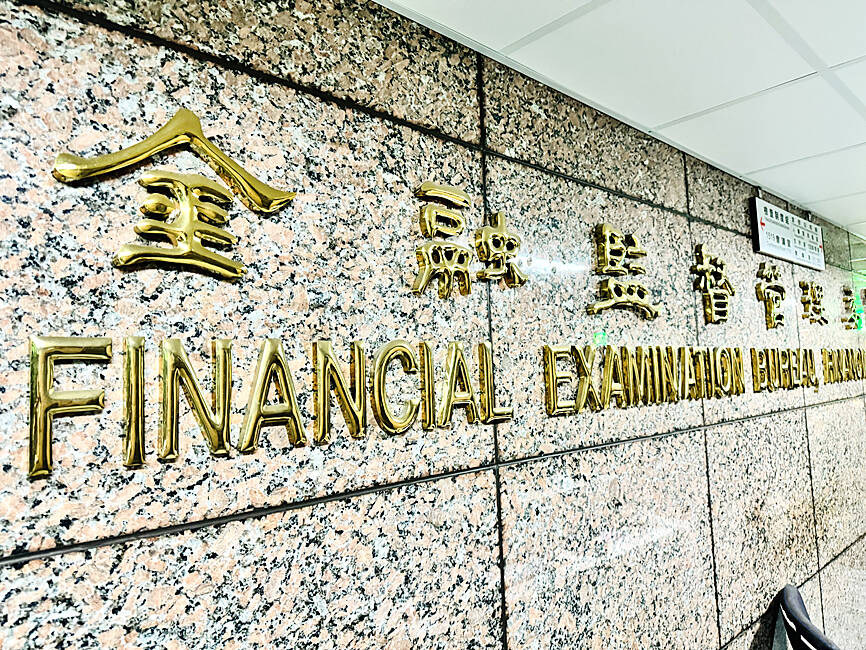
Photo: Kelson Wang, Taipei Times
Among financial firms, insurers carry the largest share of risk, as this segment’s exposure reached NT$1.77 trillion at the end of last year, with the majority of positions tied to investments, primarily in sovereign bonds, it said.
Insurers’ top three investment destinations are the UAE at NT$619.3 billion, Saudi Arabia at NT$477 billion and Qatar at NT$394.4 billion, it said.
The UAE has consistently ranked as the 10th-largest overseas market for Taiwan’s financial holding companies. The country has also become a core market for Taiwanese life insurers deploying capital in the Middle East.
Ongoing US-Iran tensions could trigger sharp short-term volatility in sovereign debt valuations, while longer-term risks might include rising energy costs, which could affect life insurers’ ability to manage long-duration bond portfolios, analysts said.
Banks reported NT$599.2 billion in combined exposure to the Middle East, concentrated in the UAE, Saudi Arabia, Qatar, Kuwait, Israel, Jordan and Oman, the commission said.
The segment’s exposure to the Middle East is primarily in the form of loans to regional financial institutions and corporations, with investment positions largely in bonds issued by local financial institutions. No Taiwanese banks have exposure to Iran, the commission said.
Taiwanese mutual funds hold a combined NT$67.8 billion in Middle East-related assets, which the Securities and Futures Bureau described as limited in both value and proportion relative to total fund assets.
Financial firms’ exposure to Israel totaled NT$136.7 billion at the end of last year, down 4 percent from a year earlier, the commission said.
The decline was the largest among the seven Middle Eastern countries, suggesting that firms have begun trimming positions to mitigate geopolitical risks there.
The TAIEX yesterday plunged 771.44 points, or 2.2 percent, to close at the day’s low of 34,323.65 following a sell-off sparked by the ongoing military conflict in the Middle East.
The New Taiwan dollar also fell sharply against the US dollar, losing NT$0.178 to end at NT$31.609 in Taipei trading.
With the geopolitical landscape in flux, financial institutions must maintain proactive risk management and monitor developments closely, particularly those heavily invested in sovereign debt markets vulnerable to sudden shifts in regional stability, the commission said.
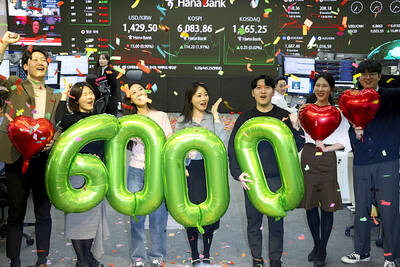
South Korea’s equity benchmark yesterday crossed a new milestone just a month after surpassing the once-unthinkable 5,000 mark as surging global memory demand powers the country’s biggest chipmakers. The KOSPI advanced as much as 2.6 percent to a record 6,123, with Samsung Electronics Co and SK Hynix Inc each gaining more than 2 percent. With the benchmark now up 45 percent this year, South Korea’s stock market capitalization has also moved past France’s, following last month’s overtaking of Germany’s. Long overlooked by foreign funds, despite being undervalued, South Korean stocks have now emerged as clear winners in the global market. The so-called “artificial intelligence
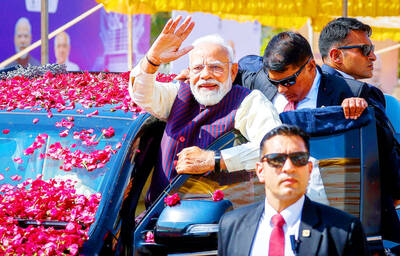
NEW IDENTITY: Known for its software, India has expanded into hardware, with its semiconductor industry growing from US$38bn in 2023 to US$45bn to US$50bn India on Saturday inaugurated its first semiconductor assembly and test facility, a milestone in the government’s push to reduce dependence on foreign chipmakers and stake a claim in a sector dominated by China. Indian Prime Minister Narendra Modi opened US firm Micron Technology Inc’s semiconductor assembly, test and packaging unit in his home state of Gujarat, hailing the “dawn of a new era” for India’s technology ambitions. “When young Indians look back in the future, they will see this decade as the turning point in our tech future,” Modi told the event, which was broadcast on his YouTube channel. The plant would convert

‘SEISMIC SHIFT’: The researcher forecast there would be about 1.1 billion mobile shipments this year, down from 1.26 billion the prior year and erasing years of gains The global smartphone market is expected to contract 12.9 percent this year due to the unprecedented memorychip shortage, marking “a crisis like no other,” researcher International Data Corp (IDC) said. The new forecast, a dramatic revision down from earlier estimates, gives the latest accounting of the ongoing memory crunch that is affecting every corner of the electronics industry. The demand for advanced memory to power artificial intelligence (AI) tasks has drained global supply until well into next year and jeopardizes the business model of many smartphone makers. IDC forecast about 1.1 billion mobile shipments this year, down from 1.26 billion the prior
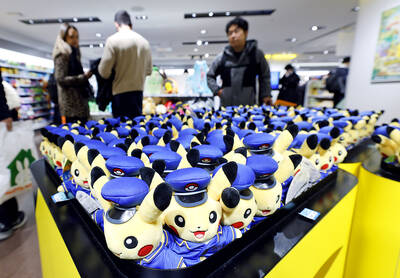
People stand in a Pokemon store in Tokyo on Thursday. One of the world highest-grossing franchises is celebrated its 30th anniversary yesterday.


 RSS
RSS