


Meta Platforms Inc topped projections for quarterly revenue and gave a strong forecast for the current period, boosted by a robust online advertising business that is making it possible for the company to invest in artificial intelligence (AI) at record levels this year.
The social-media company on Wednesday said first-quarter sales will be US$53.5 billion to US$56.5 billion, beating the US$51.3 billion average analyst estimate.
The owner of Facebook, Instagram and WhatsApp said full-year capital expenditures will be US$115 billion to US$135 billion, exceeding the US$110.6 billion average analyst estimate, according to data compiled by Bloomberg.

Photo: Ina Fassbender, AFP
In October last year, Microsoft chief financial officer Susan Li said that capital expenditures for this year were expected to be “notably larger” than last year, primarily due to infrastructure costs, spooking some investors. Capital expenditures last year topped US$72 billion, the company said on Wednesday.
Meta reported sales of US$59.9 billion for the quarter ended Dec. 31, beating the US$58.4 billion that Wall Street expected on average on the strength of its advertising business. Meta executives have repeatedly said that the company’s AI investments are improving ad targeting and effectiveness.
The company made a profit of US$22.8 billion in the recently ended quarter, adding that it could take in as much as US$56.5 billion in the current quarter.
"We had strong business performance in 2025," Meta chief executive Mark Zuckerberg said in an earnings release.
Looking forward, Zuckerberg has committed publicly, including at a high-profile White House dinner, to spend US$600 billion in the US by 2028 to support AI technology, infrastructure and workforce expansion.
Meta shares gained as much as 11 percent in after-market trading after closing at US$668.73.
Meta’s virtual reality and AI-enabled hardware unit, known as Reality Labs, posted US$955 million in sales last quarter. The division continues to lose money. Reality Labs reported an operating loss of more than US$6 billion for the quarter, bringing its total 2025 losses to more than US$19 billion. Li said in a statement that she expects the unit to face similar losses in 2026.
Earlier this month, Meta cut about 10 percent of staff across Reality Labs as part of a move to shift resources away from some of the virtual reality products and into more AI-focused ventures, including its AI wearables, like the Ray-Ban Meta glasses.
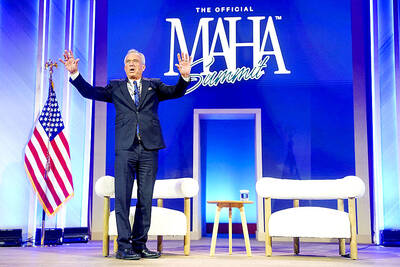
Sweeping policy changes under US Secretary of Health and Human Services Robert F. Kennedy Jr are having a chilling effect on vaccine makers as anti-vaccine rhetoric has turned into concrete changes in inoculation schedules and recommendations, investors and executives said. The administration of US President Donald Trump has in the past year upended vaccine recommendations, with the country last month ending its longstanding guidance that all children receive inoculations against flu, hepatitis A and other diseases. The unprecedented changes have led to diminished vaccine usage, hurt the investment case for some biotechs, and created a drag that would likely dent revenues and

Macronix International Co (旺宏), the world’s biggest NOR flash memory supplier, yesterday said it would spend NT$22 billion (US$699.1 million) on capacity expansion this year to increase its production of mid-to-low-density memory chips as the world’s major memorychip suppliers are phasing out the market. The company said its planned capital expenditures are about 11 times higher than the NT$1.8 billion it spent on new facilities and equipment last year. A majority of this year’s outlay would be allocated to step up capacity of multi-level cell (MLC) NAND flash memory chips, which are used in embedded multimedia cards (eMMC), a managed

CULPRITS: Factors that affected the slip included falling global crude oil prices, wait-and-see consumer attitudes due to US tariffs and a different Lunar New Year holiday schedule Taiwan’s retail sales ended a nine-year growth streak last year, slipping 0.2 percent from a year earlier as uncertainty over US tariff policies affected demand for durable goods, data released on Friday by the Ministry of Economic Affairs showed. Last year’s retail sales totaled NT$4.84 trillion (US$153.27 billion), down about NT$9.5 billion, or 0.2 percent, from 2024. Despite the decline, the figure was still the second-highest annual sales total on record. Ministry statistics department deputy head Chen Yu-fang (陳玉芳) said sales of cars, motorcycles and related products, which accounted for 17.4 percent of total retail rales last year, fell NT$68.1 billion, or

In the wake of strong global demand for AI applications, Taiwan’s export-oriented economy accelerated with the composite index of economic indicators flashing the first “red” light in December for one year, indicating the economy is in booming mode, the National Development Council (NDC) said yesterday. Moreover, the index of leading indicators, which gauges the potential state of the economy over the next six months, also moved higher in December amid growing optimism over the outlook, the NDC said. In December, the index of economic indicators rose one point from a month earlier to 38, at the lower end of the “red” light.


 RSS
RSS