


Gold and silver advanced as trading began in the new year, building on their best annual performances since 1979.
Bullion rose to US$4,375 an ounce, while silver gained more than 2 percent.
While traders have flagged that the metals could do well this year on further US interest rate cuts and US dollar weakness, there is near-term concern that broad index rebalancing could pressure prices.
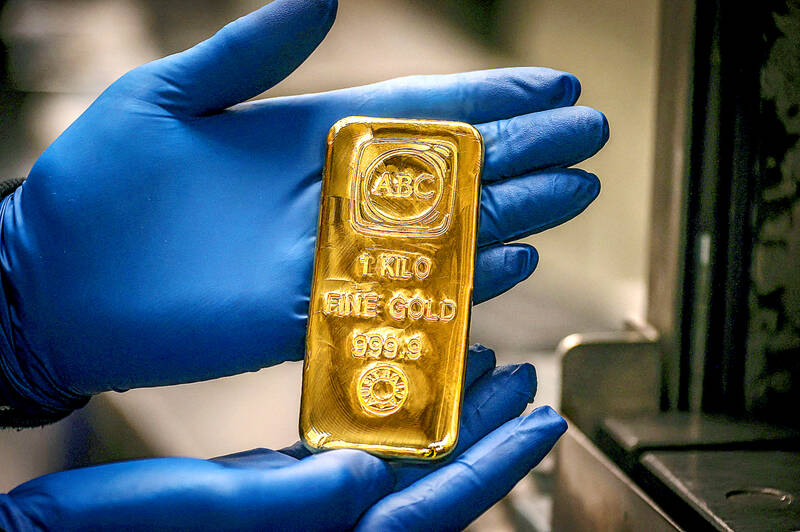
Photo: AFP
Given that the metals have rallied, passive tracking funds could sell some contracts to match new weightings as they are confirmed.
“We expect a massive 13 percent of aggregate open interest in Comex silver markets will be sold over the coming two weeks, to result in a dramatic repricing lower,” TD Securities senior commodity strategist Daniel Ghali wrote in a note.
Lower post-holiday liquidity could amplify price moves, Ghali said.
Precious metals posted a ferocious run higher last year, although there was significant volatility late last month as some investors booked profits and trading metrics pointed to overbought conditions.
Gold notched a series of records last year, aided by central bank buying, easing US Federal Reserve policy and a weaker US dollar.
Demand for haven assets driven by geopolitical tensions and US-led trade frictions was also supportive.
Silver rallied even harder than gold last year, hitting records and blowing through levels that until recently had seemed unthinkable to all but the most enthusiastic of market watchers.
In addition to the factors that aided gold, silver has also been a beneficiary of sustained concerns that the US administration could eventually impose import tariffs on the refined metal.
Among leading banks, there is support for further rises in gold this year, especially with the Fed expected to deliver additional rate reductions and US President Donald Trump reshaping the central bank’s leadership.
Goldman Sachs Group Inc last month said that its base case was for a rally to US$4,900 an ounce, with risks to the upside.
Gold gained 1.3 percent to US$4,375.15 an ounce at 12:01pm in Singapore. The Bloomberg Dollar Spot Index was 0.1 percent lower.
Silver advanced 2.5 percent to US$73.4459. Palladium and platinum also surged.

GROWING OWINGS: While Luxembourg and China swapped the top three spots, the US continued to be the largest exposure for Taiwan for the 41st consecutive quarter The US remained the largest debtor nation to Taiwan’s banking sector for the 41st consecutive quarter at the end of September, after local banks’ exposure to the US market rose more than 2 percent from three months earlier, the central bank said. Exposure to the US increased to US$198.896 billion, up US$4.026 billion, or 2.07 percent, from US$194.87 billion in the previous quarter, data released by the central bank showed on Friday. Of the increase, about US$1.4 billion came from banks’ investments in securitized products and interbank loans in the US, while another US$2.6 billion stemmed from trust assets, including mutual funds,
Micron Memory Taiwan Co (台灣美光), a subsidiary of US memorychip maker Micron Technology Inc, has been granted a NT$4.7 billion (US$149.5 million) subsidy under the Ministry of Economic Affairs A+ Corporate Innovation and R&D Enhancement program, the ministry said yesterday. The US memorychip maker’s program aims to back the development of high-performance and high-bandwidth memory chips with a total budget of NT$11.75 billion, the ministry said. Aside from the government funding, Micron is to inject the remaining investment of NT$7.06 billion as the company applied to participate the government’s Global Innovation Partnership Program to deepen technology cooperation, a ministry official told the
Taiwan Semiconductor Manufacturing Co (TSMC, 台積電), the world’s leading advanced chipmaker, officially began volume production of its 2-nanometer chips in the fourth quarter of this year, according to a recent update on the company’s Web site. The low-key announcement confirms that TSMC, the go-to chipmaker for artificial intelligence (AI) hardware providers Nvidia Corp and iPhone maker Apple Inc, met its original roadmap for the next-generation technology. Production is currently centered at Fab 22 in Kaohsiung, utilizing the company’s first-generation nanosheet transistor technology. The new architecture achieves “full-node strides in performance and power consumption,” TSMC said. The company described the 2nm process as

Even as the US is embarked on a bitter rivalry with China over the deployment of artificial intelligence (AI), Chinese technology is quietly making inroads into the US market. Despite considerable geopolitical tensions, Chinese open-source AI models are winning over a growing number of programmers and companies in the US. These are different from the closed generative AI models that have become household names — ChatGPT-maker OpenAI or Google’s Gemini — whose inner workings are fiercely protected. In contrast, “open” models offered by many Chinese rivals, from Alibaba (阿里巴巴) to DeepSeek (深度求索), allow programmers to customize parts of the software to suit their


 RSS
RSS