


Nvidia Corp has published a blog post reiterating that its chips did not have backdoors or kill switches and appealed to US policymakers to forgo such ideas saying it would be a "gift" to hackers and hostile actors.
The blog post, which was published on Tuesday in both English and Chinese, comes a week after the Chinese government summoned the US artificial intelligence (AI) chip giant to a meeting saying it was concerned by a US proposal for advanced chips sold abroad to be equipped with tracking and positioning functions.
The White House and both houses of US Congress have proposed the idea of requiring US chip firms to include location verification technology with their chips to prevent them from being diverted to countries where US export laws ban sales. The separate bills and White House recommendation have not become a formal rule, and no technical requirements have been established.
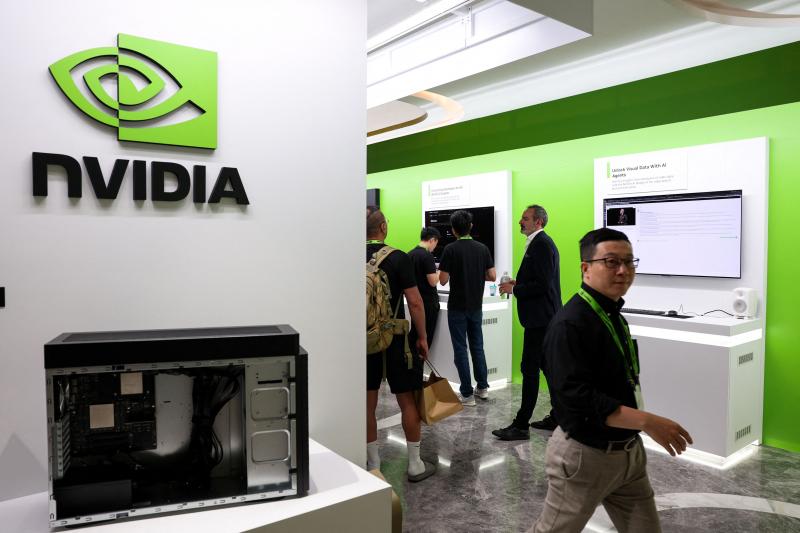
Photo: I-Hwa Cheng, AFP
"Embedding backdoors and kill switches into chips would be a gift to hackers and hostile actors. It would undermine global digital infrastructure and fracture trust in US technology," Nvidia said.
The company's products have no backdoors that would allow remote access or control, it said last week.
A backdoor refers to a hidden method of bypassing normal authentication or security controls.
Nvidia emphasized that "there is no such thing as a 'good' secret backdoor — only dangerous vulnerabilities that need to be eliminated."
A senior US official confirmed on Tuesday that the US is exploring ways to equip chips with better location-tracking capabilities.
“There is discussion about potentially the types of software or physical changes you could make to the chips themselves to do better location-tracking,” said Michael Kratsios, one of the architects of a US AI action plan unveiled by US President Donald Trump last month.
“That is something we explicitly included in the plan,” the White House Office of Science and Technology Policy director told Bloomberg Television on Tuesday.
Kratsios, who was in South Korea to attend an APEC Digital and AI Ministerial Meeting, said during the interview that he’s not had conversations “personally” with either Nvidia or Advanced Micro Devices Inc about exploring location-tracking technology.
Additional reporting by Bloomberg

Shares of contract chipmaker Taiwan Semiconductor Manufacturing Co (TSMC, 台積電) came under pressure yesterday after a report that Apple Inc is looking to shift some orders from the Taiwanese company to Intel Corp. TSMC shares fell NT$55, or 2.4 percent, to close at NT$2,235 on the local main board, Taiwan Stock Exchange data showed. Despite the losses, TSMC is expected to continue to benefit from sound fundamentals, as it maintains a lead over its peers in high-end process development, analysts said. “The selling was a knee-jerk reaction to an Intel-Apple report over the weekend,” Mega International Investment Services Corp (兆豐國際投顧) analyst Alex Huang

Taiwan Semiconductor Manufacturing Co (TSMC, 台積電) is expected to remain Apple Inc’s primary chip manufacturing partner despite reports that Apple could shift some orders to Intel Corp, industry experts said yesterday. The comments came after The Wall Street Journal reported on Friday that Apple and Intel had reached a preliminary agreement following more than a year of negotiations for Intel to manufacture some chips for Apple devices. Taiwan Institute of Economic Research (台灣經濟研究院) economist Arisa Liu (劉佩真) said TSMC’s advanced packaging technologies, including integrated fan-out and chip-on-wafer-on-substrate, remain critical to the performance of Apple’s A-series and M-series chips. She said Intel and Samsung
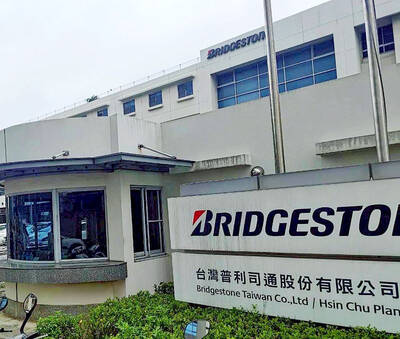
TRANSITION: With the closure, the company would reorganize its Taiwanese unit to a sales and service-focused model, Bridgestone said Bridgestone Corp yesterday announced it would cease manufacturing operations at its tire plant in Hsinchu County’s Hukou Township (湖口), affecting more than 500 workers. Bridgestone Taiwan Co (台灣普利司通) said in a statement that the decision was based on the Tokyo-based tire maker’s adjustments to its global operational strategy and long-term market development considerations. The Taiwanese unit would be reorganized as part of the closure, effective yesterday, and all related production activities would be concluded, the statement said. Under the plan, Bridgestone would continue to deepen its presence in the Taiwanese market, while transitioning to a sales and service-focused business model, it added. The Hsinchu

Taiwan Semiconductor Manufacturing Co (TSMC, 台積電) has approved a capital budget of US$31.28 billion for production expansion to meet long-term development needs during the artificial intelligence (AI) boom. The company’s board meeting yesterday approved the capital appropriation plan for purposes such as the installation of advanced technology capacity and fab construction, the world’s largest contract chipmaker said in a statement. At an earnings conference last month, TSMC forecast that its capital expenditure for this year would be at the higher end of the US$52 billion to US$56 billion range it forecast in January in response to robust demand for 5G, AI and


 RSS
RSS