


Pay for financial services workers in the UK has surged at double the pace for the rest of the economy since the COVID-19 pandemic began, widening inequality at a time when consumer spending power is being squeezed.
The Institute for Fiscal Studies (IFS) calculated that average monthly pay in finance was 31 percent higher in February than at the end of 2019, above the 14 percent rate prevailing across all sectors. The median increase was lower still, implying that growth was concentrated among the highest earners in banking and insurance.
The findings add to growing alarm over inflation, which is running at three times the pace that the Bank of England targets, and fuel concerns about the poorest segments of society being left behind in a wage boom enjoyed by the some of the richest.
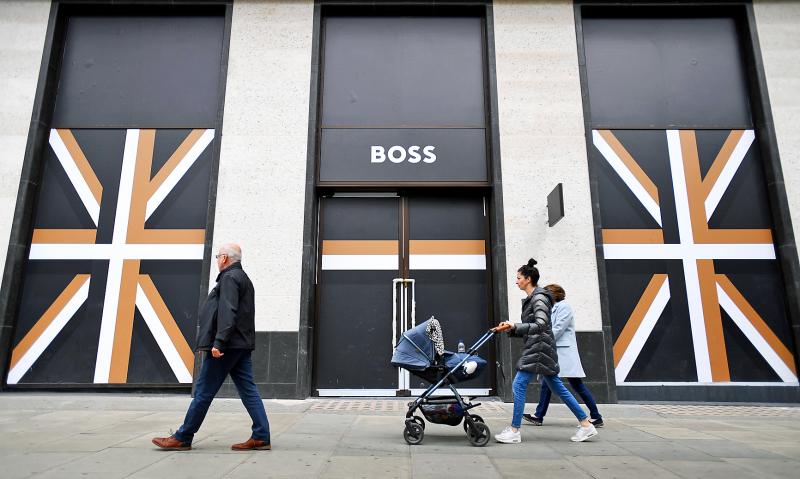
Photo: Andy Rain, EPA-EFE
“This appears to be the first time since the 2008-2009 financial crisis that financial sector pay has taken off like this, and it remains to be seen whether this is a one-off spike or a new trend,” IFS senior researcher Xiaowei Xu said in a statement yesterday.
Pay in finance has “dramatically pulled ahead” of the rest of the economy since October last year, the IFS said.
It studied payroll data from Britain’s Her Majesty’s Revenue and Customs and the Monthly Wage & Salaries survey.
The IFS said that finance accounts for 29 percent of the top 1 percent of earnings and 44 percent of those rank in the top 0.1 percent.
The institute found few reasons that pay in the sector has broken away so quickly, saying that finance is no more reliant on immigrants from the EU than the rest of the economy and does not have higher rates of people over the age of 50 leaving the workforce.
“Earnings inequality has been falling for some years before the pandemic hit, with low-paid workers seeing the strongest pay growth,” it said. “The recent surge in pay among financial sector employees, particularly the top earners, has led to a reversal of this trend.”
Separately, UK retailers said that a surge in food prices would keep inflation rising, as the world adapts to supply-chain bottlenecks holding up the flow of goods across borders.
The British Retail Consortium (BRC) said that shop price inflation last month accelerated to 2.7 percent from a year earlier, the most since 2011 and up from 2.1 percent in March.
The cost of food rose 3.5 percent, and there was a broad increase in the price of other goods, ranging from furniture to electrical products and books, the BRC said.
A separate survey of manufacturers, carried out by the Confederation of British Industry, showed the sharpest drop in optimism in the three months to last month since the onset of the pandemic, as costs and prices saw the biggest jump since the survey began in 1988.
“Customers should brace themselves for further price rises,” BRC chief executive officer Helen Dickinson said in a statement. “Global food prices have reached record highs. They will place further upward pressure on UK food prices in coming months.”
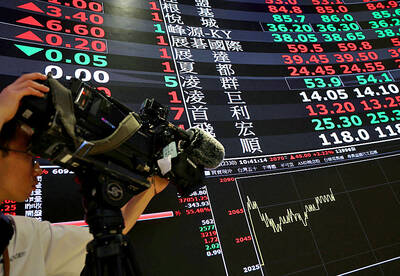
After several years flying high as Asia’s best Nvidia Corp proxy, Taiwan Semiconductor Manufacturing Co (TSMC, 台積電) is increasingly vying with other artificial intelligence (AI) stocks for investor attention. Stock traders are chasing a wider array of beneficiaries as mainstream usage of AI creates demand for hardware beyond the most-advanced chips TSMC makes for Nvidia. Subthemes from the deepening memory crunch to advances in robotics are also luring bids. At the same time, investment caps on single stocks are pushing funds to diversify, while retail investors long familiar with TSMC through its US depositary receipts are being offered a broader set of

Netherlands-based semiconductor equipment supplier ASML Holding NV yesterday said that it is planning to hire an additional 1,000 people in Taiwan this year in response to growing demand from clients. ASML had previously planned to recruit 600 people this year, but that the plan has been adjusted upward, ASML vice president and ASML Taiwan general manager Grace Wang (汪佳慧) told reporters. ASML has a workforce of more than 4,500 in Taiwan, accounting for about 10 percent of its global total, Wang said. This year’s recruitment campaign would focus on adding people in the customer support, manufacturing and supply chain domains to assist ASML
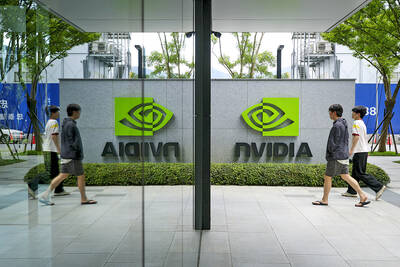
UNDER MICROSCOPE: Taiwan detained three people who allegedly conspired to buy servers in Taiwan and export them using fraudulent documentation, prosecutors said Nvidia Corp chief executive officer Jensen Huang (黃仁勳) on Saturday urged Super Micro Computer Inc to tighten up on compliance after Taiwan detained three people this week for allegedly making fraudulent declarations about artificial intelligence (AI) servers made by its US partner. The development marked the nation’s first crackdown on semiconductor smuggling, which grew after the US slapped restrictions on exports of high-end chips such as Nvidia AI accelerators to China. Nvidia is “rigorous” in explaining regulations to all of its partners, Huang told reporters after arriving in Taipei. “Ultimately Super Micro has to run their own company,” he said in response to

Nvidia Corp yesterday announced that CEO Jensen Huang (黃仁勳) would attend an employee meeting in Taipei tomorrow to celebrate the launch of the company’s Taiwan headquarters project. Huang would attend a gathering at the site of Nvidia’s planned headquarters in Beitou Shilin Technology Park (北投士林科技園區), the company said in a statement. After arriving in Taiwan on Saturday last week, Huang told reporters that he plans to meet with Quanta Computer Inc (廣達) chairman Barry Lam (林百里) and Taiwan Semiconductor Manufacturing Co (TSMC, 台積電) chairman C.C. Wei (魏哲家), and would attend the groundbreaking ceremony for Nvidia’s Taiwan headquarters tomorrow. Nvidia has not yet applied


 RSS
RSS