


Jarindr Thitadilaka said he made as much as US$2,000 a month last year from his collection of digital pets, which he would breed and send into battle to win cryptocurrency.
The 28-year-old from Bangkok was playing Axie Infinity, one of a new breed of blockchain-based online games dubbed “play-to-earn,” which blend entertainment with financial speculation.
These games can make for lucrative businesses amid the hype around non-fungible tokens (NFTs) and virtual worlds, attracting millions of players plus billions of dollars from investors who see the games as a way to introduce more people to cryptocurrency.
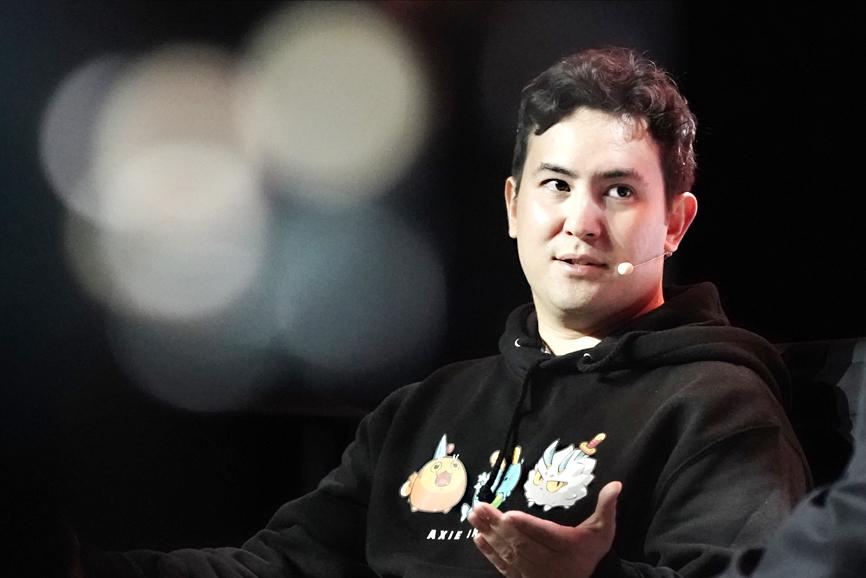
Photo: Bloomberg
In Axie Infinity, users buy virtual blob-like creatures with varying attributes as NFTs, or non-fungible tokens — digital assets whose owner is recorded on the blockchain — for anything from tens of dollars to hundreds of thousands.
Players can then use the pets to earn money by winning battles, as well as creating new pets, whose value depends on their rarity. The assets can be traded with other players on the platform, which says it has about 1.5 million daily users.
“It’s not just a game anymore. It’s more like an ecosystem,” Thitadilaka said. “You can even call it a country, right?”

Photo: AFP
The dangers of this speculative ecosystem, and the largely unregulated crypto gaming industry, were brought into sudden focus last week when Axie Infinity was hit by a US$615 million heist. Hackers targeted a part of the system used to transfer cryptocurrency in and out of the game.
Axie Infinity’s Vietnam-based owner, Sky Mavis, said that it would reimburse the lost money through a combination of its own balance sheet funds and US$150 million raised by investors, including cryptocurrency exchange Binance and venture capital firm Andreessen Horowitz.
Sky Mavis cofounder Aleksander Larsen said that if he could do things differently, he would have focused more on security when growing the game, which was launched in 2018.
“We were running 100 miles per hour, basically, to even get to this point,” he said. “The trade-offs we made maybe weren’t the ideal ones.”
The hack, one of the biggest crypto heists ever, shone a light on play-to-earn games, a young world largely unknown outside crypto and gaming circles, that is becoming big business.
Players spent US$4.9 billion on NFTs in games last year, representing about 3 percent of the global gaming industry, market tracker DappRadar said.
Although demand has cooled since peaking in November last year, gaming NFTs have still racked up US$484 million in sales so far this year.
Investor interest in NFT-based games has also ballooned, with projects attracting US$4 billion of venture capital funding last year, up from US$80,000 in 2020, DappRadar said.
“There’s so many users who want to interact with the tech,” Larsen said, adding that Axie Infinity’s revenues exceeded US$1.3 billion last year.
“It’s like you found a new continent ... like finding America all over again,” Larsen said.
HAVES AND HAVE NOTS
Adding layers of complexity, unofficial financial networks have also emerged around these games, as some players leverage their coveted in-game possessions for further gain.
Thitadilaka wanted make more money than he could by simply playing on his own, so in July last year, he and his friends decided to form what is known a “guild.” They allowed their NFTs to be used by people who wanted to play Axie Infinity free of charge, without investing in an asset, and took a cut of any winnings in return.
This model is commonplace across play-to-earn games.
Thitadilaka said that his guild, GuildFi, grew into a network with 3,000 Axie Infinity players who split their earnings with the asset owners 50-50.
Thitadilaka now runs GuildFi as a full-time job, and the company has raised US$146 million from investors.
Southeast Asian countries such as Thailand and the Philippines have emerged as some of the hottest global gaming hubs.
Teriz Pia, who is 25 and lives in Manila, quit her job as a preschool teacher in June last year after her brother founded a play-to-earn gaming guild, Real Deal Guild.
Now she says she makes as much as US$20,000 a month through her network of more than 300 players across multiple games, plus other crypto assets.
For Axie Infinity, Pia lets her players keep 70 percent, while she takes a 30 percent cut. In another play-to-earn game, Pegaxy, where players buy and trade NFTs of virtual horses to compete in races to win crypto tokens, she splits it 60-40.
“I don’t call them workers. I just call them my friends or my scholars,” she said. “The salary in the Philippines if you’re a teacher ... I’m a college graduate, I’m an educator, but it’s not enough. I never imagined that I could earn this kind of money.”
However, Pia said that it is a dangerous business.
“There’s a lot of risk. When I’m investing in a new game ... being a member of Real Deal Guild, we have a partnership team, we have researchers, but at the end of the day, it’s still crypto, it’s still a risk,” she said.
One of the biggest play-to-earn guilds, Yield Guild Games, said it had 10,000 Axie Infinity players as of the fourth quarter of last year who kept 70 percent of their earnings and had received US$11.7 million in total.
Australian-based Corey Wilton, 25, founded Pegaxy, which he says has about 160,000 daily users.
He said that an estimated 95 percent of users of play-to-earn games participate as “renters,” generating revenue without owning the assets, while 5 percent are asset owners.
‘PEOPLE GET HURT’
Legal experts say there is no safety net for players who effectively invest in risky assets, leaving them highly vulnerable should a project fail or the market for the assets dry up.
As global regulators seek to get to grips with cryptocurrencies themselves, there is little oversight of NFTs or the relatively niche offshoot of play-to-earn games, which typically use in-game crypto tokens that can then be cashed out into traditional money.
“Storing any value in projects like this is risky. The earning in play to earn, blockchain-based games is often through rewards paid in the native token of the project,” said David Lee, cryptocurrency associate at London-based law firm Fladgate LLP.
“There are no guaranteed values of either the token or the in-game asset as their value is often determined by supply and demand in the market. This means there can be significant volatility in the price and, if the project becomes less popular or is abandoned, then there is a potential for the assets to become worthless,” Lee said.
Yet advocates of these games say success is built upon a combination of factors such as skill, strategy and luck.
“There is definitely money to be made, but there is also money to be lost here,” Wilton said. “Play to earn should not be confused with charity, that’s how people get hurt.”

UNPRECEDENTED PACE: Micron Technology has announced plans to expand manufacturing capabilities with the acquisition of a new chip plant in Miaoli Micron Technology Inc unveiled a newly acquired chip plant in Miaoli County yesterday, as the company expands capacity to meet growing demand for advanced DRAM chips, including high-bandwidth memory chips amid the artificial intelligence boom. The plant in Miaoli County’s Tongluo Township (銅鑼), which Micron acquired from Powerchip Semiconductor Manufacturing Corp (力積電) for US$1.8 billion, is expected to make a sizeable capacity contribution to the company from fiscal 2028, the company said in a statement. It would be an extended production site of Micron’s large-scale manufacturing hub in Taichung, the company said. As the global semiconductor industry is racing to reach US$1 trillion

Singapore-based ride-hailing and delivery giant Grab Holdings Ltd has applied for regulatory approval to acquire the Taiwan operations of Germany-based Delivery Hero SE's Foodpanda in a deal valued at about US$600 million. Grab submitted the filing to the Fair Trade Commission on Friday last week, with the transaction subject to regulatory review and approval, the company said in a statement yesterday. Its independent governance structure would help foster a healthy and competitive market in Taiwan if the deal is approved, Grab said. Grab, which is listed on the NASDAQ, said in the filing that US-based Uber Technologies Inc holds about 13 percent of

ABOVE LEGAL REQUIREMENT: The Ministry of Economic Affairs is prepared if LNG supply is disrupted, with more than the legal requirement of 11 days of inventory Taiwan has largely secured liquefied natural gas (LNG) supplies through May and arranged about half of June’s supply, Minister of Economic Affairs Kung Ming-hsin (龔明鑫) said yesterday. Since the Middle East conflict began on Feb. 28, Taiwan’s LNG inventories have remained more than 12 days, exceeding the legal requirement of 11 days, indicating no major supply concerns for domestic gas and electricity, Kung said at a meeting of the legislature’s Economics Committee in Taipei. The ministry aims to increase the figure to 14 days by the end of next year, he said. While one or two LNG or crude oil shipments for May

Taiwan’s food delivery market could undergo a major shift if Singapore-based Grab Holdings Ltd completes its planned acquisition of Delivery Hero SE’s Foodpanda business in Taiwan, industry experts said. Grab on Monday last week announced it would acquire Foodpanda’s Taiwan operations for US$600 million. The deal is expected to be finalized in the second half of this year, with Grab aiming to complete user migration to its platform by the first half of next year. A duopoly between Uber Eats and Foodpanda dominates Taiwan’s delivery market, a structure that has remained intact since the Fair Trade Commission (FTC) blocked Uber Technologies Inc’s


 RSS
RSS