


Seventy years after its first model rolled off the factory line, Volkswagen AG (VW) is reinventing the VW bus, symbol of the hippy movement, for today’s climate-conscious generation — but some of its former afficionados remain to be convinced.
The German automaker on Wednesday unveiled the camper’s latest iteration, known as the ID.Buzz, part of the flagship ID line with which Volkswagen is leading a multibillion-euro charge into the electric vehicle market.
Reviving the “icon” was a “priority,” VW chief executive officer Herbert Diess said in a question-and-answer session on the online forum Reddit.
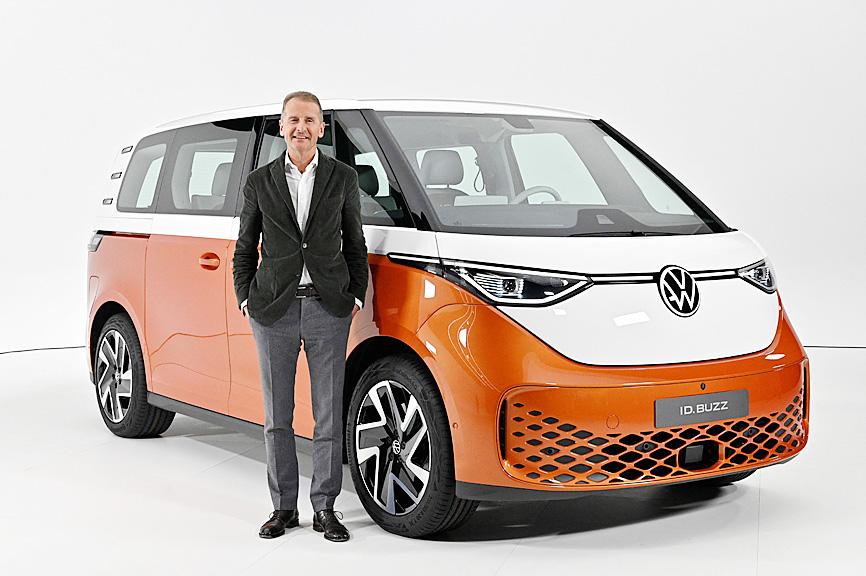
Photo: AFP
The new model, with its curvy resemblance to the original VW campers that had their heyday in the 1960s and 1970s, was a “turning point” for Volkswagen, Center for Automotive Research director Ferdinand Dudenhoeffer said.
The design classic was the inspiration of Dutch importer Ben Pon, whose eye was caught by an employee-built transport vehicle, when he visited the Volkswagen plant in Wolfsburg in 1947.
Following his eureka moment, Pon drafted the first plans and convinced VW to start production in March 1950, christening its second model after the Beetle.
The chubby camper, a symbol of liberty and free-thinking, was particularly successful in the US, where it was embraced by the Californian surfer community.
The bus has become a pop culture mainstay, transporting Scooby-Doo through his adventures, as well as the cast of the cult independent film Little Miss Sunshine. Volkswagen is hoping to build on the camper’s positive image.
The bus which “contributed to the history of the flower power movement” is now the vehicle “for the Fridays for Future generation” and “hippies of the climate crisis,” Dudenhoeffer said.
However, inning over classic van-owners to the new electric model might prove to be a little harder.
The ID.Buzz has “taken on the V-shape” on the bonnet of the original T1 camper, said Melanie Wolf, 33, a member of a VW Bus-lovers club in Bavaria.
With her partner Tobias Toplak, 43, she regularly hits the open road in her 1973 camper van model, most recently taking it on a tour of Norway.
“I am interested to see how Volkswagen pulls off the mash-up between the hipster world and the Bulli mindset,” said Tobias, using the camper’s affectionate German nickname.
The spirit of “liberty and independence” on four wheels is difficult to match with the limited autonomy offered by electric motors, which need to be recharged, he said.
While there are no official figures, the ID.Buzz’s range has been estimated at about 400km by the Allgemeiner Deutscher Automobil-Club.
“In the most beautiful places, when you spend the night in the middle of nowhere, there won’t be charging points even in another 20 years,” said Roland Graebner, 52, who owns a quartet of old campers with which he has “crossed Europe,”
The fossil fuel-powered models “are just so flexible,” his partner Britta Kellermann, 53, said, even though she added that she finds the electric model “fascinating.”
“The adventures you can have will certainly be different” with the ID.Buzz, said Hans Toma, 62, a proud owner of a T2 camper from the late 1970s.
The government yesterday approved applications by Alphabet Inc’s Google to invest NT$27.08 billion (US$859.98 million) in Taiwan, the Ministry of Economic Affairs said in a statement. The Department of Investment Review approved two investments proposed by Google, with much of the funds to be used for data processing and electronic information supply services, as well as inventory procurement businesses in the semiconductor field, the ministry said. It marks the second consecutive year that Google has applied to increase its investment in Taiwan. Google plans to infuse NT$25.34 billion into Charter Investments Ltd (特許投資顧問) through its Singapore-based subsidiary Fructan Holdings Singapore Pte Ltd, and

SECOND-RATE: Models distilled from US products do not perform the same as the original and undo measures that ensure the systems are neutral, the US’ cable said The US Department of State has ordered a global push to bring attention to what it said are widespread efforts by Chinese companies, including artificial intelligence (AI) start-up DeepSeek (深度求索), to steal intellectual property from US AI labs, according to a diplomatic cable. The cable, dated Friday and sent to diplomatic and consular posts around the world, instructs diplomatic staff to speak to their foreign counterparts about “concerns over adversaries’ extraction and distillation of US AI models.” Distillation is the process of training smaller AI models using output from larger, more expensive ones to lower the costs of training a powerful new
Micron Technology Inc is a driving force pushing the US Congress to pass legislation that would put new export restrictions on equipment its Chinese competitors use to make their chips, according to people familiar with the matter. A US House of Representatives panel yesterday was to vote on the “MATCH Act,” a bill designed to close gaps in restrictions on chipmaking equipment. It would also pressure foreign companies that sell equipment to Chinese chipmaking facilities to align with export curbs on US companies like Lam Research Corp and Applied Materials Inc. The bill targets facilities operated by China’s ChangXin Memory Technologies Inc

Singapore-based ride-hailing and delivery giant Grab Holdings’ planned acquisition of Foodpanda’s Taiwan operations has yet to enter the formal review stage, as regulators await supplementary documents, the Fair Trade Commission (FTC) said yesterday. Acting FTC Chairman Chen Chih-min (陳志民) told the legislature’s Economics Committee that although Grab submitted its application on March 27, the case has not been officially accepted because required materials remain incomplete. Once the filing is finalized, the FTC would launch a formal probe into the deal, focusing on issues such as cross-shareholding and potential restrictions on market competition, Chen told lawmakers. Grab last month announced that it would acquire


 RSS
RSS