


EQUITIES
TAIEX rallies despite war
The TAIEX yesterday made a significant technical comeback after heavy losses last week triggered by Russia’s invasion of Ukraine. Bargain hunters could be found across the board, with the electronics sector — which had been hard hit — in focus. Buying also rotated to raw material stocks on the back of rising product prices, as well as shipping stocks due to hopes of high cash dividends, dealers said. However, the TAIEX failed to reach 18,000 during the session, as high technical hurdles remained above that level, the dealers added. The TAIEX closed up 246.07 points, or 1.39 percent, at 17,898.25. Turnover totaled NT$357.919 billion (US$12.77 billion), with foreign institutional investors buying a net NT$6.33 billion of shares, Taiwan Stock Exchange data showed.
EQUITIES
Foreign buyers offload tech
Foreign investors last week sold a net NT$166.54 billion of local shares after selling NT$6.31 billion a week earlier, the Taiwan Stock Exchange said in a statement yesterday. As of Friday, foreign investors had sold NT$195.02 billion of local shares from the beginning of the year, it said. Last week, the top three shares foreign investors sold were China Airlines Ltd (中華航空), Taiwan Semiconductor Manufacturing Co (台積電) and United Microelectronics Corp (聯電), while the top three bought were Evergreen Marine Corp (長榮海運), Tatung Co (大同) and Macronix International Co (旺宏), the exchange said. The market capitalization of shares held by foreign investors was NT$23.38 trillion, or 42.74 percent of total market capitalization, it said.
SEMICONDUCTORS
Inergy rises 3% on debut
Shares in Inergy Technology Inc (廣閎科技), a fabless IC design firm that provides green energy solutions, yesterday rose 3.02 percent on the firm’s Taipei Exchange trading debut, following a well-received share sale last month. The shares opened at NT$122.5 and rose as high as NT$129.5 in the morning session before paring gains to close the day at NT$119.5, which was 3.02 percent higher than the initial offering price of NT$116 per share. Inergy was established in 2007 and is based in Hsinchu County’s Jhubei City (竹北). It offers integrated power components that are optimized for system applications, as well as integrated power modules for motor drives and hall sensors. It reported net profit of NT$74.093 million in the first three quarters of last year, down from NT$17.613 million a year earlier, or earnings per share of NT$1.82. Revenue last year rose 40.9 percent to NT$1.212 billion from NT$860.44 million in 2020.
INVESTMENTS
Scams rose 72% in 2021
The number of investment scams last year rose 72 percent annually to 4,904 cases, with total financial losses doubling to NT$2.08 billion, the Financial Supervisory Commission (FSC) said on Thursday last week, citing data compiled by the National Policy Agency (NPA). The figure accounted for 19.7 percent of total scams that the Criminal Investigation Bureau addressed last year, second only to online shopping scams at 22.8 percent, NPA data showed. The bureau has categorized three main types of investment scams: online gambling, cryptocurrency investments and overseas investments, Banking Bureau Chief Secretary Phil Tong (童政彰) said. Firms attending a financial crime seminar on Wednesday in Taipei had proposed that the NPA and the commission should have a platform to exchange information and crack down on such scams.

Japanese Prime Minister Sanae Takaichi has talked up the benefits of a weaker yen in a campaign speech, adopting a tone at odds with her finance ministry, which has refused to rule out any options to counter excessive foreign exchange volatility. Takaichi later softened her stance, saying she did not have a preference for the yen’s direction. “People say the weak yen is bad right now, but for export industries, it’s a major opportunity,” Takaichi said on Saturday at a rally for Liberal Democratic Party candidate Daishiro Yamagiwa in Kanagawa Prefecture ahead of a snap election on Sunday. “Whether it’s selling food or

CONCERNS: Tech companies investing in AI businesses that purchase their products have raised questions among investors that they are artificially propping up demand Nvidia Corp chief executive officer Jensen Huang (黃仁勳) on Saturday said that the company would be participating in OpenAI’s latest funding round, describing it as potentially “the largest investment we’ve ever made.” “We will invest a great deal of money,” Huang told reporters while visiting Taipei. “I believe in OpenAI. The work that they do is incredible. They’re one of the most consequential companies of our time.” Huang did not say exactly how much Nvidia might contribute, but described the investment as “huge.” “Let Sam announce how much he’s going to raise — it’s for him to decide,” Huang said, referring to OpenAI
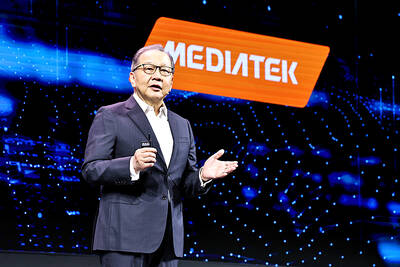
CHIP HANG-UP: Surging memorychip prices would deal a blow to smartphone sales this year, potentially hindering one of MediaTek’s biggest sources of revenue MediaTek Inc (聯發科), the world’s biggest smartphone chip designer, yesterday said its new artificial intelligence (AI) chips used in data centers are to account for 20 percent of its total revenue next year, as cloud service providers race to deploy AI infrastructure to meet voracious demand. MediaTek is believed to be developing tensor processing units for Google, which are used in AI applications. While it did not confirm such reports, MediaTek said its new application-specific IC (ASIC) business would be a new growth engine for the company. It again hiked its forecast for the addressable ASIC market to US$70 billion by 2028, compared

SIGNS OF STABILITY: With US tariff risks to GDP subsiding, reliable economic conditions are expected to reinforce the bank operating environment, Fitch said Fitch Ratings has upgraded the outlook for Taiwan’s banking sector to “neutral” from “deteriorating,” citing a tariff agreement with the US that has reduced uncertainty in Taiwan’s macroeconomic environment and stabilized financial performance. The US on Jan. 15 agreed to lower tariffs on Taiwanese goods from 20 percent to 15 percent, without stacking them on existing most-favored-nation rates, placing Taiwan on equal footing with major competitors such as Japan, South Korea and the EU. The deal also grants Taiwan-made semiconductors and related products most-favorable-nation treatment under Section 232 of the US Trade Expansion Act. Under the agreement, Taiwanese semiconductor, electronics manufacturing service, artificial


 RSS
RSS