


Soybean buyers stung by puny yields and harvest delays in Brazil are turning to the US for supply, driving up prices and threatening to worsen food inflation.
What was expected to be a record crop in Brazil is now looking far smaller as adverse weather events catch traders and end-users shorthanded.
More than 110 ships have been chartered to load crops at ports in the Pacific Northwest, said Bill Tierney, chief economist for AgResource Co in Chicago.
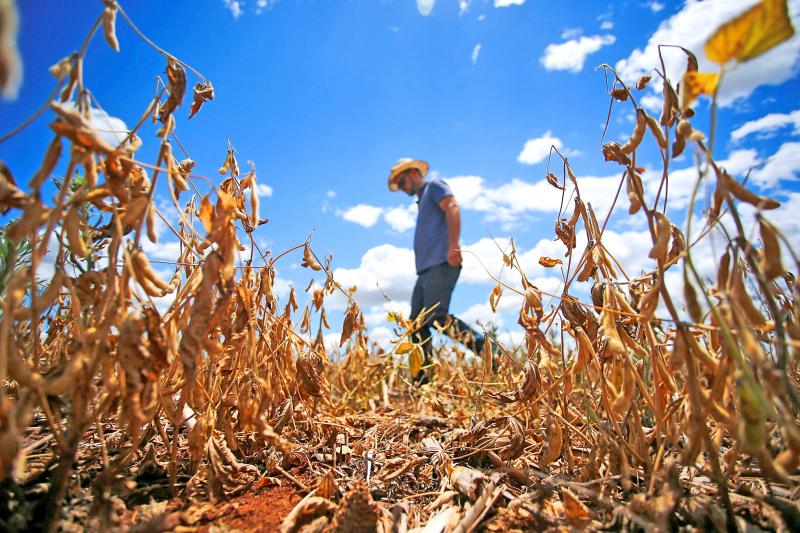
Photo: Reuters
The rush by physical traders and financial players has boosted benchmark Chicago futures by 31 percent since early November last year to an eight-month high, with the premium for July versus November contracts surging eightfold.
Demand for immediate delivery has pushed cash prices at elevators in places such as Iowa and Illinois to unusually high premiums over futures.
Money managers have raised bullish bets on soybeans to the highest in more than eight months, weekly US Commodity Futures Trading Commission data showed on Friday.
The effect of higher soy costs is set to ripple through food supply chains at a time when global prices already are near a record. It would become more expensive to feed pigs, chickens and other livestock with meal crushed from beans, while the price of the other primary soy byproduct — cooking oil — might also climb.
“South America’s soybean losses put a great responsibility on the US, where plantings and yields will need to increase to avoid” persistent high prices, Etore Baroni, an analyst at StoneX in Brazil, said during a Webinar on Thursday.
US soybean sales for export jumped to about 1.8 million tonnes last week, exceeding all analyst forecasts.
The US Department of Agriculture on Friday reported an additional sale of 228,611 tonnes to “unknown” buyers.
Chinese firms and other buyers typically look to South America for supply at this time of year. As recently as a few months ago, all signs were for a bumper crop.
However, a La Nina weather system swept key growing regions in southern Brazil and Argentina with heat and drought, damaging the crop.
More dry stretches probably still lie ahead, according to weather forecaster Maxar.
Brazil, Argentina and Paraguay are to export about 18 million tons less than projected, analysts have said.
Robust processing margins would keep demand for soybeans elevated in Brazil, with local industries competing with foreign buyers, Baroni said.
The signs of urgent demand are clear in the rising levels of so-called basis differentials and physical prices in market hubs of Santos, Brazil and New Orleans.
Farmers in Brazil are being offered record prices, and ships are lining up outside the main export terminals as traders vie to secure any beans they can to fill vessels bound for China and other markets.
The basis, or premium buyers will pay above futures, is up 35 percent this year in Santos; in New Orleans, it is US$1.34 a bushel, up almost 60 percent from a year earlier.
Chicago soybeans for March delivery posted a third straight week of gains on Friday, climbing to a fresh eight-month high of US$15.535 a bushel. Wheat and corn also rose.
Other commodities:
‧Gold for April delivery rose US$3.70 to US$1,807.80 an ounce, gaining 1.19 percent on the week.
Silver for March delivery rose US$0.10 to US$22.48 an ounce, up 0.8 percent from a week earlier, while March copper rose US$0.02 to US$4.49 a pound, posting a weekly increase of 4.18 percent.
Additional reporting by staff writer, with AP
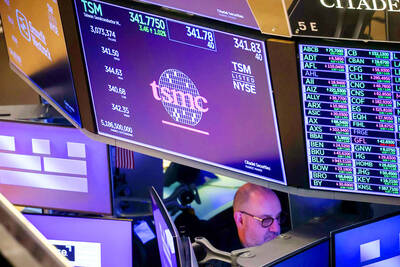
STRONG INTEREST: Analysts have pointed to optimism in TSMC’s growth prospects in the artificial intelligence era as the cause of the rising number of shareholders The number of people holding shares of chipmaker Taiwan Semiconductor Manufacturing Co (TSMC, 台積電) hit a new high last week despite a decline in its stock price, the Taiwan Depository and Clearing Corp (TDCC, 台灣集保) said. The number of TSMC shareholders rose to 2.46 million as of Friday, up 75,536 from a week earlier, TDCC data showed. The stock price fell 1.34 percent during the same week to close at NT$1,840 (US$57.55). The decline in TSMC’s share price resulted from volatility in global tech stocks, driven by rising international crude oil prices as the war against Iran continues. Dealers said
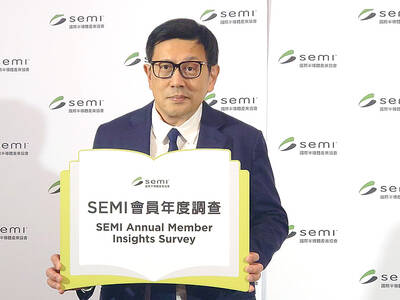
PRICE HIKES: The war in the Middle East would not significantly disrupt supply in the short term, but semiconductor companies are facing price surges for materials Taiwan’s semiconductor companies are not facing imminent supply disruptions of essential chemicals or raw materials due to the war in the Middle East, but surges in material costs loom large, industry association SEMI Taiwan said yesterday. The association’s comments came amid growing concerns that supplies of helium and other key raw materials used in semiconductor production could become a choke point after Qatar shut down its liquefied natural gas (LNG) production and helium output earlier this month due to the conflict. Qatar is the second-largest LNG supplier in the world and accounts for about 33 percent of global helium output. Helium is
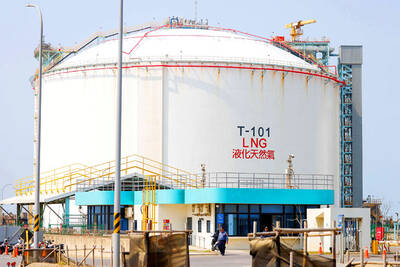
Taiwan’s natural gas supply remains stable through the end of May, despite rising concerns about potential disruptions to Qatari liquefied natural gas (LNG) supplies due to escalating conflicts in the Middle East, the Ministry of Economic Affairs said yesterday. The ministry in a statement said that Taiwan has completed preparations for natural gas supply and shipping schedules through the end of May. It has also made plans to increase natural gas imports from regions outside the Middle East in June to ensure a stable supply, it added. Taiwan sources natural gas from 14 countries and is not solely dependent on the Middle East,
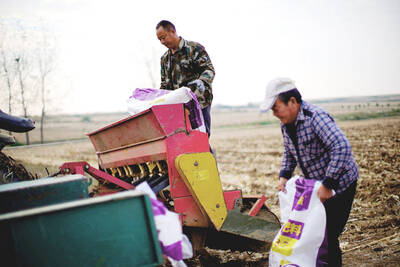
China is clamping down on fertilizer exports to protect its domestic market, industry sources said, putting an additional strain on global markets that were already grappling with shortages caused by the US-Israeli war on Iran. China is among the largest fertilizer exporters — shipping more than US$13 billion of it last year — and it has a history of controlling exports to keep prices low for farmers. Shipments through the war-blocked Strait of Hormuz account for about one-third of the sea-borne supply. This month, Beijing banned exports of nitrogen-potassium fertilizer blends and certain phosphate varieties, sources said. The ban, which has not


 RSS
RSS