


Jardine Matheson Holdings Ltd (怡和洋行), a diversified Asia-based group whose businesses span property, transport, retail and luxury hotels, is considering strategic options for its restaurant unit, people with knowledge of the matter said.
The Singapore-traded conglomerate is weighing a sale of Jardine Restaurant Group (怡和餐飲集團), a wholly owned subsidiary that operates KFC and Pizza Hut franchises in Taiwan, Hong Kong, Macau and Vietnam, said the people, who asked not to be identified as the information is private.
The subsidiary also runs Pizza Hut restaurants in Myanmar, according to its Web site.
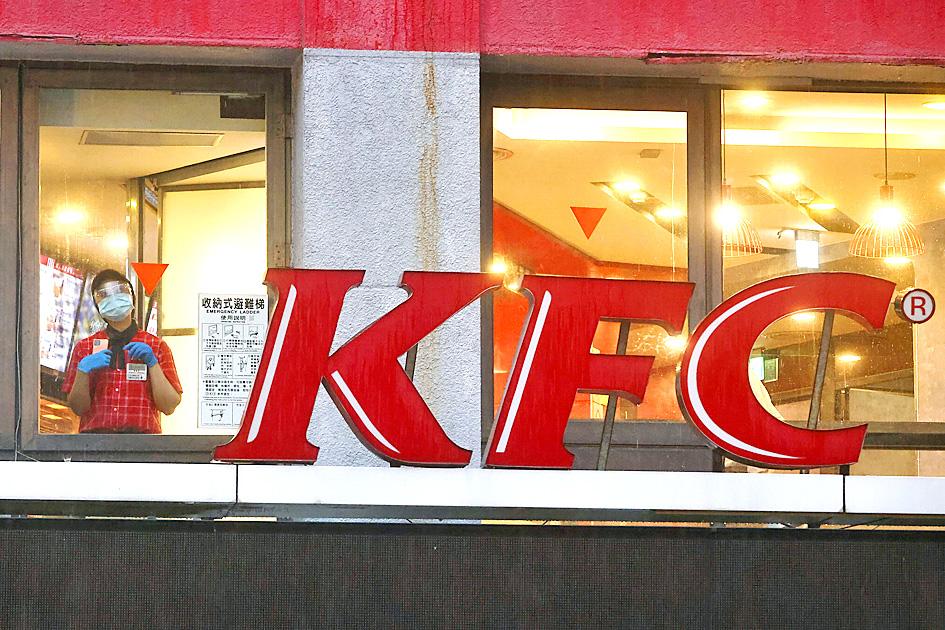
Photo: Ann Wang, Reuters
Jardine Matheson has held preliminary discussions with advisers, the people said, adding that deliberations are still at an early stage and the group could decide to keep the business.
A representative for Jardine Matheson did not immediately respond to requests for comment.
Yum! Brands Inc, the owner of the KFC and Pizza Hut trademarks, sold the KFC business in Taiwan in 2010 and offloaded the KFC franchises in Hong Kong and Macau to Jardine Restaurant Group in 2013, the unit’s Web site said.
Jardine Restaurant Group operates more than 900 restaurants in the region and has more than 27,000 employees, the Web site shows.
The unit contributed US$18 million profit to Jardine Group in the six months ended in June last year, compared with US$15 million in 2020, Jardine Matheson’s half-yearly earnings announcement showed.

AI TALENT: No financial details were released about the deal, in which top Groq executives, including its CEO, would join Nvidia to help advance the technology Nvidia Corp has agreed to a licensing deal with artificial intelligence (AI) start-up Groq, furthering its investments in companies connected to the AI boom and gaining the right to add a new type of technology to its products. The world’s largest publicly traded company has paid for the right to use Groq’s technology and is to integrate its chip design into future products. Some of the start-up’s executives are leaving to join Nvidia to help with that effort, the companies said. Groq would continue as an independent company with a new chief executive, it said on Wednesday in a post on its Web

GROWING OWINGS: While Luxembourg and China swapped the top three spots, the US continued to be the largest exposure for Taiwan for the 41st consecutive quarter The US remained the largest debtor nation to Taiwan’s banking sector for the 41st consecutive quarter at the end of September, after local banks’ exposure to the US market rose more than 2 percent from three months earlier, the central bank said. Exposure to the US increased to US$198.896 billion, up US$4.026 billion, or 2.07 percent, from US$194.87 billion in the previous quarter, data released by the central bank showed on Friday. Of the increase, about US$1.4 billion came from banks’ investments in securitized products and interbank loans in the US, while another US$2.6 billion stemmed from trust assets, including mutual funds,

RESPONSE: The Japanese Ministry of Finance might have to intervene in the currency markets should the yen keep weakening toward the 160 level against the US dollar Japan’s chief currency official yesterday sent a warning on recent foreign exchange moves, after the yen weakened against the US dollar following Friday last week’s Bank of Japan (BOJ) decision. “We’re seeing one-directional, sudden moves especially after last week’s monetary policy meeting, so I’m deeply concerned,” Japanese Vice Finance Minister for International Affairs Atsushi Mimura told reporters. “We’d like to take appropriate responses against excessive moves.” The central bank on Friday raised its benchmark interest rate to the highest in 30 years, but Bank of Japan Governor Kazuo Ueda chose to keep his options open rather than bolster the yen,

Even as the US is embarked on a bitter rivalry with China over the deployment of artificial intelligence (AI), Chinese technology is quietly making inroads into the US market. Despite considerable geopolitical tensions, Chinese open-source AI models are winning over a growing number of programmers and companies in the US. These are different from the closed generative AI models that have become household names — ChatGPT-maker OpenAI or Google’s Gemini — whose inner workings are fiercely protected. In contrast, “open” models offered by many Chinese rivals, from Alibaba (阿里巴巴) to DeepSeek (深度求索), allow programmers to customize parts of the software to suit their


 RSS
RSS