


Interactive comment sections and virtual reality headsets: Internet-connected fitness gear and services have boomed during the COVID-19 pandemic as at-home athletes seek a proxy for gym life.
While home workouts long predate COVID-19, they have taken on a social aspect that looks set to become the standard in a world reshaped by the pandemic.
“A big part of going to the gym together is sort of suffering together ... you build a camaraderie around that,” Jeremy Needham, who does customer education for US boxing fitness company Liteboxer, told reporters at the Consumer Electronics Show (CES) in Las Vegas, Nevada.
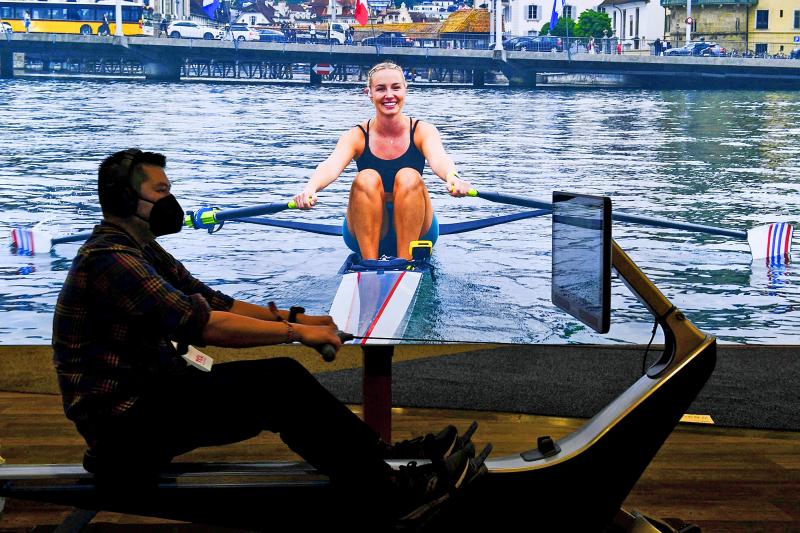
Photo: AFP
“And now that we don’t share that space, at least in real time, we have to do it virtually,” he added.
Like other companies that sell Internet-connected fitness gear, Liteboxer offers customers access to workouts, competitions and other features for a monthly charge — on top of the roughly US$1,200 wall-mounted machine.
The market for fitness tech has been growing for years, but the industry has gotten a boost in the past couple of years, similarly to how the pandemic accelerated e-commerce and remote working trends.
“Connected equipment exploded onto the scene in a big way as consumers had to shift the way to work out during the pandemic,” CES organizer Consumer Technology Association (CTA) said in an industry forecast.
Internet-connected exercise equipment was a nearly US$3.8 billion market last year, and double-digit percentage growth is expected this year, the CTA’s forecast said.
“[Customers] want connectivity,” CTA analyst Richard Kowalski said. “They want to engage with other people online.”
Connected rowing machine maker Hydrow allows customers to comment and like others’ workouts, and users have developed their own social media groups.
“You start talking to each other and then all of a sudden, you have a group of maybe six guys, you know, from all over the world,” Aquil Abdullah, who leads workouts on the system, told reporters. “A guy is in London, a guy is out in California, a guy is down in Florida, and you have this community.”
The machines, which sell for US$2,295, have the usual rowing bar and seat, but also a screen that allows clients to exercise along with instructors on the water, in locales from Miami to London.
However, the connected fitness industry has shown some sensitivity to the changing conditions of the pandemic and the way it affects equipment users’ lives.
Fitness firm Peloton Interactive Inc’s shares have been under pressure since early November, when the company cut its forecast as more consumers returned to reopening gyms. Credit Suisse Group AG downgraded the firm last month, saying the market shifts have forced Peloton to increase advertising and discounting.
However, as cases of the Omicron variant of SARS-CoV-2 break records around the world, many are again hunkering down at home.
That shift could work in favor of home fitness tech companies.
The CTA took a bullish perspective, saying: “The growth trajectory suggests that health-conscious consumers are finding practicality and convenience in exercising at home, even as gyms and workout classes reopen.”
Exercise of any kind has offered some people a relief from the pandemic’s effects — as work, school and travel disruptions and simmering health worries offer plenty to stress about.
“The pandemic locked us inside ... we couldn’t do the things that we loved,” Needham said. “But the human body still needs cardiovascular activity, it’s quite simple. You just need a really engaging way ... to release that energy that builds up in you.”

In Italy’s storied gold-making hubs, jewelers are reworking their designs to trim gold content as they race to blunt the effect of record prices and appeal to shoppers watching their budgets. Gold prices hit a record high on Thursday, surging near US$5,600 an ounce, more than double a year ago as geopolitical concerns and jitters over trade pushed investors toward the safe-haven asset. The rally is putting undue pressure on small artisans as they face mounting demands from customers, including international brands, to produce cheaper items, from signature pieces to wedding rings, according to interviews with four independent jewelers in Italy’s main

Japanese Prime Minister Sanae Takaichi has talked up the benefits of a weaker yen in a campaign speech, adopting a tone at odds with her finance ministry, which has refused to rule out any options to counter excessive foreign exchange volatility. Takaichi later softened her stance, saying she did not have a preference for the yen’s direction. “People say the weak yen is bad right now, but for export industries, it’s a major opportunity,” Takaichi said on Saturday at a rally for Liberal Democratic Party candidate Daishiro Yamagiwa in Kanagawa Prefecture ahead of a snap election on Sunday. “Whether it’s selling food or

CONCERNS: Tech companies investing in AI businesses that purchase their products have raised questions among investors that they are artificially propping up demand Nvidia Corp chief executive officer Jensen Huang (黃仁勳) on Saturday said that the company would be participating in OpenAI’s latest funding round, describing it as potentially “the largest investment we’ve ever made.” “We will invest a great deal of money,” Huang told reporters while visiting Taipei. “I believe in OpenAI. The work that they do is incredible. They’re one of the most consequential companies of our time.” Huang did not say exactly how much Nvidia might contribute, but described the investment as “huge.” “Let Sam announce how much he’s going to raise — it’s for him to decide,” Huang said, referring to OpenAI
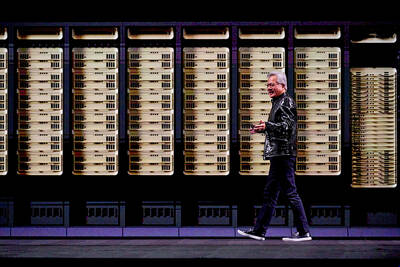
The global server market is expected to grow 12.8 percent annually this year, with artificial intelligence (AI) servers projected to account for 16.5 percent, driven by continued investment in AI infrastructure by major cloud service providers (CSPs), market researcher TrendForce Corp (集邦科技) said yesterday. Global AI server shipments this year are expected to increase 28 percent year-on-year to more than 2.7 million units, driven by sustained demand from CSPs and government sovereign cloud projects, TrendForce analyst Frank Kung (龔明德) told the Taipei Times. Demand for GPU-based AI servers, including Nvidia Corp’s GB and Vera Rubin rack systems, is expected to remain high,


 RSS
RSS