


Business is booming for cyberextortionists.
DarkSide, the hacking group that shut down a key US oil pipeline earlier this month, has collected more than US$90 million in hard-to-trace bitcoin from 47 victims, blockchain analytics firm Elliptic has said.
The pipeline hack ended only after Colonial Pipeline Co paid nearly US$5 million in ransom to regain control of computer systems needed to supply gasoline to much of the eastern US, and was widely dubbed a “wake-up call” to batten down loose digital hatches.

Photo: AP
Following the subsequent release of US President Joe Biden’s new “Executive Order on Improving the Nation’s Cybersecurity,” the US Department of Homeland Security is moving to regulate cybersecurity in the pipeline industry. The US Transportation Security Administration (TSA) is expected to issue mandatory rules and reporting requirements for safeguarding pipelines against cyberattacks.
However, there are key gaps. In all the recent reporting on cyberattacks, there is been scant coverage of how they actually occur. You would almost think that bad guys are breaking into corporate data centers in the dead of night armed with sinister thumb drives, or sneaking lines of malevolent code past snoozing information security officers. It is as if malware materializes spontaneously on a server, then worms its way in to seize control of operational assets.
Companies are reluctant to correct the misimpressions by discussing the details of a breach, because it makes for terrible press and inevitably reveals some sloppy security. The absence of information creates a sense of bystander apathy, leaving many in the industry unprepared for the next attack.
In real life, corporate servers are often breached through remote login services as employees connect to the office from compromised home networks. Once an attacker has gained initial access to an enterprise network, other hacking tools can be used to exploit software flaws and infiltrate critical control systems. The rise of remote work during the COVID-19 pandemic has drastically increased these attack surfaces.
Most people do not think of their personal computers as vectors for infectious malware, but that is what they are. Laptops are thought of as places to store private photographs and files, and manufacturers tend to downplay the vulnerabilities. It came as a surprise last week when Apple Inc senior vice president of software engineering Craig Federighi admitted that Mac has a malware problem.
According to Federighi, there have been 130 types of Mac malware in the past year, one of which infected 300,000 systems.
All this is coming from a company that historically advertised its machines as a more secure alternative to Microsoft Windows.
Brutal honesty could encourage greater consumer vigilance. In 2016, the comedian John Oliver featured a satirical clip of Apple engineers scrambling to put out fires and patch software vulnerabilities while a malicious hacker steals intimate photos from user devices. It is a fairly accurate depiction of the challenges of information security, where a few engineers must hold off potential hackers in 24 different time zones.
The lack of transparency is not just the fault of corporate public relations. Software vulnerabilities are often kept secret for national security purposes. Nobody likes to talk about it, but the US government exploits security flaws all the time for intelligence-gathering and counterterrorism measures.
The US National Security Agency (NSA) and the CIA notoriously stockpile hacking tools, many of which have fallen into the wrong hands. In 2019, hackers used a leaked NSA exploit to disrupt government services in Baltimore, Maryland.
Biden’s executive order addresses part of the problem by envisioning the movement of government data and services to the cloud from local servers. A reputable cloud-hosting provider has full-time staff monitoring the infrastructure and staying on top of security updates, so newly disclosed vulnerabilities can be patched immediately.
This might be sensible for government agencies, but perhaps not the private companies operating critical infrastructure. The cloud computing market is dominated by three players: Google Cloud, Microsoft Azure and Amazon Web Services.
Greater dependence on tech giants would make the Internet more susceptible to catastrophic failure by reducing the number of prime hacking targets. A distributed communications system, by contrast, should be able to survive a nuclear strike; now, malfunctions at major cloud-storage providers can disable service for the entire country.
Also, people concerned about the increasing monopoly power of big tech would have their own reasons to object.
The TSA’s new cybersecurity rules would probably draw from the Cybersecurity Framework maintained by the US Department of Commerce’s National Institute of Standards and Technology. The framework was prompted by an executive order signed by then-US president Barack Obama in 2013 and establishes industry best practices for cyber-risk management, but adherence has been limited because implementation requires a huge investment.
Security measures are easy to undervalue because the consequences of sloppiness are unknowable. Laziness is a competitive advantage until the day the bad guys strike.
Even with TSA-enforced security standards, the industry would benefit from greater transparency about breaches and software vulnerabilities. Cybersecurity ultimately comes down to human behavior, and people are prone to cut corners when they underestimate risk. The worst outcome would be for cybersecurity to turn into a checkbox-ticking exercise like the pointless ritual that we suffer at the airport.
Elaine Ou is a Bloomberg Opinion columnist. She is a blockchain engineer at Global Financial Access in San Francisco. Previously she was a lecturer in the electrical and information engineering department at the University of Sydney.
This column does not necessarily reflect the opinion of the editorial board or Bloomberg LP and its owners.

Taichung reported the steepest fall in completed home prices among the six special municipalities in the first quarter of this year, data compiled by Taiwan Realty Co (台灣房屋) showed yesterday. From January through last month, the average transaction price for completed homes in Taichung fell 8 percent from a year earlier to NT$299,000 (US$9,483) per ping (3.3m²), said Taiwan Realty, which compiled the data based on the government’s price registration platform. The decline could be attributed to many home buyers choosing relatively affordable used homes to live in themselves, instead of newly built homes in the city’s prime property market, Taiwan Realty
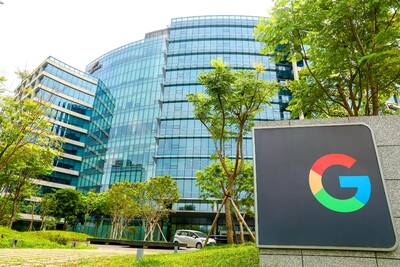
The government yesterday approved applications by Alphabet Inc’s Google to invest NT$27.08 billion (US$859.98 million) in Taiwan, the Ministry of Economic Affairs said in a statement. The Department of Investment Review approved two investments proposed by Google, with much of the funds to be used for data processing and electronic information supply services, as well as inventory procurement businesses in the semiconductor field, the ministry said. It marks the second consecutive year that Google has applied to increase its investment in Taiwan. Google plans to infuse NT$25.34 billion into Charter Investments Ltd (特許投資顧問) through its Singapore-based subsidiary Fructan Holdings Singapore Pte Ltd, and

JET JUICE: The war on Iran’s secondary effects have seen fuel prices skyrocket, knocking flight schedules down to earth in return as airlines struggle with costs Airline passengers should brace for more irritation in the next few months as carriers worldwide cancel flights and ground planes to cope with stratospheric increases in jet-fuel prices. Dutch flag carrier KLM is the latest company to cut its schedule, saying on Thursday that it would scrap 80 return flights at Amsterdam’s Schiphol Airport in the coming month. That puts it in the same league as United Airlines Holdings Inc, Deutsche Lufthansa AG and Cathay Pacific Airways Ltd, which have all pruned itineraries to mitigate costs. Global capacity for next month has been reduced by about 3 percentage points, with all

FORESEEABLE CONSEQUENCES: New technology always comes with new innovations by the iniquitous in exploiting users for financial gain or more nefarious ends Artificial intelligence (AI) “agents” say they can save users time and energy by automating tasks, but the growing power of systems such as OpenClaw is putting cybersecurity experts on edge. Powered by a wave of hype, OpenClaw today says it has more than three million users worldwide. The system allows users to create so-called agents, tools based on a large language model (LLM) such as OpenAI’s ChatGPT or Anthropic PBC’s Claude, that can carry out online tasks. “We’ve moved from an AI you could talk with via a chatbot to an agentic AI, which can take action... the threat and the risks are


 RSS
RSS