


Vacancy rates for grade A offices in Taipei held relatively steady at 2.1 percent last quarter, while monthly rent edged up 0.7 percent to an average of NT$2,828 (US$99.48) per ping (3.3m2) as demand remained strong, while space is limited, Jones Lang LaSalle Inc (JLL) said yesterday.
The vacancy rates suggested a small net takeout of 25 ping as a lack of new supply is hampering activity, JLL Taiwan managing director Tony Chao (趙正義) told a news briefing in Taipei.
JLL Taiwan, which commanded more than 60 percent of the market in Taipei, said that demand, especially from tech firms, is so strong that even upcoming new office buildings have secured tenants, Chao said, referring to a new office complex in Zhongshan District (中山) developed by Fubon Life Insurance Co (富邦人壽).
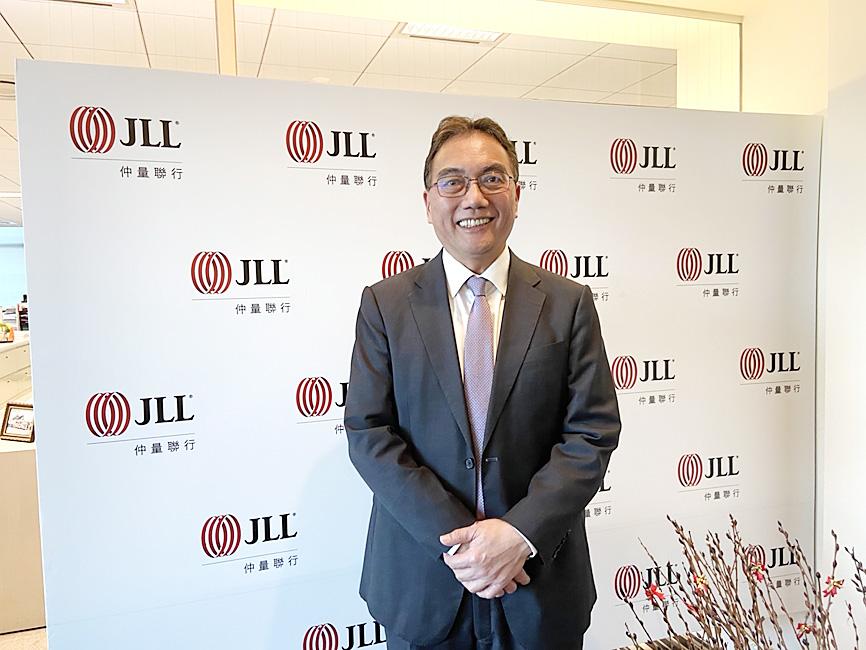
Photo: Hsu Yi-ping, Taipei Times
Standard Chartered Bank Taiwan (渣打台灣銀行) is to relocate its headquarters to the new building and so would a fitness brand, Chao said.
Another new office building developed by Transglobe Life Insurance Co (全球人壽) is to be mainly occupied by Japan's Panasonic Corp and e-commerce operator Shopee Taiwan Co (樂購蝦皮), which has seen its business grow rapidly amid the COVID-19 pandemic, he said.
Preleasing is common in locations where demand is greater than supply, Chao said, citing as an example Taipei Nan Shan Plaza (台北南山廣場), which found many of its tenants before the mixed-use complex in Taipei’s prime Xinyi District (信義) came into service.
Huang Hsiang Construction Corp (皇翔建設) has called off plans to build a hotel near Taipei Railway Station in favor of constructing an upscale office building that might enter the preleasing market next year, Chao said.
About 40 percent of Grade A office spaces in Taipei are 20 years or older, fueling relocation demand for new office spaces that feature environmentally friendly designs and offer the latest technological conveniences, Chao said.
Real demand has underpinned the local leasing market, supported by Taiwan’s vibrant economy, he said, adding that he had helped Alphabet Inc’s Google find office space in Taiwan.
If the trend is sustained, average monthly office rent might climb above the NT$3,000 mark per ping to a record high next year, Chao said.
Office rent reached that level in the early 2000s, but slid after the technology bubble burst, the SARS pandemic and a global financial crisis, Chao said.
The office crunch has a fair chance of a turnaround from 2025, when a large supply of properties are expected to enter the market, observers said.

GROWING OWINGS: While Luxembourg and China swapped the top three spots, the US continued to be the largest exposure for Taiwan for the 41st consecutive quarter The US remained the largest debtor nation to Taiwan’s banking sector for the 41st consecutive quarter at the end of September, after local banks’ exposure to the US market rose more than 2 percent from three months earlier, the central bank said. Exposure to the US increased to US$198.896 billion, up US$4.026 billion, or 2.07 percent, from US$194.87 billion in the previous quarter, data released by the central bank showed on Friday. Of the increase, about US$1.4 billion came from banks’ investments in securitized products and interbank loans in the US, while another US$2.6 billion stemmed from trust assets, including mutual funds,

AI TALENT: No financial details were released about the deal, in which top Groq executives, including its CEO, would join Nvidia to help advance the technology Nvidia Corp has agreed to a licensing deal with artificial intelligence (AI) start-up Groq, furthering its investments in companies connected to the AI boom and gaining the right to add a new type of technology to its products. The world’s largest publicly traded company has paid for the right to use Groq’s technology and is to integrate its chip design into future products. Some of the start-up’s executives are leaving to join Nvidia to help with that effort, the companies said. Groq would continue as an independent company with a new chief executive, it said on Wednesday in a post on its Web

JOINT EFFORTS: MediaTek would partner with Denso to develop custom chips to support the car-part specialist company’s driver-assist systems in an expanding market MediaTek Inc (聯發科), the world’s largest mobile phone chip designer, yesterday said it is working closely with Japan’s Denso Corp to build a custom automotive system-on-chip (SoC) solution tailored for advanced driver-assistance systems and cockpit systems, adding another customer to its new application-specific IC (ASIC) business. This effort merges Denso’s automotive-grade safety expertise and deep vehicle integration with MediaTek’s technologies cultivated through the development of Media- Tek’s Dimensity AX, leveraging efficient, high-performance SoCs and artificial intelligence (AI) capabilities to offer a scalable, production-ready platform for next-generation driver assistance, the company said in a statement yesterday. “Through this collaboration, we are bringing two

Even as the US is embarked on a bitter rivalry with China over the deployment of artificial intelligence (AI), Chinese technology is quietly making inroads into the US market. Despite considerable geopolitical tensions, Chinese open-source AI models are winning over a growing number of programmers and companies in the US. These are different from the closed generative AI models that have become household names — ChatGPT-maker OpenAI or Google’s Gemini — whose inner workings are fiercely protected. In contrast, “open” models offered by many Chinese rivals, from Alibaba (阿里巴巴) to DeepSeek (深度求索), allow programmers to customize parts of the software to suit their


 RSS
RSS