


Taipei Financial Center Corp (TFCC, 台北金融大樓), which operates Taipei 101 — including its shopping mall, observatory deck and office space — aims to increase revenue to pre-COVID-19 pandemic levels this year after taking a hard hit from the crisis last year, it said on Thursday.
TFCC president Angela Chang (張振亞) announced the goal at a news conference, when the firm unveiled a 42 percent slump in net income to NT$1.27 billion (US$44.4 million) for last year.
The results translated into earnings per share of NT$0.87, below NT$1 for the first time in seven years, as foreign tourist arrivals virtually stopped amid COVID-19 border controls.

Photo: Chuang Shih-hsien, Taipei Times
Although the unfavorable effects of the pandemic linger, Taipei 101 is to strengthen its shopping mall operation and maintain full occupancy for its office space in the city’s central business district, where leasing demand is strong with no new space available in the near term, Chang said.
The observatory deck previously generated 30 percent of overall revenue, but made a meager contribution last year, she said.
TFCC has set a goal of growing the shopping mall’s operation by 10 percent this year, helped by a continued economic recovery, and collaborations with domestic and foreign luxury brands to bolster high-end consumption.
The mall hosted more than 200 shows and exhibitions last year to consolidate its leadership position in sales of luxury watches, jewelry and other items, raising revenue 30 percent and mitigating the effects of the pandemic to single-digit percentage points, TFCC said.
A 10 percent increase is viable given that spending by 300,000 members soared 55 percent last year, with one-third of them being active shoppers, the company said.
The skyscraper’s operator is to spend NT$1.5 billion renovating the complex’s exterior, as well as its shopping area and parking spaces to make them more welcoming, TFCC said.
Taipei 101 has been able to raise rents, with upward adjustments reaching 45 percent in some cases, thanks to its landmark status, TFCC said.

Japanese Prime Minister Sanae Takaichi has talked up the benefits of a weaker yen in a campaign speech, adopting a tone at odds with her finance ministry, which has refused to rule out any options to counter excessive foreign exchange volatility. Takaichi later softened her stance, saying she did not have a preference for the yen’s direction. “People say the weak yen is bad right now, but for export industries, it’s a major opportunity,” Takaichi said on Saturday at a rally for Liberal Democratic Party candidate Daishiro Yamagiwa in Kanagawa Prefecture ahead of a snap election on Sunday. “Whether it’s selling food or

CONCERNS: Tech companies investing in AI businesses that purchase their products have raised questions among investors that they are artificially propping up demand Nvidia Corp chief executive officer Jensen Huang (黃仁勳) on Saturday said that the company would be participating in OpenAI’s latest funding round, describing it as potentially “the largest investment we’ve ever made.” “We will invest a great deal of money,” Huang told reporters while visiting Taipei. “I believe in OpenAI. The work that they do is incredible. They’re one of the most consequential companies of our time.” Huang did not say exactly how much Nvidia might contribute, but described the investment as “huge.” “Let Sam announce how much he’s going to raise — it’s for him to decide,” Huang said, referring to OpenAI
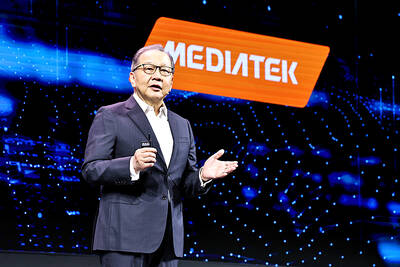
CHIP HANG-UP: Surging memorychip prices would deal a blow to smartphone sales this year, potentially hindering one of MediaTek’s biggest sources of revenue MediaTek Inc (聯發科), the world’s biggest smartphone chip designer, yesterday said its new artificial intelligence (AI) chips used in data centers are to account for 20 percent of its total revenue next year, as cloud service providers race to deploy AI infrastructure to meet voracious demand. MediaTek is believed to be developing tensor processing units for Google, which are used in AI applications. While it did not confirm such reports, MediaTek said its new application-specific IC (ASIC) business would be a new growth engine for the company. It again hiked its forecast for the addressable ASIC market to US$70 billion by 2028, compared

SIGNS OF STABILITY: With US tariff risks to GDP subsiding, reliable economic conditions are expected to reinforce the bank operating environment, Fitch said Fitch Ratings has upgraded the outlook for Taiwan’s banking sector to “neutral” from “deteriorating,” citing a tariff agreement with the US that has reduced uncertainty in Taiwan’s macroeconomic environment and stabilized financial performance. The US on Jan. 15 agreed to lower tariffs on Taiwanese goods from 20 percent to 15 percent, without stacking them on existing most-favored-nation rates, placing Taiwan on equal footing with major competitors such as Japan, South Korea and the EU. The deal also grants Taiwan-made semiconductors and related products most-favorable-nation treatment under Section 232 of the US Trade Expansion Act. Under the agreement, Taiwanese semiconductor, electronics manufacturing service, artificial


 RSS
RSS