


Taiwan Land Development Corp (台灣土地開發) has teamed up with Canada-based Cameron Thomson Group to build a studio park in Hualien County with a view to making it a local version of Hollywood.
The “Huallywood” project aims to create an end-to-end ecosystem in the scenic area to assist global film and TV producers by facilitating content development, production, distribution and monetization, Taiwan Land Development chairman Chiu Fu-sheng (邱復生) said.
The park is part of an ongoing development project in the Hualien Bay area that is to encompass a residential complex, hotels, movie theaters and recreational and retail spaces, Chiu said.
“Hualien has advantages to offer the world production market by creating the next generation of filming facilities for international producers,” said Chiu, who gained credentials in TV and film production before delving into property development.
The park might help local film and TV producers move into the spotlight, taking over as the nation’s main industry from the information technology and communications sectors, Chiu said.
Huallywood is to have eight sound stages of sizes including 3,000m2, 2,000m2, 1,500m2 and 500m2. It is also to have 20,000m2 of production and executive office space, as well as outdoor stages and other facilities, Taiwan Land Development said.
The film industry has entered the era of digitalization, where content development has gained more importance than distribution channels, Chiu said, adding that quality content allows Hollywood to maintain its lead position on the world stage.
“Content creators need advanced facilities, technology and production resources to increase cost efficiency,” Chiu said.
“Huallywood studios is designed to provide world-class facilities to cover every phase of production,” he said.
After its completion, the project will provide jobs for media production professionals in Taiwan and contribute to the national treasury, Chiu said.
Cameron Thomson Group president Ronald Thomson said the digital revolution and intellectual property-based content distribution have caused dramatic changes in the film and TV industry worldwide, driving producers to search for ways to produce better-quality content at lower costs.
“Efficiency enhancement is the key to survival for industry participants these days, and Huallywood intends to provide solutions covering aspects of finance, studio development, operation, production, post production, media asset management and content distribution into its value chain,” Thomson said in Taipei.
Cameron Thomson Group is a major provider of outsourced business development solutions for the media, entertainment and technology sectors.

Japanese Prime Minister Sanae Takaichi has talked up the benefits of a weaker yen in a campaign speech, adopting a tone at odds with her finance ministry, which has refused to rule out any options to counter excessive foreign exchange volatility. Takaichi later softened her stance, saying she did not have a preference for the yen’s direction. “People say the weak yen is bad right now, but for export industries, it’s a major opportunity,” Takaichi said on Saturday at a rally for Liberal Democratic Party candidate Daishiro Yamagiwa in Kanagawa Prefecture ahead of a snap election on Sunday. “Whether it’s selling food or

CONCERNS: Tech companies investing in AI businesses that purchase their products have raised questions among investors that they are artificially propping up demand Nvidia Corp chief executive officer Jensen Huang (黃仁勳) on Saturday said that the company would be participating in OpenAI’s latest funding round, describing it as potentially “the largest investment we’ve ever made.” “We will invest a great deal of money,” Huang told reporters while visiting Taipei. “I believe in OpenAI. The work that they do is incredible. They’re one of the most consequential companies of our time.” Huang did not say exactly how much Nvidia might contribute, but described the investment as “huge.” “Let Sam announce how much he’s going to raise — it’s for him to decide,” Huang said, referring to OpenAI
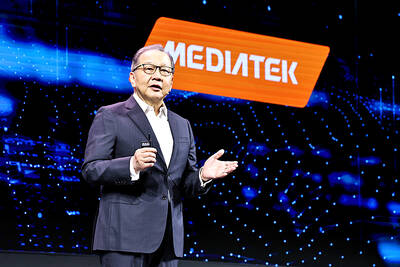
CHIP HANG-UP: Surging memorychip prices would deal a blow to smartphone sales this year, potentially hindering one of MediaTek’s biggest sources of revenue MediaTek Inc (聯發科), the world’s biggest smartphone chip designer, yesterday said its new artificial intelligence (AI) chips used in data centers are to account for 20 percent of its total revenue next year, as cloud service providers race to deploy AI infrastructure to meet voracious demand. MediaTek is believed to be developing tensor processing units for Google, which are used in AI applications. While it did not confirm such reports, MediaTek said its new application-specific IC (ASIC) business would be a new growth engine for the company. It again hiked its forecast for the addressable ASIC market to US$70 billion by 2028, compared

SIGNS OF STABILITY: With US tariff risks to GDP subsiding, reliable economic conditions are expected to reinforce the bank operating environment, Fitch said Fitch Ratings has upgraded the outlook for Taiwan’s banking sector to “neutral” from “deteriorating,” citing a tariff agreement with the US that has reduced uncertainty in Taiwan’s macroeconomic environment and stabilized financial performance. The US on Jan. 15 agreed to lower tariffs on Taiwanese goods from 20 percent to 15 percent, without stacking them on existing most-favored-nation rates, placing Taiwan on equal footing with major competitors such as Japan, South Korea and the EU. The deal also grants Taiwan-made semiconductors and related products most-favorable-nation treatment under Section 232 of the US Trade Expansion Act. Under the agreement, Taiwanese semiconductor, electronics manufacturing service, artificial


 RSS
RSS