


Turkey yesterday vowed that the Syrian regime will “pay a price” for dozens of dead Turkish soldiers and raised pressure on the EU over the conflict by threatening to let thousands of migrants enter the bloc.
Turkey and Russia, which back opposing forces in the Syria conflict, held high-level talks to try to defuse tensions that have sparked fears of a broader war and a new migration crisis for Europe.
Greek police clashed with thousands of migrants who were already gathering on the border to try to enter Europe.
Turkish President Recep Tayyip Erdogan vowed to allow refugees to travel on to Europe from Turkey, which he said can no longer handle new waves of people fleeing war-torn Syria.
It already hosts 3.6 million Syrian refugees.
The comments were his first after 34 Turkish troops were killed since Thursday in the northern Syria province of Idlib, where Moscow-backed Syrian regime forces are battling to retake the last rebel holdout area.
“What did we do yesterday [Friday]? We opened the doors,” Erdogan said in Istanbul. “We will not close those doors... Why? Because the European Union should keep its promises.”
He was referring to a 2016 deal with the EU to stop refugee flows in exchange for billions of euros in aid.
In Athens, Greek Prime Minister Kyriakos Mitsotakis held an emergency meeting to discuss tensions on the border with Turkey.
The Turkish leader said 18,000 migrants have amassed on the Turkish borders with Europe since Friday, adding that the number could reach as many as 30,000 yesterday.
Thousands of migrants who remained stuck on the Turkish-Greek border were in skirmishes with Greek police, who fired tear gas to push them back, according to an Agence France-Presse photographer in the western Turkish province of Edirne.
The migrants massed at the Pazarkule border crossing responded by hurling stones at the police.
In 2015, Greece became the main EU entry point for 1 million migrants, most of them refugees fleeing the Syrian civil war. The pressure to cope with the influx split the EU.
“Greece yesterday came under an organized, mass, illegal attack ... a violation of our borders and endured it,” government spokesman Stelios Petsas said after the emergency meeting with Mitsotakis. “We averted more than 4,000 attempts of illegal entrance to our land borders.”
A Greek police source said security forces fired tear gas against migrants massing on the Turkish side, because the migrants had set fires and opened holes in the border fences.
Armed policemen and soldiers are patrolling the Evros River shores — a common crossing point — and are warning with loudspeakers not to enter Greek territory.
Greek authorities were also using drones to monitor the migrants moves.
Greek Minister of Defense Nikos Panagiotopoulos told Skai television the situation was under control
“I believe that the borders have been protected,” he said.
From early Friday to early yesterday 180 migrants reached the islands of Eastern Aegean, Lesbos and Samos in sea crossings, the Greek coast guard said.
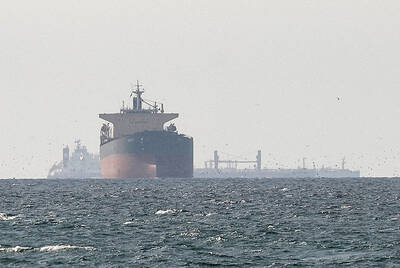
A ship that appears to be taking on the identity of a scrapped gas carrier exited the Strait of Hormuz on Friday, showing how strategies to get through the waterway are evolving as the Middle East war progresses. The vessel identifying as liquefied natural gas (LNG) carrier Jamal left the Strait on Friday morning, ship-tracking data show. However, the same tanker was also recorded as having beached at an Indian demolition yard in October last year, where it is being broken up, according to market participants and port agent’s reports. The ship claiming to be Jamal is likely a zombie vessel that
Japan is to downgrade its description of ties with China from “one of its most important” in an annual diplomatic report, according to a draft reviewed by Reuters, as relations with Beijing worsen. This year’s Diplomatic Bluebook, which Japanese Prime Minister Sanae Takaichi’s government is expected to approve next month, would instead describe China as an important neighbor and the relationship as “strategic” and “mutually beneficial.” The draft cites a series of confrontations with Beijing over the past year, including export controls on rare earths, radar lock-ons targeting Japanese military aircraft and increased pressure around Taiwan. The shift in tone underscores a deterioration
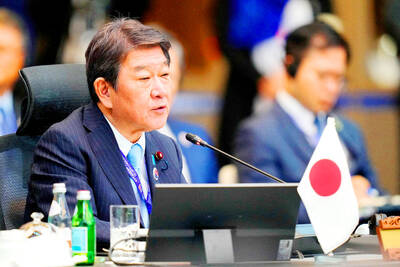
LAW CONSTRAINTS: The US has been pressing allies to send warships to open the Strait, but Tokyo’s military actions are limited under its postwar pacifist constitution Japan could consider deploying its military for minesweeping in the Strait of Hormuz if a ceasefire is reached in the war on Iran, Japanese Minister of Foreign Affairs Toshimitsu Motegi said yesterday. “If there were to be a complete ceasefire, hypothetically speaking, then things like minesweeping could come up,” Motegi said. “This is purely hypothetical, but if a ceasefire were established and naval mines were creating an obstacle, then I think that would be something to consider.” Japan’s military actions are limited under its postwar pacifist constitution, but 2015 security legislation allows Tokyo to use its Self-Defense Forces overseas if an attack,

German Chancellor Friedrich Merz’s conservative Christian Democratic Union (CDU) yesterday faced a regional election battle in Rhineland-Palatinate, now held by the center-left Social Democratic Party (SPD). Merz’s CDU has enjoyed a narrow poll lead over the SPD — their coalition partners at the national level — who have ruled the mid-sized state for 35 years. Polling third is the far-right Alternative for Germany (AfD), which spells a greater threat to the two centrist parties in several state elections in September in the country’s ex-communist east. The picturesque state of Rhineland-Palatinate, bordering France, Belgium and Luxembourg and with a population of about 4 million,


 RSS
RSS