


The cost of renovating the new home of Prince Harry and his wife, Meghan, was £2.4 million (US$3.06 million), Buckingham Palace said yesterday as it detailed how the royal family had spent money provided by taxpayers.
The sum, part of the annual “Sovereign Grant,” funded the conversion of Frogmore Cottage to a single dwelling, while the couple, the Duke and Duchess of Sussex, paid for the fittings and furnishings.
“The property had not been subject of work for some years and had already been earmarked for renovation in line with our responsibility to maintain the condition of the occupied royal palaces estate,” said Michael Stevens, the Keeper of the Privy Purse and responsible for royal accounts.

Photo: AFP
“Outdated infrastructure was replaced to guarantee the long-term future of the property,” he said ahead of the publication of the Sovereign Grant report, which details official income and expenditure of Queen Elizabeth II and her household.
The 19th-century Frogmore Cottage, in the grounds of the queen’s Windsor Castle estate, became the official residence of Harry and Meghan when they moved in shortly before the birth of their first child, Archie, last month.
The building had been previously converted into five separate residences and royal officials had already planned to renovate it before it was agreed that it would become the couple’s residence.
The six-month refurbishment included new electrical wiring, replacement of defective ceiling beams and floor joists, new heating systems and the introduction of new gas and water mains.
A palace source, speaking on condition of anonymity, said the taxpayer grant covered the basic cost for kitchens, bathrooms and flooring with additional outlays for anything more bespoke being met privately by the royals who also paid for items such as curtains and furnishings.
Work has been “substantially” completed and outstanding renovations would not feature in next year’s annual report, meaning the cost would be under the £350,000 threshold to be included in the public report.
The outlay on Frogmore Cottage formed part of the £82.2 million Sovereign Grant, the government handout which covers the official duties of the queen, including staffing costs, upkeep of royal palaces and travel expenses.
It is based on 15 percent of surplus revenue from the Crown Estate, the monarchy’s property portfolio, from two years previously.
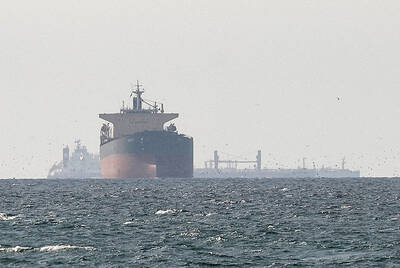
A ship that appears to be taking on the identity of a scrapped gas carrier exited the Strait of Hormuz on Friday, showing how strategies to get through the waterway are evolving as the Middle East war progresses. The vessel identifying as liquefied natural gas (LNG) carrier Jamal left the Strait on Friday morning, ship-tracking data show. However, the same tanker was also recorded as having beached at an Indian demolition yard in October last year, where it is being broken up, according to market participants and port agent’s reports. The ship claiming to be Jamal is likely a zombie vessel that

Japan is to downgrade its description of ties with China from “one of its most important” in an annual diplomatic report, according to a draft reviewed by Reuters, as relations with Beijing worsen. This year’s Diplomatic Bluebook, which Japanese Prime Minister Sanae Takaichi’s government is expected to approve next month, would instead describe China as an important neighbor and the relationship as “strategic” and “mutually beneficial.” The draft cites a series of confrontations with Beijing over the past year, including export controls on rare earths, radar lock-ons targeting Japanese military aircraft and increased pressure around Taiwan. The shift in tone underscores a deterioration
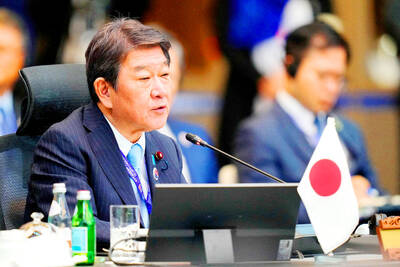
LAW CONSTRAINTS: The US has been pressing allies to send warships to open the Strait, but Tokyo’s military actions are limited under its postwar pacifist constitution Japan could consider deploying its military for minesweeping in the Strait of Hormuz if a ceasefire is reached in the war on Iran, Japanese Minister of Foreign Affairs Toshimitsu Motegi said yesterday. “If there were to be a complete ceasefire, hypothetically speaking, then things like minesweeping could come up,” Motegi said. “This is purely hypothetical, but if a ceasefire were established and naval mines were creating an obstacle, then I think that would be something to consider.” Japan’s military actions are limited under its postwar pacifist constitution, but 2015 security legislation allows Tokyo to use its Self-Defense Forces overseas if an attack,

German Chancellor Friedrich Merz’s conservative Christian Democratic Union (CDU) yesterday faced a regional election battle in Rhineland-Palatinate, now held by the center-left Social Democratic Party (SPD). Merz’s CDU has enjoyed a narrow poll lead over the SPD — their coalition partners at the national level — who have ruled the mid-sized state for 35 years. Polling third is the far-right Alternative for Germany (AfD), which spells a greater threat to the two centrist parties in several state elections in September in the country’s ex-communist east. The picturesque state of Rhineland-Palatinate, bordering France, Belgium and Luxembourg and with a population of about 4 million,


 RSS
RSS