


The decapitated bodies of five civilians have been found in Marawi City, the military said yesterday, warning the number of residents killed by rebel “atrocities” could rise sharply as troops retake more ground.
The discovery would be the first evidence that civilians trapped in the besieged town have been decapitated, as some who escaped the city have previously reported.
The five decapitated people were found among 17 civilians killed by militants, Lieutenant Colonel Emmanuel Garcia of the Western Mindanao Command said in a text message to reporters.
Garcia did not respond immediately to repeated requests for more details. It was not clear when the bodies were found.
The battle for Marawi yesterday entered its 36th day, with intense gunfights and bombing in the heart of the town and black-clad fighters seen from afar running between buildings as explosions rang out.
Military spokesman Restituto Padilla said it was likely that many civilians had been killed and the death toll — which stood at 27 before the discovery of the 17 bodies — was only what the authorities could confirm independently.
He said a “significant number” of dead had been seen by those who had escaped fighting.
“[It] may increase significantly once we are able to validate all this information,” Padilla said. “There have been a significant number that have been seen, but again, we cannot include many of these.”
The cause of those deaths would be “atrocities committed by the terrorists,” he said.
Videos have appeared this month on the Web site of Islamic State’s Amaq news agency and its social media channels of hostages in Marawi pleading for their lives, saying they would be beheaded if air strikes were not stopped.
Clips have also appeared of people on their knees, shot in the head from behind.
Reporters were unable to confirm the authenticity of the reports.
The military has so far been reluctant to discuss the possibility that the real impact of the fighting on civilians could be far more severe than has been reported.
It has played down the impact of daily air strikes and mortar assaults aimed at rebel sniper positions, which have reduced areas of the lakeside town to rubble and alarmed people stuck there, some of whom have said the shelling was a bigger threat than the militants.
President Rodrigo Duterte said on Tuesday that he was prepared from the outset for a long fight against a well-armed Maute group motivated only by murder and destruction.
“It seems to be limitless supply. They were able to stockpile their arms,” he said. “Some of those who travelled to the Middle East got contaminated, brought the ideology back home and promised to declare war against humanity.”
Padilla called for patience and said troops needed more time to flush out the gunmen and secure the city.
“Our combat environment is sensitive. First, there are trapped civilians that we have to protect. They also have hostages and third, there are many traps so we have to clear buildings slowly,” he said.
About 71 security forces and 299 militants have been killed, and 246,000 people have been displaced in the conflict, which erupted after a failed attempt on May 23 to arrest Abu Sayyaf commander-in-chief Isnilon Hapilon, who is backed by Islamic State’s leadership.
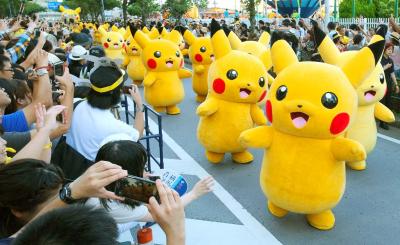
China’s military news agency yesterday warned that Japanese militarism is infiltrating society through series such as Pokemon and Detective Conan, after recent controversies involving events at sensitive sites. In recent days, anime conventions throughout China have reportedly banned participants from dressing as characters from Pokemon or Detective Conan and prohibited sales of related products. China Military Online yesterday posted an article titled “Their schemes — beware the infiltration of Japanese militarism in culture and sports.” The article referenced recent controversies around the popular anime series Pokemon, Detective Conan and My Hero Academia, saying that “the evil influence of Japanese militarism lives on in

DIPLOMATIC THAW: The Canadian prime minister’s China visit and improved Beijing-Ottawa ties raised lawyer Zhang Dongshuo’s hopes for a positive outcome in the retrial China has overturned the death sentence of Canadian Robert Schellenberg, a Canadian official said on Friday, in a possible sign of a diplomatic thaw as Canadian Prime Minister Mark Carney seeks to boost trade ties with Beijing. Schellenberg’s lawyer, Zhang Dongshuo (張東碩), yesterday confirmed China’s Supreme People’s Court struck down the sentence. Schellenberg was detained on drug charges in 2014 before China-Canada ties nosedived following the 2018 arrest in Vancouver of Huawei chief financial officer Meng Wanzhou (孟晚舟). That arrest infuriated Beijing, which detained two Canadians — Michael Spavor and Michael Kovrig — on espionage charges that Ottawa condemned as retaliatory. In January

A sign hanging from a rusty ice-green shipping container installed by Thai forces on what they say is the border with Cambodia reads: “Cambodian citizens are strictly prohibited from entering this area.” On opposite sides of the makeshift barricade, fronted by coils of barbed wire, Cambodians lamented their lost homes and livelihoods as Thailand’s military showed off its gains. Thai forces took control of several patches of disputed land along the border during fighting last year, which could amount to several square kilometers in total. Cambodian Kim Ren said her house in Chouk Chey used to stand on what is now the Thai
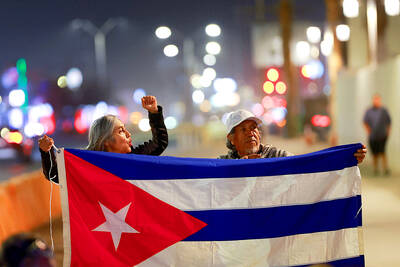
NEW RULES: There would be fewer school days, four-day workweeks, and a reduction in transportation services as the country battles a crisis exacerbated by US pressure The Cuban government on Friday announced emergency measures to address a crippling energy crisis worsened by US sanctions, including the adoption of a four-day work week for state-owned companies and fuel sale restrictions. Cuban Deputy Prime Minister Oscar Perez-Oliva Fraga blamed Washington for the crisis, telling Cuban television the government would “implement a series of decisions, first and foremost to guarantee the vitality of our country and essential services, without giving up on development.” “Fuel will be used to protect essential services for the population and indispensable economic activities,” he said. Among the new measures are the reduction of the working week in


 RSS
RSS