


Bibi Aisha, the Afghan girl whose nose and ears were cut off by her husband, was a “lucky victim” because she survived her attack and got help, a top human rights official in the country said on Thursday.
While Aisha escaped her abusive family, the deputy chairman of the country’s Independent Human Rights Commission said many women in similar circumstances were less lucky.
“For sure, we have hundreds of Bibi Aishas in Afghanistan,” Ahmad Fahim Hakim said.
His remarks came after the news that one of the men responsible for attacking Aisha had been arrested, a development hailed by human rights workers as a sign the Afghan authorities are starting to take deep-rooted abuse of women seriously.
Hakim was speaking during the publication of a major UN report that showed how despite improvements in women’s rights the country is still blighted by forced marriages, the giving away of infant girls to future husbands to settle disputes, honor killings and desperate women resorting to death by self-immolation.
The report by the UN’s Afghanistan mission said that such practices are problems in all communities and cause “suffering, humiliation and marginalization for millions of Afghan women and girls.”
Despite recent efforts to toughen laws designed to protect women, the government does little to combat abuses, the report said.
One long-observed tradition covered by the report is the concept of baad, where a young girl will be given in marriage to settle disputes between families.
“Many of the women told us that, instead of the murderer being punished, an innocent girl is punished and has to spend her life in slavery and subject to cruel violence,” the UN’s director of human rights in Kabul Georgette Gagnon said.
The head of Afghanistan’s only specialist burns unit is quoted as saying that forced marriages are the main reason women try to commit suicide by setting themselves on fire.
According to figures quoted in the report, in 57 percent of Afghan marriages one of the partners is younger than 16.
Meanwhile, Afghan and foreign troops freed 18 kidnapped Afghan de-miners yesterday in southeastern Khost Province, the provincial police chief said.
The group from the Kabul-based Mine Detection Centre were kidnapped on Thursday in Musa Khel District by unidentified gunmen. It was the second abduction of a mine clearing team in Afghanistan this month.
Provincial Police Chief Abdul Hakim Ishaqzai said the abductors fled when the de-miners were freed and there were no casualties on either side.

Through the noise of rushing papers and whirring belts at a print factory in Kyoto, two creators watch their photo essay come to life in broadsheet form — part of an effort to win new audiences in the age of artificial intelligence (AI). Despite the decline of the publishing industry, self-publication and handmade “zine” magazines are growing in popularity in Japan, reflecting the nation’s enduring love of paper in the digital era. While speaking to Agence France-Presse at the plant, his hands black with ink, one of the creators, Kazuma Obara, said: “I think [paper] is a medium that engages all five
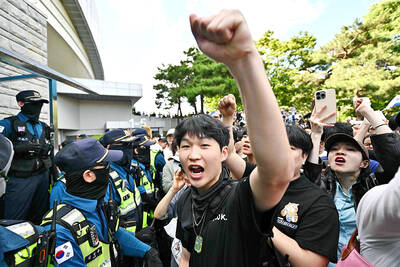
‘ABSURD MISTAKE’: The election commission said that there had been a failure to anticipate turnout after 14 polling stations ran short of ballot papers South Korean riot police yesterday cleared protesters from a Seoul polling station after a 35-hour blockade sparked by a shortage of ballot papers during local elections earlier this week. Wednesday’s election was the first nationwide vote since South Korean President Lee Jae-myung took office following the ouster of Yoon Suk-yeol over his short-lived martial law declaration. Lee’s ruling Democratic Party swept most races, but failed to flip the crucial Seoul mayoral seat. The South Korean National Election Commission apologized, blaming a failure to anticipate turnout after 14 polling stations in Seoul ran short of ballot papers. Some polling stations stayed open until 10pm to

Australian researchers have trained lab-grown brain cells on a silicon computer chip to play the 1990s shooter game Doom and said they are just scratching the surface of what the neurons could be capable of doing. It is the science-fiction work of biotech boffins at Cortical Labs, who researched and developed the technology that harnesses the workings of the brain’s networking system. Each so-called “biological computer” contains about 200,000 living human brain cells, grown from stem cells that were harvested from blood donations. Having mastered the simple computer game Pong, where a paddle is moved up and down to send a ball

France experienced its hottest spring on record, the French weather service said on Tuesday, after an exceptional early heat wave that also broke highs for the season in England and Wales. Meteo-France said the average nationwide temperature over March to May was 13.8°C — about 1.7°C above the norm, and surpassing records set in 2011 and 2020. “The warmest spring since records began in 1900,” it said in a bulletin. All three months were warmer than average, but the onset of an “unprecedented heatwave” late last month pushed the mercury to highs typically seen at the height of the summer. “Our country had never


 RSS
RSS