


Brazilian President Luiz Inacio Lula da Silva’s chief of staff resigned on Thursday over an ethics scandal that the opposition is trying to use to derail his candidate in next month’s presidential election.
Erenice Guerra, whose role as Cabinet chief is an influential post in the Lula government, had been under growing pressure in recent days to step down over allegations that she was involved in a kickback scheme for public works contracts.
Trailing badly in opinion polls, main opposition candidate Jose Serra has sought to link the scandal to ruling party contender Dilma Rousseff, who preceded Guerra as Lula’s chief of staff before hitting the campaign trail.
Rousseff remains on course to win a majority of votes in the first round of voting on Oct. 3 and become Brazil’s first woman president, despite the allegations that she condoned unethical conduct within her leftist Workers’ Party.
She has not been directly linked to any wrongdoing, which analysts say makes it unlikely the scandals will cut her lead.
“The chances that it forces a second round are still rather small. The opposition would have to be very skilled to exploit this incident,” said Amaury de Souza, a Rio de Janeiro-based political analyst.
“The corruption scandals so far didn’t change voter preference except among those with higher education or income. That is insufficient to change the odds,” de Souza said.
Rousseff has 51 percent of voter intention against 27 percent for Serra of the opposition PSDB party, according to a Datafolha poll released on Thursday.
The same poll last week showed Rousseff with 50 percent against Serra’s 27 percent.
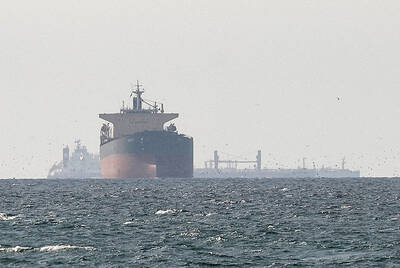
A ship that appears to be taking on the identity of a scrapped gas carrier exited the Strait of Hormuz on Friday, showing how strategies to get through the waterway are evolving as the Middle East war progresses. The vessel identifying as liquefied natural gas (LNG) carrier Jamal left the Strait on Friday morning, ship-tracking data show. However, the same tanker was also recorded as having beached at an Indian demolition yard in October last year, where it is being broken up, according to market participants and port agent’s reports. The ship claiming to be Jamal is likely a zombie vessel that

German Chancellor Friedrich Merz’s conservative Christian Democratic Union (CDU) yesterday faced a regional election battle in Rhineland-Palatinate, now held by the center-left Social Democratic Party (SPD). Merz’s CDU has enjoyed a narrow poll lead over the SPD — their coalition partners at the national level — who have ruled the mid-sized state for 35 years. Polling third is the far-right Alternative for Germany (AfD), which spells a greater threat to the two centrist parties in several state elections in September in the country’s ex-communist east. The picturesque state of Rhineland-Palatinate, bordering France, Belgium and Luxembourg and with a population of about 4 million,

Ugandan wildlife authorities have reintroduced rhinos into a remote protected area where they were once poached into extinction, an event seen by conservationists as a milestone in efforts to support the recovery of a species threatened by poaching. On Tuesday, two southern white rhinos from a private ranch in the East African country were reintroduced into Kidepo Valley National Park in the country’s northeast. Two more rhinos in metallic crates arrived on Thursday. There have been no rhinos in the park since 1983, the result of poaching. However, a private ranch in central Uganda — the Ziwa Rhino Sanctuary — has been
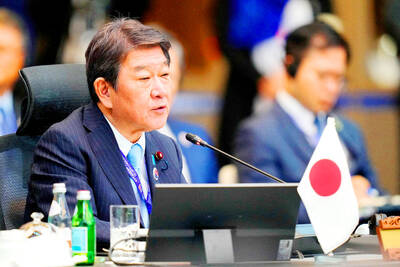
LAW CONSTRAINTS: The US has been pressing allies to send warships to open the Strait, but Tokyo’s military actions are limited under its postwar pacifist constitution Japan could consider deploying its military for minesweeping in the Strait of Hormuz if a ceasefire is reached in the war on Iran, Japanese Minister of Foreign Affairs Toshimitsu Motegi said yesterday. “If there were to be a complete ceasefire, hypothetically speaking, then things like minesweeping could come up,” Motegi said. “This is purely hypothetical, but if a ceasefire were established and naval mines were creating an obstacle, then I think that would be something to consider.” Japan’s military actions are limited under its postwar pacifist constitution, but 2015 security legislation allows Tokyo to use its Self-Defense Forces overseas if an attack,


 RSS
RSS