


Greenpeace yesterday made fresh allegations that units of Indonesian paper and palm oil giant Sinar Mas are clearing high conservation-value (HCV) forests, including habitats of endangered orangutans.
Greenpeace Indonesia forest campaigner Bustar Maitar said new investigations showed Sinar Mas subsidiaries logging peat forests and orangutan habitats on the island of Borneo despite repeated promises to end such practices.
“Our photos provide fresh evidence of Sinar Mas’ continued active clearance of remaining rainforests and deep peatlands,” he said as the environmental group released a report on the issue.
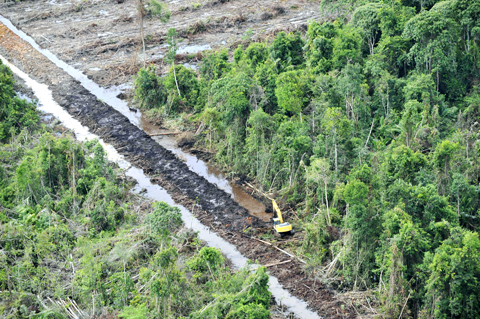
PHOTO: AFP
“Contrary to their claims of sustainability, land-clearing is still happening on the ground,” he said.
The allegations are the latest in a string of Greenpeace attacks on Sinar Mas, whose palm oil unit, PT SMART, has recently suffered the loss of major clients Unilever and Nestle over environmental concerns.
“Sinar Mas is the leading palm oil producer in Indonesia. It is their duty to show the way and that’s the reason why we have targeted them. We would be more than happy to stop this campaign,” Maitar said.
In addition to sheltering critically endangered species like orangutans, high conservation-value forests are also rich stores of greenhouse gases blamed for global warming.
Sinar Mas denies the Greenpeace allegations and SMART has promised to release an audit on Aug. 10 to prove that its operations are sustainable.
Indonesia is considered the world’s third-biggest emitter of greenhouse gases, mainly through deforestation, much of which is carried out illegally with the alleged connivance of officials and security forces.
The Greenpeace report published yesterday says Sinar Mas, which is controlled by the Widjaja family headed by company founder Eka Tjipta Widjaja, is planning to aggressively target sensitive forests in Papua province.
“Analysis by Greenpeace of areas targeted by Sinar Mas for oil palm development in Papua indicates that these areas contain 50 percent primary forest cover and significant areas of peatland,” it said.
“Its future expansion into rainforest areas and peatlands will further contribute to habitat loss and climate change,” it said.
SMART president director Daud Dharsono said the company was in fact helping to preserve forests and species such as orangutans.
“We are not responsible for clearing primary forests, which are the natural habitats for orangutans, and high conservation-value areas,” he said in a statement.
“On the contrary, all our concession areas do not contain primary forests and we conserve high conservation-value areas, creating sanctuaries that will continue to preserve biodiversity,” he said.
A company statement said that forested areas in Greenpeace photographs of SMART concession areas showed that the firm was conserving high-value areas on the degraded land it owned or managed.
“They are not remnants of primary forest caused by SMART’s palm oil operations. These are in fact preserved areas, as a result of our commitment to conserve HCV land,” it said.
“SMART is a responsible company ... We reiterate that as part of our sustainability commitments, SMART does not plant oil palm trees on peat land, primary forests nor convert land with HCV,” it said.
Greenpeace earlier this month accused foreign firms like Walmart, Carrefour and Tesco of contributing to forest destruction and species loss in Indonesia by buying from paper and palm oil giant Sinar Mas.
A coalition of civil rights groups on Tuesday asked a New York State judge to order one of its largest suburban counties to stop its deployment of nearly 600 license plate readers, calling it a warrantless and “indiscriminate surveillance system” that violates the state constitution. The class action lawsuit also alleged that Westchester County never got proper authorization to launch the program, which has amassed a database of 1.6 billion plate scans that has been shared with more than 50 outside law enforcement agencies. The complaint said the network “records the long-term travel patterns, daily habits, and intimate information of millions of

Pope Leo XIV on Wednesday blessed a giant new tower at Barcelona’s famed Sagrada Familia Basilica after celebrating mass inside what is now the world’s tallest church. A fireworks and light show illuminated the exterior of the temple at the end of the ceremony, bathing the unfinished basilica in shifting colours that highlighted its towering spires. A choir of 600 singers performed at the service which lasted around 90 minutes and was attended by Spanish Prime Minister Pedro Sanchez as well as King Felipe VI and Queen Letizia. The stained-glass windows in various colours shone brightly in between the tree-like

Scientists have discovered communities of marine life — including jellyfish, tubeworms and brittle stars — thriving on a whale graveyard. The graveyards form when whale carcasses fall to the sea floor, becoming a sustaining snack for nearby critters. This one, which is up to 7km below the surface of the southeastern Indian Ocean, spans the largest area, and is so far the deepest found. A whale’s sheer size and the unique chemistry of its bones are the keys to forming these unique underwater neighborhoods, said Song Xikun (宋希坤), a biologist with the Chinese Academy of Sciences’ Institute of Deep-sea Science and Engineering

IMAGE ‘DAMAGED’? Ted Tseng, who emigrated to the US from Taiwan, was concerned the espionage case would deepen animosity against Asian Americans In 2024, voters in the Southern California city of Arcadia elected the first all-Asian city council in the city’s history. Now, one of those politicians has pleaded guilty to being an illegal agent of the Chinese government. Former Arcadia mayor Eileen Wang’s (王愛琳) plea, entered in federal court on Friday last year, continues a saga that some residents of the area worry could bring unfair scrutiny on the broader Chinese and Asian American community. Arcadia has gone under rapid demographic change in the past two decades as immigrants from Taiwan, China and Hong Kong flocked to the San Gabriel Valley


 RSS
RSS