


The pope defended priestly celibacy on Friday after a series of pedophile priest scandals rekindled debate on the Church’s policy as the head of Germany’s Catholics again apologized to victims.
Speaking ahead of a meeting with the German Catholic Church’s leader, Pope Benedict XVI stressed that celibacy is “the sign of full devotion” and of an “entire commitment to the Lord”.
“The value of sacred celibacy, which in the Latin Church is ... required for ordination [of priests], is held in great regard by Eastern Churches,” he added at a theological convention.
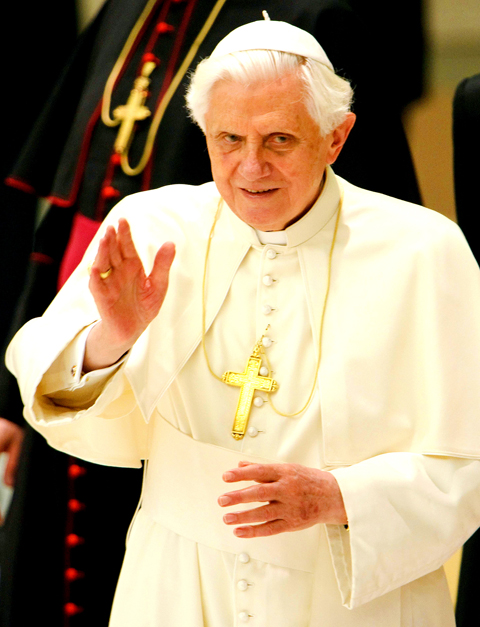
PHOTO: AFP
The pope’s comments came a day after Archbishop of Vienna Christoph Schoenborn called for an unflinching examination of the possible roots of child sex abuse by priests, saying it should include the issue of priestly celibacy.
Another of Austria’s most senior clerics, the Archbishop of Salzburg Alois Kothgasser, also said the Catholic Church must ask itself whether celibacy is still an appropriate way of life for priests.
“In the Church’s current situation, the question must be asked whether celibacy is an appropriate way of life for priests and an appropriate way of life for believers,” Kothgasser told ORF public television. “Times have changed and society has changed.”
A proliferation of abuse scandals across Europe has prompted deep soul searching among Church leaders, not least in Benedict’s native Germany where 19 of the 27 dioceses have been implicated in allegations.
The flood of revelations began in late January when an elite Jesuit school in Berlin admitted systematic sexual abuse of pupils by two priests in the 1970s and 1980s. A school attached to a cathedral in Regensburg where Benedict’s brother was choir master was among those later implicated.
Speaking after his meeting with Benedict in the Vatican, Germany’s top Catholic cleric issued a new apology to all those who had been affected and announced the creation of a watchdog to counter abuses.
“I want to repeat here in Rome the apology that I made two weeks ago,” Archbishop Robert Zollitsch of Freiburg told a news conference in the Vatican.
He said the pope had praised “the steps taken by the German Bishops Conference [including] the naming of a bishop as a special counsel” who would act as a watchdog on the issue of the sexual abuse of children.
Most of the priests concerned are not expected to face criminal charges because the alleged crimes took place too long ago, but there have been growing calls for a change in the law and for the Church to pay compensation.
Meanwhile, the pope once helped get housing for a clergyman suspected of child sex abuse, it emerged on Friday.
Pope Benedict’s former diocese of Munich confirmed a report that, as an archbishop in 1980, the pontiff approved housing for the priest, who was to undergo therapy.
The priest — identified only as H — had been accused of forcing an 11-year-old boy to perform oral sex, the Sueddeutsche Zeitung newspaper reported.
“It was decided in 1980 to give H. accommodation in a rectory so that he could receive therapy. The archbishop [Pope Benedict] took part in this decision,” the German diocese of Munich and Freising said in a statement.
Six years later, the priest was given a suspended prison sentence for child sex offences. The archdiocese said he still works in Bavaria, with no known repeat violations.
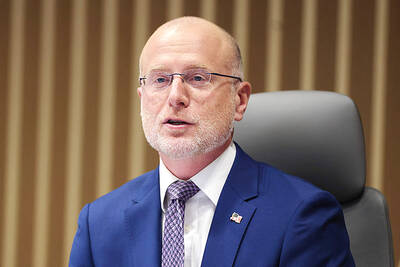
FAKE NEWS? ‘When the government demands the press become a state mouthpiece under the threat of punishment, something has gone very wrong,’ a civic group said The top US broadcast regulator on Saturday threatened media outlets over negative coverage of the Middle East war, after US President Donald Trump slammed critical headlines from the “Fake News Media.” The US president since his first term has derided mainstream media as “fake news” and has sued major outlets over what he sees as unfair coverage. Brendan Carr, head of the US Federal Communications Commission — which oversees the nation’s radio, television and Internet media — said broadcasters risked losing their licenses over news coverage. “The law is clear. Broadcasters must operate in the public interest, and they will
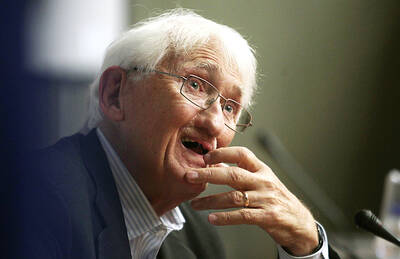
INFLUTENTIAL THEORIST: Habermas was particularly critical of the ‘limited interest’ shown by German politicians in ‘shaping a politically effective Europe Jurgen Habermas, whose work on communication, rationality and sociology made him one of the world’s most influential philosophers and a key intellectual figure in his native Germany, has died. He was 96. Habermas’ publisher, Suhrkamp, said he died on Saturday in Starnberg, near Munich. Habermas frequently weighed in on political matters over several decades. His extensive writing crossed the boundaries of academic and philosophical disciplines, providing a vision of modern society and social interaction. His best-known works included the two-volume Theory of Communicative Action. Habermas, who was 15 at the time of Nazi Germany’s defeat, later recalled the dawn of

The Chinese public maintains relatively warm sentiments toward Taiwan and strongly prefers non-military paths to improving cross-strait relations, a recent survey conducted by the Atlanta, Georgia-based Carter Center and Emory University showed. The “China Pulse” research project, which polled 2,506 adults between Oct. 27 last year and Jan. 1 this year, found that 86 percent of respondents support strengthening cultural ties, while 81 percent favor deepening economic interaction. The report, co-authored by political scientists at Emory University and advisors at the Carter Center, indicates that the Chinese public views Taiwan’s importance through a lens of shared history and culture rather than geopolitical

Cannabis-based medicines have shown little evidence of effectiveness for treating most mental health and substance-use disorders, according to a large review of past studies published in a major medical journal on Monday. Medical use of cannabinoids has been expanding, including in the US, Canada and Australia, where many patients report using cannabis products to manage conditions such as anxiety, post-traumatic stress disorder and sleep problems. Researchers reviewed data from 54 randomized clinical trials conducted between 1980 and May last year involving 2,477 participants for their analysis published in The Lancet. The studies assessed cannabinoids as a primary treatment for mental disorders or substance-use


 RSS
RSS