


Asian carp may have breached an electronic barrier designed to prevent the giant invaders from upsetting the ecosystem in the Great Lakes and jeopardizing a US$7 billion sport fishery, officials said on Friday.
Scientists recently collected 32 DNA samples of Asian carp between the barrier and Lake Michigan in waterways south of Chicago, although the fish have yet to be spotted in the area, said Major General John Peabody of the US Army Corps of Engineers.
If the feared bighead and silver carp have got through the US$9 million barrier, the only remaining obstacle between the carp and Lake Michigan is a navigational lock on the Calumet River.
Some DNA was found as close as 1.6km south of the lock and 12km south of the lake.
Still, federal officials insisted a Great Lakes invasion was not inevitable.
“We’re going to keep throwing everything we possibly can at them to keep them out,” said Cameron Davis, senior Great Lakes adviser to Lisa Jackson, head of the Environmental Protection Agency.
MONSTROUS
Asian carp escaped from Southern fish farms into the Mississippi River during 1990s flooding and have been migrating northward since.
The monstrous creatures can 1.2m long and 45kg. They consume up to 40 percent of their body weight daily in plankton, starving out smaller and less aggressive competitors.
Aside from decimating species prized by anglers and commercial fishers, Asian carp are known to leap from the water at the sound of passing motors and sometimes collide with boaters.
A worst-case scenario envisions them spreading “like a cancer cell,” he said, eventually dominating a fishery already damaged by zebra mussels, sea lamprey and other exotic pests.
In 2002, the Army Corps placed an electronic device on the Chicago Sanitary and Ship Canal, a man-made waterway south of the city that forms part of a linkage between the Mississippi and Lake Michigan.
NEW DEVICE
A more powerful device went online this year.
Both emit electrical pulses designed to repel the carp or give them a non-lethal jolt.
David Lodge, a University of Notre Dame invasive species expert, confirmed the presence of DNA of bighead and silver carp in the Cal-Sag Channel, between the canal to the Calumet River and in the river itself, which flows into Lake Michigan.
The newer electronic device is scheduled to be deactivated for maintenance early next month. Officials plan to treat a 10km section of the canal with a fish toxin to prevent Asian carp from advancing.
Environmental groups called for tougher action, including closure of all Illinois gateways and locks leading to Lake Michigan.
That would draw opposition from barge companies.
“If we don’t close the locks, we are waving the white flag and allowing one of the greatest ecological tragedies to occur,” said Jennifer Nalbone of Great Lakes United.

When a hiker fell from a 55m waterfall in wild New Zealand bush, rescuers were forced to evacuate the badly hurt woman without her dog, which could not be found. After strangers raised thousands of dollars for a search, border collie Molly was flown to safety by a helicopter pilot who was determined to reunite the pet and the owner. A week earlier, an emergency rescue helicopter found the woman with bruises and lacerations after a fall at a rocky spot at the waterfall on the South Island’s West Coast. She was airlifted on March 24, but they were forced to
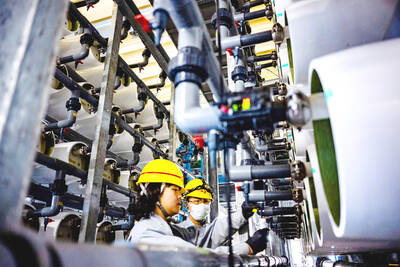
HIGH HOPES: The power source is expected to have a future, as it is not dependent on the weather or light, and could be useful for places with large desalination facilities A Japanese water plant is harnessing the natural process of osmosis to generate renewable energy that could one day become a common power source. The possibility of generating power from osmosis — when water molecules pass from a less salty solution to a more salty one — has long been known. However, actually generating energy from that has proved more complicated, in part due the difficulty of designing the membrane through which the molecules pass. Engineers in Fukuoka, Japan, and their private partners think they might have cracked it, and have opened what is only the world’s second osmotic power plant. It generates

Hundreds of Filipinos and tourists flocked to a sun-bleached field north of Manila yesterday, on Good Friday, to witness one of the country’s most blood-soaked displays of religious fervor, undeterred by rising fuel prices. Scores of bare-chested flagellants with covered faces walked barefoot through the dusty streets of Pampanga Province’s San Fernando as they flogged their backs with bamboo whips in the scorching heat. Agence France-Presse (AFP) journalists said they saw devotees deliberately puncturing their skin with glass shards attached to a small wooden paddle to ensure their bleeding during the ritual, a way to atone for sins and seek miracles from

Chinese dissident artist Gao Zhen (高兟), famous for making provocative satirical sculptures of former Chinese leader Mao Zedong (毛澤東), was tried on Monday over accusations of “defaming national heroes and martyrs,” his wife and a rights group said. Gao, 69, who was detained in 2024 during a visit from the US, faces a maximum three-year prison sentence, said his wife, Zhao Yaliang (趙雅良), and Shane Yi, a researcher at the Chinese Human Rights Defenders group which operates outside the nation. The closed-door, one-day trial took place at Sanhe City People’s Court in Hebei Province neighboring the capital, Beijing, and ended without a


 RSS
RSS