


Twenty years after a seismic jolt of history sent it tumbling down, a section of the Berlin Wall has been rebuilt in Los Angeles, offering residents a glimpse of the brutal Cold War frontier that once divided Europe.
Since the middle of last month, 10 towering slabs of concrete that separated East and West Berlin until Nov. 9, 1989, have been installed along Wilshire Boulevard in front of Los Angeles County Museum of Art.
The wall sections were acquired by the Los Angeles-based Wende Museum, a non-profit organization dedicated to acquiring, preserving and enabling access to Cold War-era artifacts from Eastern Europe. The 2.35 tonne slabs have been made available to artists, who have been given free rein to make their own statements on each block of concrete.
“The Wall is a blank canvas,” Wende Museum president Justinian Jampol said. “The Berlin Wall is such an international symbol. And it’s not even a wall any more. People have imposed their own ideas about what it means.”
Jampol said visitors to the wall exhibit had different interpretations of what it represented.
“You have people coming by, they don’t quite know whether they can touch it or not, if it’s historical, if it’s not, is it something we are allowed to interface with or not,” he said. “It’s amazing to see the diversity of those responses. Sometimes, it’s the Mexican-American wall, sometimes it’s the Israeli wall, sometimes, it’s a psychological wall.”
Artists who have been invited to use the wall as their canvas include Berlin-based Frenchman Thierry Noir, who was invited to help “maintain the memory” of the end of the Cold War.
Noir, a Berlin resident since 1982, has painted a large, stylized and lengthened facial profile composed of only three colors, a variation on an image he often painted on the wall in the years before its collapse.
The simplicity of the image’s design was rooted in practicality, Noir explained. Artists painting on the wall often had to work quickly in order to avoid the attention of East German border guards.
Noir recalled being harangued with the command: “Citizen of West Berlin, return immediately to your zone.”
“But in the last few months before the fall of the wall we got our revenge,” he said. “We were able to go through holes in the wall in some places and paint on the eastern side, which enraged the soldiers because they’d been told they could no longer shoot on sight.”
Los Angeles-based artist Farrah Karapetian said the exhibit had relevance to city neighborhoods divided by large multi-lane freeways: “LA has a horrible freeway system that kind of cuts through everything and make it possible to avoid certain neighborhoods if you want to ... It’s kind of a class wall.”
The Wende Museum’s “Wall Project” will culminate at midnight on Sunday, when a graffiti-strewn replica of the Berlin Wall will be erected across Wilshire Boulevard, one of Los Angels’ main east-west transport routes, before being symbolically toppled.
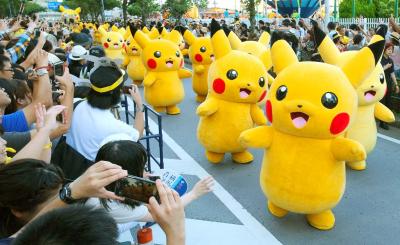
China’s military news agency yesterday warned that Japanese militarism is infiltrating society through series such as Pokemon and Detective Conan, after recent controversies involving events at sensitive sites. In recent days, anime conventions throughout China have reportedly banned participants from dressing as characters from Pokemon or Detective Conan and prohibited sales of related products. China Military Online yesterday posted an article titled “Their schemes — beware the infiltration of Japanese militarism in culture and sports.” The article referenced recent controversies around the popular anime series Pokemon, Detective Conan and My Hero Academia, saying that “the evil influence of Japanese militarism lives on in
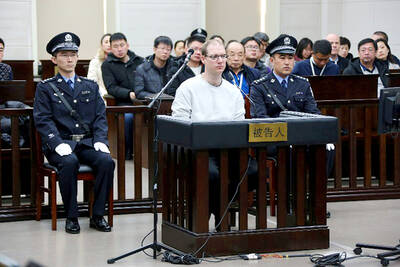
DIPLOMATIC THAW: The Canadian prime minister’s China visit and improved Beijing-Ottawa ties raised lawyer Zhang Dongshuo’s hopes for a positive outcome in the retrial China has overturned the death sentence of Canadian Robert Schellenberg, a Canadian official said on Friday, in a possible sign of a diplomatic thaw as Canadian Prime Minister Mark Carney seeks to boost trade ties with Beijing. Schellenberg’s lawyer, Zhang Dongshuo (張東碩), yesterday confirmed China’s Supreme People’s Court struck down the sentence. Schellenberg was detained on drug charges in 2014 before China-Canada ties nosedived following the 2018 arrest in Vancouver of Huawei chief financial officer Meng Wanzhou (孟晚舟). That arrest infuriated Beijing, which detained two Canadians — Michael Spavor and Michael Kovrig — on espionage charges that Ottawa condemned as retaliatory. In January

A sign hanging from a rusty ice-green shipping container installed by Thai forces on what they say is the border with Cambodia reads: “Cambodian citizens are strictly prohibited from entering this area.” On opposite sides of the makeshift barricade, fronted by coils of barbed wire, Cambodians lamented their lost homes and livelihoods as Thailand’s military showed off its gains. Thai forces took control of several patches of disputed land along the border during fighting last year, which could amount to several square kilometers in total. Cambodian Kim Ren said her house in Chouk Chey used to stand on what is now the Thai
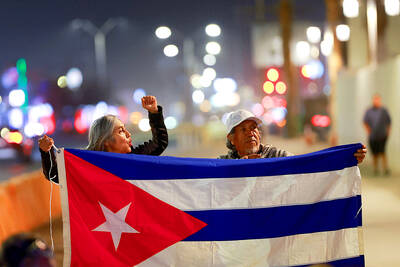
NEW RULES: There would be fewer school days, four-day workweeks, and a reduction in transportation services as the country battles a crisis exacerbated by US pressure The Cuban government on Friday announced emergency measures to address a crippling energy crisis worsened by US sanctions, including the adoption of a four-day work week for state-owned companies and fuel sale restrictions. Cuban Deputy Prime Minister Oscar Perez-Oliva Fraga blamed Washington for the crisis, telling Cuban television the government would “implement a series of decisions, first and foremost to guarantee the vitality of our country and essential services, without giving up on development.” “Fuel will be used to protect essential services for the population and indispensable economic activities,” he said. Among the new measures are the reduction of the working week in


 RSS
RSS