


Thailand’s main international airport continued to clear a backlog of stranded tourists yesterday while the abrupt return of exiled Thai prime minister Thaksin Shinawatra’s powerful ex-wife threatened to deepen the country’s political crisis.
The reopening of the airports, still partially crippled after a weeklong siege by protesters, had raised hopes the country was emerging from the chaos of the past months. However, many Thais were also following with trepidation the health of King Bhumibol Adulyadej, regarded as crucial to the country’s stability.
The palace announced on Friday night that he was suffering from an inflamed throat and fluctuating fever after he failed to give his annual birthday address.
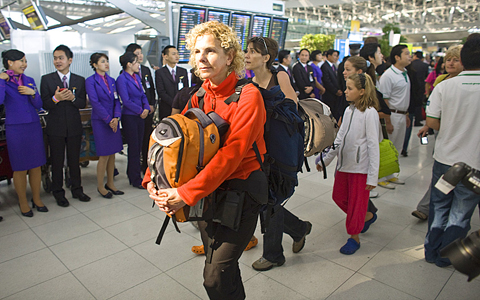
PHOTO: AP
Bangkok’s Suvarnabhumi international airport — Thailand’s main gateway to the world — officially reopened on Friday after protesters ended a weeklong siege that trapped more than 300,000 travelers. The occupation of the capital’s two airports by the People’s Alliance for Democracy (PAD) dealt a heavy blow to tourism.
The airport was operating at about 50 percent capacity on Friday, but a public relations official at the airport said yesterday that most international flights were now back on schedule.
“Flights to Asia are now operating in full gear. But there are a few airlines that are still checking their systems to ensure safety,” said the official, who demanded anonymity because she was not authorized to speak with the press.
The return to Bangkok on Friday of Thaksin’s ex-wife, Pojamarn Damapong, who faces a three-year jail term on a tax evasion conviction, added a complicating element to the political crisis. Thaksin, ousted in a 2006 military coup, remains at the epicenter of instability.
Thai media speculated Pojamarn might rally the ex-leader’s supporters following a court decision that dissolved the ruling political party made up of his allies and drove the prime minister from office.
But a spokesman for the ex-prime minister, Pongthep Thepkanchana, said Pojamarn had returned solely to visit her sick mother “not to manage the problems among factions in the party.”
A number of members of ousted Thai prime minister Somchai Wongsawat’s People Power Party have regrouped in a new party, Pheua Thai, and they retain the right to name a new prime minister within 30 days.
Local media said that the party would meet today to put forward a leader amid behind-the-scenes scurrying among several parties and factions.
Any move to reinstate Thaksin’s allies would likely set off more protests from the anti-government alliance, which charges that the party and the recently toppled government is merely a front for Thaksin.
The ousted prime minister and his ex-wife, a highly influential figure during his years in power, are hated by many of the country’s elite, who charge that they were trying to usurp royal authority. Their divorce is widely regarded as a ploy to reduce each party’s legal liability and preserve the family fortune, made in telecommunications.

ACTIONABLE ADVICE: The majority of chatbots tested provided guidance on weapons, tactics and target selections, with Perplexity and Meta AI deemed to be the least safe From school shootings to synagogue bombings, leading artificial intelligence (AI) chatbots helped researchers plot violent attacks, according to a study published on Wednesday that highlighted the technology’s potential for real-world harm. Researchers from the nonprofit watchdog Center for Countering Digital Hate and CNN posed as 13-year-old boys in the US and Ireland to test 10 chatbots, including ChatGPT, Google Gemini, Perplexity, Deepseek and Meta AI. Eight of the chatbots assisted the make-believe attackers in more than half the responses, providing advice on “locations to target” and “weapons to use” in an attack, the study said. The chatbots had become a “powerful accelerant for

Australians were downloading virtual private networks (VPNs) in droves, while one of the world’s largest porn distributors said it was blocking users from its platforms as the country yesterday rolled out sweeping online age restriction. Australia in December became the first country to impose a nationwide ban on teenagers using social media. A separate law now requires artificial intelligence (AI)-powered chatbot services to keep certain content — including pornography, extreme violence and self-harm and eating disorder material — from minors or face fines of up to A$49.5 million (US$34.6 million). The country also joined Britain, France and dozens of US states requiring

KINGPIN: Marset allegedly laundered the proceeds of his drug enterprise by purchasing and sponsoring professional soccer teams and even put himself in the starting lineups Notorious Latin American narco trafficker Sebastian Marset, who eluded police for years, was handed over to US authorities after his arrest on Friday in Bolivia. Marset, a Uruguayan national who was on the US most-wanted list, was passed to agents of the US Drug Enforcement Administration at Santa Cruz airport in Bolivia, then put on a US airplane, Bolivian state television showed. “The arrest and deportation were carried out pursuant to a court order issued by the US justice system,” Bolivian Minister of Government Marco Antonio Oviedo told reporters. The alleged kingpin was arrested in an upscale neighborhood of Santa

SCANDAL: Other images discovered earlier show Andrew bent over a female and lying across the laps of a number of women, while Mandelson is pictured in his underpants A photograph of former British prince Andrew and veteran politician Peter Mandelson sitting in bathrobes alongside late sex offender Jeffrey Epstein was unearthed on Friday in previously published documents. The image is believed to be the first known photograph of the two men with Epstein. They are currently engulfed in scandal in the UK over their ties to their mutual friend. The undated photograph, first reported by ITV News, shows King Charles III’s disgraced brother and former British ambassador to the US sitting barefoot outside on a wooden deck. They appear to have mugs with a US flag on them


 RSS
RSS