


Israel and Gaza’s Hamas rulers on Wednesday sought to contain the fallout from the worst fighting since a truce went into effect five months ago, but a flare-up later in the day threatened to unravel it anew.
Gaza militants pounded southern Israel with dozens of rockets to avenge a deadly Israeli raid. Neither side seems to have much to gain from a renewal of hostilities, and officials on both sides said they wanted to restore calm.
Late on Wednesday, however, an Israeli air strike killed one Palestinian militant in northern Gaza. The army said it was targeting a rocket launcher, which the Islamic Jihad militant group identified as its own.

PHOTO: AP
Islamic Jihad militants had earlier fired two rockets at the Israeli border town of Sderot, a favorite target. One of its leaders, Khader Habib, declared the truce over.
Hamas, which agreed to the Egyptian-mediated truce, said Israel was breaching it.
“The occupier has a clear plan to destroy the truce and drown us in blood,” Hamas spokesman Fawzi Barhoum said.
Before the June truce, near daily rocket barrages had severely disrupted life in southern border towns and Israel has not found a military solution to stop them. Retaliatory Israeli air strikes have killed scores of Palestinians in Gaza.
“We have no intention of violating the quiet,” Israeli Defense Minister Ehud Barak said on a tour of southern Israeli areas bordering Gaza. “But in any place where we need to thwart an action against Israeli soldiers and civilians, we will act.”
Hamas, on the other hand, needs the calm to strengthen its hold on Gaza, which it seized control of in June last year, and restore its military capabilities ahead of a potential future battle with Israel.
Barhoum said the group had fired deep into Israel on Wednesday to demonstrate the price of continued Israeli aggression. At the same time, he said Hamas had contacted Egyptian mediators to find ways of keeping the truce intact.
Clashes began late on Tuesday after the Israeli army burst into Gaza to destroy what it said was a tunnel being dug near the border to abduct Israeli troops. During the incursion, Hamas gunmen battled Israeli forces. One Hamas fighter was killed, prompting a wave of mortar fire at nearby Israeli targets.
An Israeli air strike then killed five Hamas militants preparing to fire mortar shells. Hamas responded with the barrage of rockets, including one that reached the city of Ashkelon, about 16km north of Gaza.
Israeli police said the rocket landed in an empty area. There were no reports of injuries or property damage. The army said four soldiers were wounded, two moderately, in the border fighting.
Thousands of Palestinian mourners rushed slain militants through the streets of the southern Gaza town of Khan Younis, waving green Hamas flags and vowing revenge.
Gaza residents crowded into hospitals, as ambulances delivered the dead and injured. Grieving militants in military fatigues fired rounds of automatic weapon fire into the air to commemorate their fallen comrades.
Over Gaza City, the thudding sound of rockets being fired into Israel was audible. Unmanned Israeli aircraft, often used to target militants, buzzed in the sky overhead.

DIPLOMATIC THAW: The Canadian prime minister’s China visit and improved Beijing-Ottawa ties raised lawyer Zhang Dongshuo’s hopes for a positive outcome in the retrial China has overturned the death sentence of Canadian Robert Schellenberg, a Canadian official said on Friday, in a possible sign of a diplomatic thaw as Canadian Prime Minister Mark Carney seeks to boost trade ties with Beijing. Schellenberg’s lawyer, Zhang Dongshuo (張東碩), yesterday confirmed China’s Supreme People’s Court struck down the sentence. Schellenberg was detained on drug charges in 2014 before China-Canada ties nosedived following the 2018 arrest in Vancouver of Huawei chief financial officer Meng Wanzhou (孟晚舟). That arrest infuriated Beijing, which detained two Canadians — Michael Spavor and Michael Kovrig — on espionage charges that Ottawa condemned as retaliatory. In January

China’s military news agency yesterday warned that Japanese militarism is infiltrating society through series such as Pokemon and Detective Conan, after recent controversies involving events at sensitive sites. In recent days, anime conventions throughout China have reportedly banned participants from dressing as characters from Pokemon or Detective Conan and prohibited sales of related products. China Military Online yesterday posted an article titled “Their schemes — beware the infiltration of Japanese militarism in culture and sports.” The article referenced recent controversies around the popular anime series Pokemon, Detective Conan and My Hero Academia, saying that “the evil influence of Japanese militarism lives on in
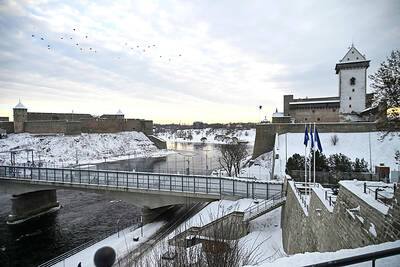
Two medieval fortresses face each other across the Narva River separating Estonia from Russia on Europe’s eastern edge. Once a symbol of cooperation, the “Friendship Bridge” connecting the two snow-covered banks has been reinforced with rows of razor wire and “dragon’s teeth” anti-tank obstacles on the Estonian side. “The name is kind of ironic,” regional border chief Eerik Purgel said. Some fear the border town of more than 50,0000 people — a mixture of Estonians, Russians and people left stateless after the fall of the Soviet Union — could be Russian President Vladimir Putin’s next target. On the Estonian side of the bridge,

Jeremiah Kithinji had never touched a computer before he finished high school. A decade later, he is teaching robotics, and even took a team of rural Kenyans to the World Robotics Olympiad in Singapore. In a classroom in Laikipia County — a sparsely populated grasslands region of northern Kenya known for its rhinos and cheetahs — pupils are busy snapping together wheels, motors and sensors to assemble a robot. Guiding them is Kithinji, 27, who runs a string of robotics clubs in the area that have taken some of his pupils far beyond the rural landscapes outside. In November, he took a team


 RSS
RSS