


The French navy has arrested nine suspected pirates and handed them over to authorities in the breakaway Somali region of Puntland, French officials said on Thursday.
French marines in the Gulf of Aden arrested the men when their patrol intercepted two boats on Wednesday in international waters about 185km off the Somali coast, Paris and local Puntland officials each said.
They found small arms and anti-tank weapons and equipment used to board ships on the vessels, said a statement from the French military in Paris. Puntland’s deputy fisheries minister Abdukadir Muse Yusuf said that “the pirates ... dropped all their weapons in the water before they were caught.” The French statement said nine suspects had been arrested, while Somali officials gave the number as eight.

PHOTO: EPA
SUSPECTS
The suspects were handed over to Somali authorities who said they would be prosecuted and would be treated according to international conventions, French officials said. France launched a rescue operation to free a French luxury yacht, Le Ponant, and its 30 crew on April 11, and last month dispatched commandos to release a French couple seized by pirates aboard their yacht.
Twelve suspected pirates are currently being held in custody by French authorities, although lawyers have argued that Paris has no jurisdiction to try their cases.
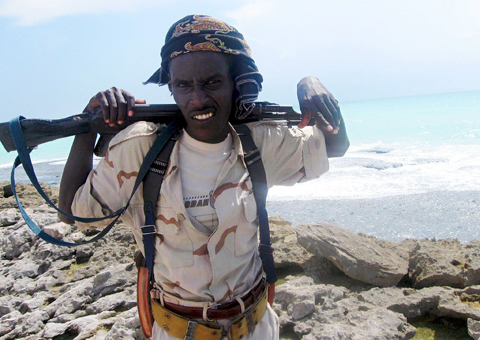
PHOTO: EPA
France’s latest military intervention — implicitly authorized by a UN Security Council resolution earlier this month — was welcomed by the authorities in Puntland, where in April a court sentenced 11 people to life imprisonment for piracy.
In a report released on Thursday, the International Maritime Bureau said 63 of the 199 piracy incidents recorded worldwide in the first nine months of this year occurred in the waters off the coast of war-ravaged Somalia.
IMB director Pottengal Mukundan said piracy in the Gulf of Aden — an important sea route for oil exports — was of particular concern.
“It is clear that pirates in the Gulf of Aden believe that they can operate with impunity in attacking vessels — some of which have included tankers and large bulk carriers,” Mukundan said.
PATROLS
Seven NATO ships including several frigates are set to start patrols off the coast of Somalia in the next few days to combat piracy and escort aid ships to the nation, an alliance spokesman said on Wednesday.
Aid agencies say at least 2.6 million people in Somalia are facing acute food shortages and warn that the figure could climb to 3.2 million by year-end.
The EU has also announced plans to send a dozen ships to the maritime region, which are intended to relieve the NATO contingent in December.
The UN Security Council on Oct. 7 urged states to commit naval and air assets to the fight against rampant piracy off lawless Somalia.
The 15-member Council unanimously adopted the French-drafted resolution under Chapter Seven of the UN Charter, which is invoked in cases of threats to international peace and security.
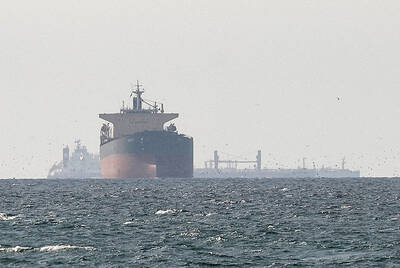
A ship that appears to be taking on the identity of a scrapped gas carrier exited the Strait of Hormuz on Friday, showing how strategies to get through the waterway are evolving as the Middle East war progresses. The vessel identifying as liquefied natural gas (LNG) carrier Jamal left the Strait on Friday morning, ship-tracking data show. However, the same tanker was also recorded as having beached at an Indian demolition yard in October last year, where it is being broken up, according to market participants and port agent’s reports. The ship claiming to be Jamal is likely a zombie vessel that
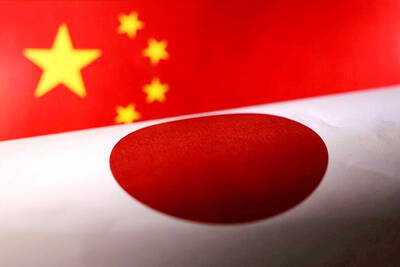
Japan is to downgrade its description of ties with China from “one of its most important” in an annual diplomatic report, according to a draft reviewed by Reuters, as relations with Beijing worsen. This year’s Diplomatic Bluebook, which Japanese Prime Minister Sanae Takaichi’s government is expected to approve next month, would instead describe China as an important neighbor and the relationship as “strategic” and “mutually beneficial.” The draft cites a series of confrontations with Beijing over the past year, including export controls on rare earths, radar lock-ons targeting Japanese military aircraft and increased pressure around Taiwan. The shift in tone underscores a deterioration

LAW CONSTRAINTS: The US has been pressing allies to send warships to open the Strait, but Tokyo’s military actions are limited under its postwar pacifist constitution Japan could consider deploying its military for minesweeping in the Strait of Hormuz if a ceasefire is reached in the war on Iran, Japanese Minister of Foreign Affairs Toshimitsu Motegi said yesterday. “If there were to be a complete ceasefire, hypothetically speaking, then things like minesweeping could come up,” Motegi said. “This is purely hypothetical, but if a ceasefire were established and naval mines were creating an obstacle, then I think that would be something to consider.” Japan’s military actions are limited under its postwar pacifist constitution, but 2015 security legislation allows Tokyo to use its Self-Defense Forces overseas if an attack,

German Chancellor Friedrich Merz’s conservative Christian Democratic Union (CDU) yesterday faced a regional election battle in Rhineland-Palatinate, now held by the center-left Social Democratic Party (SPD). Merz’s CDU has enjoyed a narrow poll lead over the SPD — their coalition partners at the national level — who have ruled the mid-sized state for 35 years. Polling third is the far-right Alternative for Germany (AfD), which spells a greater threat to the two centrist parties in several state elections in September in the country’s ex-communist east. The picturesque state of Rhineland-Palatinate, bordering France, Belgium and Luxembourg and with a population of about 4 million,


 RSS
RSS