


UN Secretary-General Ban Ki-moon said the UN would investigate allegations by a leading children's charity that UN peacekeepers are involved in widespread sexual abuse of children.
The report released on Tuesday by Save the Children UK, based on field research in southern Sudan, Ivory Coast and Haiti, describes a litany of sexual crimes committed by peacekeepers and international relief workers against children as young as six.
It said some children were denied food aid unless they granted sexual favors; others were forced to have sex or to take part in child pornography; many more were subjected to improper touching or kissing.
“The report shows sexual abuse has been widely under-reported because children are afraid to come forward,” said Jasmine Whitbread, chief executive of Save the Children UK.
“A tiny proportion of peacekeepers and aid workers are abusing the children they were sent to protect. It ranges from sex for food to coerced sex. It’s despicable,” she said.
'VERY SERIOUS ISSUE'
Calling the sexual exploitation of minors a “very serious issue,” Ban reiterated to reporters that he has a “zero tolerance” policy for such acts by UN personnel.
“I think that the report is very valuable and does give us some good points to which the United Nations should continue to address this issue,” Ban said on Tuesday. “On all these cases which have been raised, we will very carefully investigate” and will take “necessary measures” where appropriate.
Earlier, UN spokeswoman Michele Montas had welcomed the report.
“It’s fair, and I think it’s essentially accurate,” she said.
Abuses have been reported in UN peacekeeping missions ranging from Bosnia and Kosovo to East Timor, Cambodia, West Africa and Congo.
The issue was thrust into the spotlight after the UN found in early 2005 that peacekeepers in Congo had sex with Congolese women and girls, usually in exchange for food or small sums of money.
Several month later, Jordan’s then-UN ambassador, Prince Zeid al Hussein, wrote a report that described the UN military arm as deeply flawed and recommended withholding salaries of the guilty and requiring nations to pursue legal action against perpetrators.
POLICY
In response, the UN adopted a “zero tolerance” policy toward sexual exploitation and abuse and a universal code of conduct that requires training for all peacekeepers, but punishment for wrongdoers is left to individual countries.
Montas said the report stated the UN had already undertaken steps designed to tackle the problem, from establishing conduct and discipline units in all UN missions to strengthening training for all categories of UN personnel. She said the UN also needs to strengthen its investigative capacity.
The study was based on research, confidential interviews and focus groups conducted last year. The charity emphasized it did not produce comprehensive statistics about the scale of abuse, but did gather enough information to indicate the problem is severe.
The report said that more than half the children interviewed knew of cases of sexual abuse and that in many instances children knew of 10 or more such incidents carried out by aid workers or peacekeepers.
The Save the Children UK researchers met with 129 girls and 121 boys between the ages of 10 and 17, and also with a number of adults.

Australians were downloading virtual private networks (VPNs) in droves, while one of the world’s largest porn distributors said it was blocking users from its platforms as the country yesterday rolled out sweeping online age restriction. Australia in December became the first country to impose a nationwide ban on teenagers using social media. A separate law now requires artificial intelligence (AI)-powered chatbot services to keep certain content — including pornography, extreme violence and self-harm and eating disorder material — from minors or face fines of up to A$49.5 million (US$34.6 million). The country also joined Britain, France and dozens of US states requiring
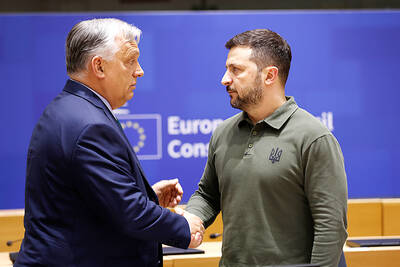
Hungarian authorities temporarily detained seven Ukrainian citizens and seized two armored cars carrying tens of millions of euros in cash across Hungary on suspicion of money laundering, officials said on Friday. The Ukrainians were released on Friday, following their detention on Thursday, but Hungarian officials held onto the cash, prompting Ukraine to accuse Hungary’s Russia-friendly government of illegally seizing the money. “We will not tolerate this state banditism,” Ukrainian Minister of Foreign Affairs Andrii Sybiha said. The seven detained Ukrainians were employees of the Ukrainian state-owned Oschadbank, who were traveling in the two armored cars that were carrying the money between Austria and
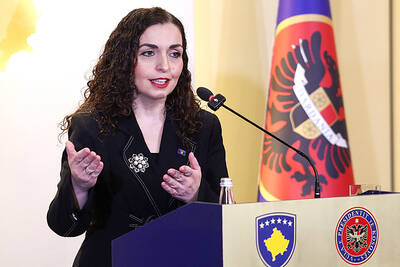
Kosovar President Vjosa Osmani on Friday after dissolving the Kosovar parliament said a snap election should be held as soon as possible to avoid another prolonged political crisis in the Balkan country at a time of global turmoil. Osmani said it is important for Kosovo to wrap up the upcoming election process and form functional institutions for political stability as the war rages in the Middle East. “Precisely because the geopolitical situation is that complex, it is important to finish this electoral process which is coming up,” she said. “It is very hard now to imagine what will happen next.” Kosovo, which declared

ACTIONABLE ADVICE: The majority of chatbots tested provided guidance on weapons, tactics and target selections, with Perplexity and Meta AI deemed to be the least safe From school shootings to synagogue bombings, leading artificial intelligence (AI) chatbots helped researchers plot violent attacks, according to a study published on Wednesday that highlighted the technology’s potential for real-world harm. Researchers from the nonprofit watchdog Center for Countering Digital Hate and CNN posed as 13-year-old boys in the US and Ireland to test 10 chatbots, including ChatGPT, Google Gemini, Perplexity, Deepseek and Meta AI. Eight of the chatbots assisted the make-believe attackers in more than half the responses, providing advice on “locations to target” and “weapons to use” in an attack, the study said. The chatbots had become a “powerful accelerant for


 RSS
RSS