


On the list of famous Serbs, there are soccer stars, tennis champions and notorious politicians. And then there's Vesna Vulovic.
Vulovic was a 22-year-old stewardess aboard a Yugoslav Airlines flight in 1972 when a bomb blew the plane to bits high above the snowy mountain ranges of Czechoslovakia.
Trapped in the plane's tail cone, she plummeted 10,000m to earth in temperatures of minus 60?C and landed on a steep heavily wooded slope near the village of Srbska Kamenice.
Amazingly, she survived.
An instant national heroine, she went on to put her celebrity at the service of political causes, protesting strongman Slobodan Milosevic's rule in the 1990s and most recently campaigning for liberal forces in upcoming elections.
The May ballot promises to determine whether Serbia moves forward in its bid to join the EU or sinks deeper into isolation as it defies international pressure to accept Kosovo's independence.
"I struggled against Milosevic's regime in the 1990s because I didn't want Serbia to be a pariah state, and I'll do the same this time because I want us to be part of the normal world," she said.
Vulovic's fame spread beyond Serb borders.
In 1985, she was inducted into the Guinness Book of Records for "the highest fall survived without a parachute."
Vulovic, 58, is even said to be a possible inspiration for the opening scene of Salman Rushdie's novel The Satanic Verses, which describes the two protagonists surviving a high-altitude fall from an airliner blown up by terrorists.
"She is one of the most famous Yugoslavs ever," said Cedomir Janjic, former head of the Yugoslav Air Force Museum. "She's certainly the luckiest."
On that fateful January day, Vulovic tumbled through pine branches and into a thick coating of snow, softening the impact and cushioning her descent down the hill.
All 27 of the other passengers and crew aboard the Douglas DC-9 aircraft perished after the blast detached the cockpit from the fuselage.
The front section, which was found 7km from the main wreckage, contained the bodies of the two pilots who had donned oxygen masks and tried to fly the plane after the explosion -- possibly unaware that nothing remained behind their cockpit door.
Croatian nationalists were blamed for planting the explosives during a scheduled stopover in Copenhagen, Denmark, but no arrests were ever made.
Villagers said they saw a flash in the sky and heard the sound of bodies falling to the ground "like sacks."
Vulovic was rescued by a woodsman who followed her screaming voice in the dark forest. She was rushed to a hospital, where she fell into a deep coma that lasted for 10 days. In all, she fractured her skull, crushed two vertebrae and broke her pelvis, several ribs and both legs.
Paralyzed from the waist down, Vulovic eventually recovered and even returned to work for the airline in a desk job. She now walks with a slight limp.
But she has never regained memory of the accident or her rescue and could only recall greeting arriving passengers before takeoff from the airport in Copenhagen, Denmark -- and then waking up in hospital with her mother at her side.
During the Milosevic regime, she braved repeated attacks by the riot police after she joined the opposition Democratic Party.
As part of a reformist coalition, the Democrats won elections in 2000, forcing Milosevic from power. She's still an activist of the Democratic Party, but holds no political posts.
"I thought I was done with politics, but the choice now is too stark," Vulovic said. "I don't assume [I] will make a huge difference, but every little bit will help."
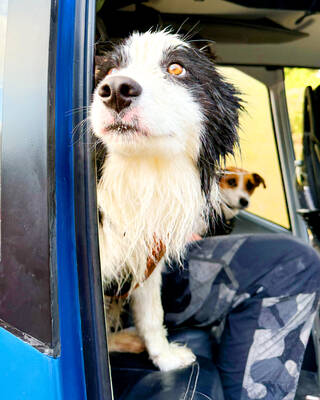
When a hiker fell from a 55m waterfall in wild New Zealand bush, rescuers were forced to evacuate the badly hurt woman without her dog, which could not be found. After strangers raised thousands of dollars for a search, border collie Molly was flown to safety by a helicopter pilot who was determined to reunite the pet and the owner. A week earlier, an emergency rescue helicopter found the woman with bruises and lacerations after a fall at a rocky spot at the waterfall on the South Island’s West Coast. She was airlifted on March 24, but they were forced to
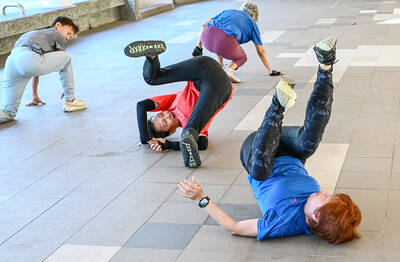
CONFIDENCE BOOSTER: ’After parkour ... you dare to do a lot of things that you think only young people can do,’ a 67-year-old parkour enthusiast said In a corner of suburban Singapore, Betty Boon vaults a guardrail, crawls underneath a slide, executes forward shoulder rolls and scales a steep slope, finishing the course to applause. “Good job,” the 69-year-old’s coach cheers. This is “geriatric parkour,” where about 20 retirees learned to tackle a series of relatively demanding exercises, building their agility and enjoying a sense of camaraderie. Boon, an upbeat grandmother, said learning parkour has aided her confidence and independence as she ages. “When you’re weak, you will be dependent on someone,” she said after sweating it out with her parkour classmates in suburban Toa Payoh,
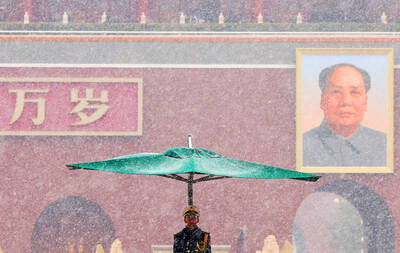
Chinese dissident artist Gao Zhen (高兟), famous for making provocative satirical sculptures of former Chinese leader Mao Zedong (毛澤東), was tried on Monday over accusations of “defaming national heroes and martyrs,” his wife and a rights group said. Gao, 69, who was detained in 2024 during a visit from the US, faces a maximum three-year prison sentence, said his wife, Zhao Yaliang (趙雅良), and Shane Yi, a researcher at the Chinese Human Rights Defenders group which operates outside the nation. The closed-door, one-day trial took place at Sanhe City People’s Court in Hebei Province neighboring the capital, Beijing, and ended without a
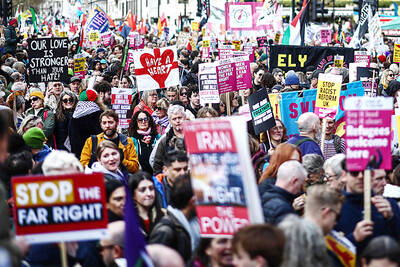
‘TOXIC CLIMATE’: ‘I don’t really recognize Labour anymore... The idea that you can implement far-right ideas in order to stop the far right is nonsense,’ a protester said Tens of thousands of people on Saturday marched through central London to protest against the far right, weeks ahead of local elections and six months after Britain saw one of its largest far-right demonstrations. Organized by hundreds of civic groups, including trade unions, anti-racism campaigners and Muslim representative bodies, Saturday’s Together Alliance event was billed as the biggest in UK history to counter right-wing extremism. A separate pro-Palestinian march had also converged with the main rally. While organizers claimed 500,000 had turned out in total, the police gave a figure of about 50,000. Protesters carrying placards with slogans such as


 RSS
RSS