


Palestinian President Mahmoud Abbas said on Wednesday he would call early elections, harshly denouncing the Islamic Hamas for its Gaza takeover, declaring, "even the devil cannot match their lies."
In a speech on Wednesday, Abbas asked the Palestine Central Council, a Palestinian Liberation Organization decision-making body, to endorse his call for elections that aides said would be designed to freeze Hamas out of the political arena.
Abbas' aides said they expected the election by the end of the year or early nexy year. His announcement came as the US and other international mediators were moving swiftly to try to revive Mideast peace efforts.
Abbas denounced Hamas in the harshest terms in his speech, blaming the Islamist militants for staging "a coup" against him in Gaza and for provoking Israel and Egypt to seal Gaza's borders.
Hamas is "committing capital crimes, bloody crimes against our people every day, every minute, every hour," he fumed. "There will be no dialogue until they return Gaza to what it was before."
"Even the devil cannot match their lies," he said.
In five days of bloody fighting last month, Hamas crushed Fatah gunmen and the presidential security force in Gaza.
Abbas retaliated by dismissing the Hamas-led coalition government formed with Fatah after last year's elections, and created a caretaker government of technocrats and moderates that governs the West Bank but holds little sway in Gaza.
"We will call on the council to decide on early elections," he said. "We won't exclude anybody from having their say in a democratic way."
In Gaza, Hamas spokesman Sami Abu Zuhri said neither Abbas nor the council was empowered to call elections.
"It is not legitimate to issue such a recommendation," he said. "This council has expired and has no mandate and no authority."
In Jerusalem, the EU foreign policy chief, Javier Solana, said the proposed elections did not come up in his talks with Abbas.
Solana was on a last trip to the region before a meeting yesterday in Portugal between the EU, UN US and Russia - the "Quartet" of Mideast peacemakers - with their newly appointed emissary, former British prime minister Tony Blair. The meeting was to follow up on US President George W. Bush's call this week for a peace conference in the autumn.
Abbas said the conference, to be chaired by US Secretary of State Condoleezza Rice, should address the core issues of Israel's borders, Palestinian refugees and the status of Jerusalem.
"We have to be ready to establish a Palestinian state when it comes," he said.
Israel has welcomed the movement to revive peace efforts that stalled in 2000, but has been reluctant to deal with the conflict's toughest issues as long as violence continues and Hamas - which rejects Israel's legitimacy as a nation - remains a political factor.
Palestinian officials said Abbas wanted to hold elections before Israel releases Hamas legislators it has arrested, pre-empting the possibility that they could return to parliament and vote the caretaker government from power.
Israel is unlikely to release the legislators except as part of a prisoner exchange for three captured Israeli soldiers, one held in Gaza and two held by the Hezbollah militia in Lebanon.
To further enhance Fatah's election chances, Abbas announced he would change the electoral system, eliminating regional balloting.
Last year, Fatah candidates fought each other in several constituencies, allowing Hamas to win those seats and contributing to Fatah's unprecedented rout.
Instead, Palestinians will vote for parties, and parliament seats would be apportioned according to the percentage of votes each party received.
Though Abbas said the elections will be open to all Palestinians, Hamas said it would oppose the balloting, and it was hard to see how they could be conducted in Gaza.
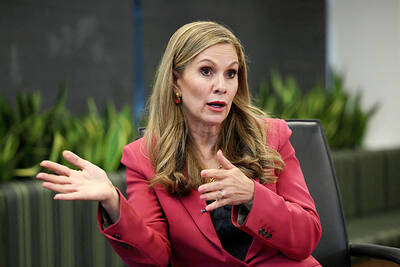
Australians were downloading virtual private networks (VPNs) in droves, while one of the world’s largest porn distributors said it was blocking users from its platforms as the country yesterday rolled out sweeping online age restriction. Australia in December became the first country to impose a nationwide ban on teenagers using social media. A separate law now requires artificial intelligence (AI)-powered chatbot services to keep certain content — including pornography, extreme violence and self-harm and eating disorder material — from minors or face fines of up to A$49.5 million (US$34.6 million). The country also joined Britain, France and dozens of US states requiring
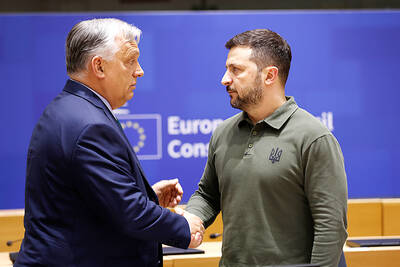
Hungarian authorities temporarily detained seven Ukrainian citizens and seized two armored cars carrying tens of millions of euros in cash across Hungary on suspicion of money laundering, officials said on Friday. The Ukrainians were released on Friday, following their detention on Thursday, but Hungarian officials held onto the cash, prompting Ukraine to accuse Hungary’s Russia-friendly government of illegally seizing the money. “We will not tolerate this state banditism,” Ukrainian Minister of Foreign Affairs Andrii Sybiha said. The seven detained Ukrainians were employees of the Ukrainian state-owned Oschadbank, who were traveling in the two armored cars that were carrying the money between Austria and
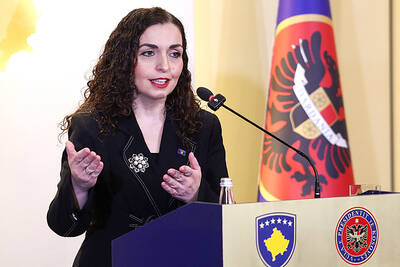
Kosovar President Vjosa Osmani on Friday after dissolving the Kosovar parliament said a snap election should be held as soon as possible to avoid another prolonged political crisis in the Balkan country at a time of global turmoil. Osmani said it is important for Kosovo to wrap up the upcoming election process and form functional institutions for political stability as the war rages in the Middle East. “Precisely because the geopolitical situation is that complex, it is important to finish this electoral process which is coming up,” she said. “It is very hard now to imagine what will happen next.” Kosovo, which declared

MORE BANS: Australia last year required sites to remove accounts held by under-16s, with a few countries pushing for similar action at an EU level and India considering its own ban Indonesia on Friday said it would ban social media access for children under 16, citing threats from online pornography, cyberbullying, online fraud and Internet addiction. “Accounts belonging to children under 16 on high-risk platforms will start to be deactivated, beginning with YouTube, TikTok, Facebook, Instagram, Threads, X, Bigo Live and Roblox,” Indonesian Minister of Communications and Digital Meutya Hafid said. “The government is stepping in so that parents no longer have to fight alone against the giants of the algorithm. Implementation will begin on March 28, 2026,” she said. The social media ban would be introduced in stages “until all platforms fulfill their


 RSS
RSS