


Prince Charles' tour of Northern California organic farms this weekend revealed something that stalwarts of the all-natural movement already knew: His Royal Highness is a green giant.
So no surprise that Marin County -- a gorgeous swathe of undulating green just north of San Francisco that is a hub of organic farming -- buzzed with talk of cabbages and kings in the days leading up to the visit by Charles and Camilla.
"We're excited because it takes our message into the world," said Helge Hellberg, executive director of the farming association Marin Organic. "It's not just royalty or a celebrity coming, it's somebody who stands for what we are doing."
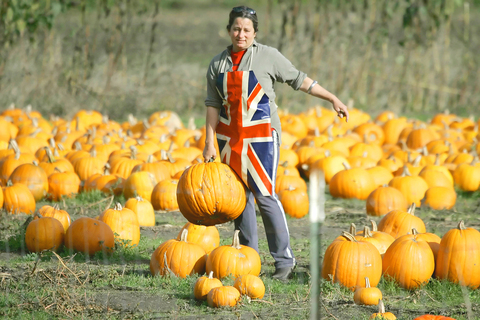
PHOTO: AP
It might be news to many in the US that Prince Charles was organic when organic most definitely wasn't cool.
He has long supported growing food without synthetic chemicals and has his own food company, Duchy Originals, which sells organic produce and other products supporting sustainable farming. The profits of the company go to charity.
For farmers who have toiled for decades to push their way onto supermarket shelves and into the general consciousness, Charles' trip to their verdant fields was a huge boost.
"As a society, we have become completely disconnected from where our food comes from," said Hellberg, who described the royal visit as a "great opportunity."
"Prince Charles acknowledges and understands and embraces sustainable agriculture," he said.
Marin County is in the vanguard of organic operations. All vegetables grown in the county are certified organic, with sales amounting to about US$5 million annually, Hellberg said.
Statewide, there about 2,000 registered organic farms, said Jake Lewin, marketing director of California Certified Organic Farmers (CCOF), where membership has been "growing quite rapidly." CCOF certifies Charles' Duchy Originals products imported to the US as organic and Lewin can vouch personally for the shortbread cookies. "They're scrumptious."
Saturday's tale of the prince and the produce began at the farmer's market in the town of Point Reyes. Then it was off to Bolinas, a small coastal community about 48km north of San Francisco. The royal couple lunched at Star Route Farms run by organic pioneer Warren Weber, who according to the Marin Organic Web site, began the operation in 1974, farming 2 hectares with a horse-drawn plow.
Around 50 people lined up outside Weber's farm to greet the prince, some waiting hours for a quick glimpse of them as they swept by.
Among those who came to catch a glimpse of the royalty was Mary Barror who brought with her a handmade sign that read "Welcome to organic Bolinas."
"I woke up one morning and thought, `I want to do something,"' she said. "And this little voice said, `Make a sign of welcome.'"
Spectators got a thrill later when the royals emerged from the farm and shook some hands in the crowd before leaving.

When a hiker fell from a 55m waterfall in wild New Zealand bush, rescuers were forced to evacuate the badly hurt woman without her dog, which could not be found. After strangers raised thousands of dollars for a search, border collie Molly was flown to safety by a helicopter pilot who was determined to reunite the pet and the owner. A week earlier, an emergency rescue helicopter found the woman with bruises and lacerations after a fall at a rocky spot at the waterfall on the South Island’s West Coast. She was airlifted on March 24, but they were forced to

CONFIDENCE BOOSTER: ’After parkour ... you dare to do a lot of things that you think only young people can do,’ a 67-year-old parkour enthusiast said In a corner of suburban Singapore, Betty Boon vaults a guardrail, crawls underneath a slide, executes forward shoulder rolls and scales a steep slope, finishing the course to applause. “Good job,” the 69-year-old’s coach cheers. This is “geriatric parkour,” where about 20 retirees learned to tackle a series of relatively demanding exercises, building their agility and enjoying a sense of camaraderie. Boon, an upbeat grandmother, said learning parkour has aided her confidence and independence as she ages. “When you’re weak, you will be dependent on someone,” she said after sweating it out with her parkour classmates in suburban Toa Payoh,

HIGH HOPES: The power source is expected to have a future, as it is not dependent on the weather or light, and could be useful for places with large desalination facilities A Japanese water plant is harnessing the natural process of osmosis to generate renewable energy that could one day become a common power source. The possibility of generating power from osmosis — when water molecules pass from a less salty solution to a more salty one — has long been known. However, actually generating energy from that has proved more complicated, in part due the difficulty of designing the membrane through which the molecules pass. Engineers in Fukuoka, Japan, and their private partners think they might have cracked it, and have opened what is only the world’s second osmotic power plant. It generates

Chinese dissident artist Gao Zhen (高兟), famous for making provocative satirical sculptures of former Chinese leader Mao Zedong (毛澤東), was tried on Monday over accusations of “defaming national heroes and martyrs,” his wife and a rights group said. Gao, 69, who was detained in 2024 during a visit from the US, faces a maximum three-year prison sentence, said his wife, Zhao Yaliang (趙雅良), and Shane Yi, a researcher at the Chinese Human Rights Defenders group which operates outside the nation. The closed-door, one-day trial took place at Sanhe City People’s Court in Hebei Province neighboring the capital, Beijing, and ended without a


 RSS
RSS