


Six US soldiers died in roadside bombings and a shooting, the military said yesterday, as lawmakers tried to persuade Sunni Arabs to accept federalism provisions in the draft constitution that is due today.
Three of the soldiers were killed in a roadside bombing late Friday near Tuz Khormato, 150km north of Baghdad, the military said. Another soldier was wounded in the blast and evacuated from the site.
One soldier on a patrol was killed yesterday and three others wounded in a blast east of Rutbah, 400km west of Baghdad, the military said. In another roadside bombing, one soldier was killed Saturday and another wounded in western Baghdad.
On Friday a US commander said the number of roadside bomb attacks against US convoys in Iraq had doubled in the past year to about 30 per week. Dozens of bombings, usually detonated by remote control, target US and Iraqi patrols each day.
The military said in a brief statement from Baghdad that one soldier was found dead Friday of a gunshot wound. The military said an investigation was underway and did not say where the soldier was found or if an attack was suspected in the soldier's death.
In the capital, a senior Iraqi Central Bank official, Haseeb Kadum, was kidnapped yesterday outside his home, police 1st Lieutenant Thaer Mahmoud said. The beheaded body of an unidentified woman was found in the violent southern neighborhood of Dora, Mahmoud added.
In northeast Baghdad, four police officers on a patrol were wounded by a roadside bombing late Saturday, police Captain Nabil Abdul Qadir said. Another bomb along a highway killed one civilian yesterday and injured another in Mahmoudiya, about 30km south of Baghdad, police Captain Saad al-Samaraei said.
Police also said two women were injured early yesterday when a mortar fell at the Noor Hospital in northwest Baghdad.
The violence came one day after US and UN diplomats stepped up pressure on Sunni Arabs to accept a new constitution that is due to be presented to parliament today. A top Sunni official said his group would never accept terms that they fear would lead to the division of the country.
Sunni Arabs were to meet yesterday with members of former Prime Minister Ayad Allawi's secular party and the Shiites would confer with Kurds, Iraqi officials said, adding that US Ambassador Zalmay Khalilzad was expected to attend both sessions.
A parliament session scheduled for yesterday was postponed because many legislators were working on the constitution, said Aref Tayfour, the deputy speaker of the assembly.
President Jalal Talabani predicted Saturday that a draft constitution would be ready by the deadline, and a Kurdish official said the draft would be presented to parliament with or without Sunni approval. Sunni leaders said they would not bow to pressure.
"We will not be subdued and will continue to cling to our stance," Sunni negotiator Kamal Hamdoun said Saturday. "We don't accept federalism ... We don't want federalism. We are confident that federalism means division and federalism cannot be approved at this time."
Mahmoud Othman, a Kurdish parliamentarian and member of the committee drafting the constitution, said the Shiites and Kurds had reached a number of agreements and were working to persuade the Sunnis to join them.
Othman cautioned Saturday that "if the Sunnis refuse to accept the agreements, we will present the draft as it is to the National Assembly."
Hamdoun, the Sunni leader, said his group did not consider themselves bound by an agreements worked out between the Shiites and Kurds. He said the Sunni Arabs were under "Iraqi and non-Iraqi pressure" but "we are not affected by pressure."
That strategy could backfire, however, in the Oct. 15 referendum when voters will be asked to ratify the constitution. According to the country's interim charter, the constitution will be void if it is rejected by two-thirds of voters in three of the 18 provinces. Sunni Arabs are a majority in four.
The US considers the charter a key part of the process to curb a Sunni-dominated insurgency. In his weekly radio address, US President George W. Bush said that the Iraqi constitution "is a critical step on the path to Iraqi self-reliance."
Talabani told reporters that negotiations were concentrating on the federalism question and the role of Islam in the government.
"We have gone forward," Talabani said Saturday. "There is a meeting today and another meeting tomorrow and God willing we will finish the job tomorrow."
Negotiations were thrown into a tailspin Thursday when the leader of the biggest Shiite party, Abdul-Aziz al-Hakim, called for a Shiite autonomous government in central and southern Iraq, including the southern oil fields. The demand was immediately rejected by Sunni Arab delegates.

Kouri Richins, a Utah mother who published a children’s book about grief after the death of her husband is to serve a life sentence for his murder without the possibility of parole, a judge ruled on Wednesday. Richins was convicted in March of aggravated murder for lacing a cocktail given to her husband, Eric Richins, with five times the lethal dose of fentanyl at their home near Park City in 2022. A jury also found her guilty of four other felonies, including insurance fraud, forgery and attempted murder for trying to poison her husband weeks earlier on Feb. 14, 2022, with a
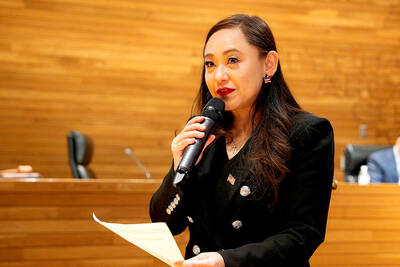
‘PERSONAL MISTAKES’: Eileen Wang has agreed to plead guilty to the felony, which comes with a maximum sentence of 10 years in federal prison A southern California mayor has agreed to plead guilty to acting as an illegal agent for the Chinese government and has resigned from her city position, officials said on Monday. Eileen Wang (王愛琳), mayor of Arcadia, was charged last month with one count of acting in the US as an illegal agent of a foreign government. She was accused of doing the bidding of Chinese officials, such as sharing articles favorable to Beijing, without prior notification to the US government as required by law. The 58-year-old was elected in November 2022 to a five-person city council, from which the mayor is selected
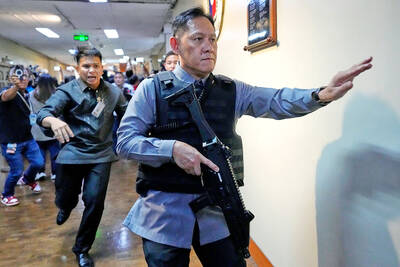
DELA ROSA CASE: The whereabouts of the senator, who is wanted by the ICC, was unclear, while President Marcos faces a political test over the senate situation Philippine authorities yesterday were seeking confirmation of reports that a top politician wanted by the International Criminal Court (ICC) had fled, a day after gunfire rang out at the Philippine Senate where he had taken refuge fearing his arrest. Senator Ronald “Bato” dela Rosa, the former national police chief and top enforcer of former Philippine president Rodrigo Duterte’s “war on drugs,” has been under Senate protection and is wanted for crimes against humanity, the same charges Duterte is accused of. “Several sources confirmed that the senator, Senator Bato, is no longer in the Senate premises, but we are still getting confirmation,” Presidential
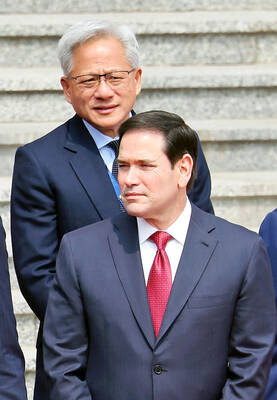
HELP DENIED? The US Department of State said that the Cuban leadership refuses to allow the US to provide aid to Cubans, ‘who are in desperate need of assistance’ US Secretary of State Marco Rubio on Wednesday said that Cuba’s leadership must change, as Washington renewed an offer of US$100 million in aid if the communist nation agrees to cooperate. Cuba has been suffering severe economic tumult led by an energy shortage that plunged 65 percent of the country into darkness on Tuesday. Cuba’s leaders have blamed US sanctions, but Rubio, a Cuban American and critic of the government established by Fidel Castro, said the system was to blame, including corruption by the military. “It’s a broken, nonfunctional economy, and it’s impossible to change it. I wish it were different,” he told


 RSS
RSS