


Sabawi Ibrahim Hasan, a half brother of Saddam Hussein and one of the remaining fugitives on the US list of most-wanted Iraqis, has been captured, officials in the prime minister's office said yesterday.
Officials in interim Prime Minister Ayad Allawi's office, speaking on condition of anonymity, confirmed the capture but gave no details on where it took place or when. It was also not immediately known whether Iraqi forces or US troops had detained Hasan.
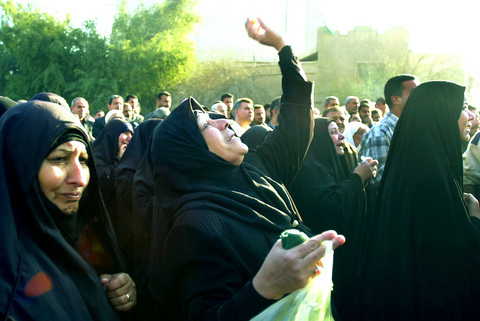
PHOTO: AP
Hasan is No. 36 on the list of 55 most-wanted Iraqis released by US authorities after US troops invaded Iraq in March 2003.
According to the US Central Command, only 12 of those 55 most-wanted remain at large. With Hasan's capture, the count would be 11 still at large.
According to the US Central Command, Hasan is also among the 29 most-wanted supporters of insurgent groups in Iraq. The US has put a US$1 million bounty on his head, and he is believed to be a financier of insurgents.
Under Saddam, Hasan served as head of intelligence and security before taking up his last post of presidential adviser in the former regime.
He is also known as Sabawi Ibrahim al-Hasan al-Tikriti, aka Thafir Alsemak.
Saddam's two other half brothers, Barzan and Watban, were captured in April 2003 and are expected to stand trial along with Saddam at the Iraqi Special Tribunal. Both appeared before the special court in Baghdad with Saddam and a handful of others to hear preliminary accusations against them.
Violence continued around the country.
In northern Iraq, major oil fire raged after insurgents blew up a pipeline, while the family of an anchorwoman for a US-funded state television station -- a mother of four who was repeatedly shot in the head -- found her body dumped on a street in the city of Mosul.
Around Baghdad, insurgents killed two civilians in a roadside bombing to the west of the city. To the southwest of the capital, a suicide car bomber killed an Iraqi national guardsman and injured seven people. The US military, meanwhile, announced the death on Saturday of a US Marine during military operations in Babil, just south of Baghdad.
Earlier, the military had announced the death of a soldier killed on Friday in a massive security sweep in the Sunni Triangle.
As part of the offensive, residents in Ramadi, the Sunni-dominated city 112km west of Baghdad, reported clashes between insurgents and US forces, but the military provided no details. US troops have been conducting an offensive in the region for nearly a week.
The US military said an insurgent was killed and another was injured trying to build a bomb in an abandoned house in Tikrit, Saddam Hussein's hometown and the site of a Thursday suicide bombing that killed 15 Iraqi police.
The body of Raiedah Mohammed Wageh Wazan, the 35-year-old news presenter for the US-funded Nineveh TV, was found dumped along a Mosul street, six days after she was kidnapped by masked gunmen, according to her husband, who said she had been shot four times in the head.
"This is a criminal act. She was an innocent woman who did not hurt anybody in all her life. I asked her several times to quit for the sake of her safety, but she refused," said Salim Saad-Allah, the husband.
The mother of three boys and a girl had been threatened with death several times by insurgents who demanded she quit her job, Saad-Allah said. The US military confirmed insurgents had threatened station employees.
It was unclear what prompted the kidnapping, but Nineveh TV was attacked last week with mortar rounds that wounded three technicians. An Arabic-language Internet bulletin board recently carried a statement from al-Qaeda In Iraq claiming responsibility for the mortar strike.
Attackers hit the oil pipeline late on Friday, setting fire to the line running about 32km from fields in Dibis to the Kirkuk, which is 240km north of Baghdad. As the line continued to blaze on Saturday night, an official with the state-run North Oil Co said it would take at least four days to repair the line.
Insurgents have regularly targeted Iraq's oil infrastructure, cutting exports and denying the country funds badly needed for reconstruction. Three pipelines were been blown up last week.
Acts of sabotage have blocked exports to Turkey's Mediterranean port of Ceyhan, a major outlet for Iraqi crude, for nearly two weeks.
Political activity moved apace on Saturday as Shiite political dissenters switched course and rallied behind the prime minister candidacy of conservative Islamic Dawa party leader Ibrahim al-Jaafari. The change of heart apparently was linked to Friday's endorsement of al-Jaafari by Iranian-born Grand Ayatollah Ali al-Sistani, the country's most powerful Shiite cleric.

Australians were downloading virtual private networks (VPNs) in droves, while one of the world’s largest porn distributors said it was blocking users from its platforms as the country yesterday rolled out sweeping online age restriction. Australia in December became the first country to impose a nationwide ban on teenagers using social media. A separate law now requires artificial intelligence (AI)-powered chatbot services to keep certain content — including pornography, extreme violence and self-harm and eating disorder material — from minors or face fines of up to A$49.5 million (US$34.6 million). The country also joined Britain, France and dozens of US states requiring
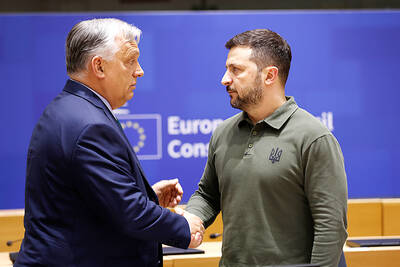
Hungarian authorities temporarily detained seven Ukrainian citizens and seized two armored cars carrying tens of millions of euros in cash across Hungary on suspicion of money laundering, officials said on Friday. The Ukrainians were released on Friday, following their detention on Thursday, but Hungarian officials held onto the cash, prompting Ukraine to accuse Hungary’s Russia-friendly government of illegally seizing the money. “We will not tolerate this state banditism,” Ukrainian Minister of Foreign Affairs Andrii Sybiha said. The seven detained Ukrainians were employees of the Ukrainian state-owned Oschadbank, who were traveling in the two armored cars that were carrying the money between Austria and
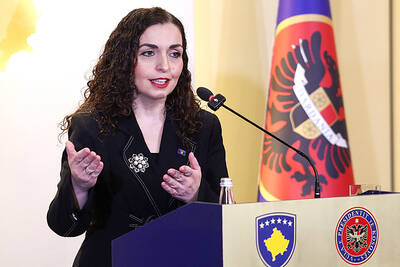
Kosovar President Vjosa Osmani on Friday after dissolving the Kosovar parliament said a snap election should be held as soon as possible to avoid another prolonged political crisis in the Balkan country at a time of global turmoil. Osmani said it is important for Kosovo to wrap up the upcoming election process and form functional institutions for political stability as the war rages in the Middle East. “Precisely because the geopolitical situation is that complex, it is important to finish this electoral process which is coming up,” she said. “It is very hard now to imagine what will happen next.” Kosovo, which declared

MORE BANS: Australia last year required sites to remove accounts held by under-16s, with a few countries pushing for similar action at an EU level and India considering its own ban Indonesia on Friday said it would ban social media access for children under 16, citing threats from online pornography, cyberbullying, online fraud and Internet addiction. “Accounts belonging to children under 16 on high-risk platforms will start to be deactivated, beginning with YouTube, TikTok, Facebook, Instagram, Threads, X, Bigo Live and Roblox,” Indonesian Minister of Communications and Digital Meutya Hafid said. “The government is stepping in so that parents no longer have to fight alone against the giants of the algorithm. Implementation will begin on March 28, 2026,” she said. The social media ban would be introduced in stages “until all platforms fulfill their


 RSS
RSS