


North Korea's claim that a huge and mysterious explosion was caused by a civil engineering project might be true, South Korea's intelligence agency said yesterday.
The National Intelligence Service (NIS) told the National Assembly that last week's explosion, which reportedly kicked up a huge mushroom cloud, could be earth-removing work to build a dam.
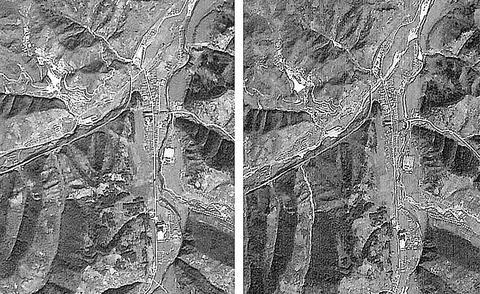
PHOTO: AP
Pyongyang said the blast was a controlled explosion to prepare for construction of a hydro-electric project in Kimhyungjik county in Ryanggang Province.
"There might have been a blast to build a hydro-electric power dam near Kimhyungjik county or there might have been natural clouds with a peculiar [mushroom-like] shape," NIS said.
"We will continue checking on the incident," Yonhap news agency quoted NIS as telling the assembly's intelligence committee.
The state-financed Korea Aerospace Research Institute released satellite pictures of the scene but these were too unclear to give any clues about the cause of the blast, which sparked initial fears of a nuclear test.
A Unification Ministry official said the images taken by South Korea's Arirang No.1 satellite were of low resolution.
"We need some high-resolution images," he said.
No abnormal radiation levels have been detected in the region, but questions remain.
"Why energy-stricken North Korea would conduct a project at night cannot be understood," an editorial in Chosun Ilbo said Tuesday. "Why it took place when the whole nation were supposed to have a day of rest remains a question."
The area where the explosion took place is North Korea's main center for launching ballistic missiles, Im Young Sun, a North Korean defector who has visited the area, said on Tuesday.
He theorized that on the night of Sept. 8, a missile launching was being prepared to celebrate the nation's 56th birthday. The explosion of liquid nitrogen fuel could have happened when the missile was being fueled on a launching pad.
In other developments, the North is waiting out the US presidential election in order to bargain with the winner over its nuclear weapons program, according to a British diplomat who left Pyong-yang on Tuesday.
"The North Koreans were saying they were still committed to the six-party talks process, but weren't prepared to commit to a date," Foreign Office minister Bill Rammell told reporters at the Beijing airport on Tuesday.
At the last round of six-party talks on the North's nuclear crisis, the countries agreed to hold the next round by Sept. 30.
One factor "is the timing of the American presidential election," Rammell said. "I made clear to them my view that whoever wins the presidential election -- whether it's President Bush or Senator Kerry -- North Korea will be faced with broadly the same strategic policy from the United States, and this isn't just about the United States."

ACTIONABLE ADVICE: The majority of chatbots tested provided guidance on weapons, tactics and target selections, with Perplexity and Meta AI deemed to be the least safe From school shootings to synagogue bombings, leading artificial intelligence (AI) chatbots helped researchers plot violent attacks, according to a study published on Wednesday that highlighted the technology’s potential for real-world harm. Researchers from the nonprofit watchdog Center for Countering Digital Hate and CNN posed as 13-year-old boys in the US and Ireland to test 10 chatbots, including ChatGPT, Google Gemini, Perplexity, Deepseek and Meta AI. Eight of the chatbots assisted the make-believe attackers in more than half the responses, providing advice on “locations to target” and “weapons to use” in an attack, the study said. The chatbots had become a “powerful accelerant for

Australians were downloading virtual private networks (VPNs) in droves, while one of the world’s largest porn distributors said it was blocking users from its platforms as the country yesterday rolled out sweeping online age restriction. Australia in December became the first country to impose a nationwide ban on teenagers using social media. A separate law now requires artificial intelligence (AI)-powered chatbot services to keep certain content — including pornography, extreme violence and self-harm and eating disorder material — from minors or face fines of up to A$49.5 million (US$34.6 million). The country also joined Britain, France and dozens of US states requiring
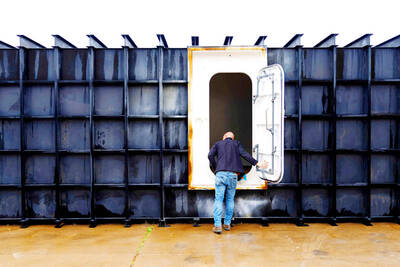
Since the war in the Middle East began nearly two weeks ago, the telephone at Ron Hubbard’s bomb shelter company in Texas has not stopped ringing. Foreign and US clients are rushing to buy his bunkers, seeking refuge in case of air raids, nuclear fallout or apocalypse. With the US and Israel pounding Iran, and Tehran retaliating with strikes across the region, Hubbard has seen demand for his product soar, mostly from Gulf nation customers in Bahrain, Qatar, Kuwait and the United Arab Emirates. “You can imagine how many people are thinking: ‘I wish I had a bomb shelter,’” Hubbard, 63, said in
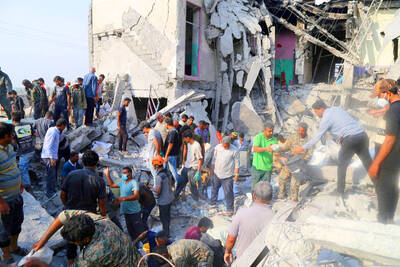
STILL IN POWER: US intelligence reports showed that the Iranian regime is not in danger of collapse and retains control of the public, casting doubt on Trump’s exit Nearly every US Senate Democrat on Wednesday signed a letter sent to US Secretary of Defense Pete Hegseth requesting a “swift investigation” of airstrikes on a girls’ school in Iran that killed scores of children and any other potential US military actions causing civilian harm. Reuters reported on Thursday last week that US military investigators believe it is likely that US forces were responsible for the Feb. 28 strike on the school, as US and Israeli forces launched attacks on Iran. “The results of this school attack are horrific. The majority of those killed in the strikes were girls between the ages


 RSS
RSS