


Following the devastation of SARS, unprecedented pro-democracy marches and controversy over a costly international music festival, Hong Kong is feeling a little fragile at the moment.
Just the right time, then, to launch a biting satirical magazine that takes no prisoners in its demolition of Hong Kong's straitened establishment.
Spike appeared on the bookstands for the first time on Friday as the territory's first mainstream publication with a mission statement to rub the authorities up the wrong way.
On a front page that belittled embattled Chief Executive Tung Chee-hwa's (董建華) record on democratic reform -- or lack thereof -- the first edition spelt out in no uncertain terms Spike's aims to test the limits of the city's tolerance of criticism of the establishment.
"My attitude is that we have a fairly free media in Hong Kong and certainly in law there's a lot of toleration of free expression and my view is that that will whither away unless it is tested to its outer limits," says Spike publisher Steve Vines. "That's where we're intending to test it."
Spike's arrival couldn't have been more timely. Earlier this year the former British territory was in turmoil over the imminent passage of a national security law.
Public opposition to the bill was so great that 500,000 people took to the streets in protest on July 1, the day the city should have been celebrating its handover of sovereignty to China six years earlier. Opponents feared the law would lead to a loss of free speech and press.
The public outcry at the so-called Article 23 law prompted the government to postpone the bill indefinitely.
"What crystallized the idea of Spike most was the July 1 demo and the feeling that there were all these angry, politically-aware and cynical people there and they might want a magazine that reflected those sentiments," said Vines, a veteran Hong Kong journalist and former editor of the now defunct Eastern Express daily newspaper.
Spike's first edition blended satirical articles, cartoons and diaries similar in style to those found in Britain's notorious Private Eye magazine, with commentary on political and business issues.
Among the targets of its many barbs was the American Chamber of Commerce's chairman, James Thompson, and the Harbour Fest music festival he organized.
The event was supposed to have reinvigorated Hong Kong's image abroad after the SARS outbreak badly dented commerce and confidence in the territory.
While the festival managed to pull in heavyweight rockers like the Rolling Stones as well as big Asian bands, poor ticket sales and a swirling political scandal over its almost US$100 million public subsidy meant it was criticized as an embarrassing failure.
Others who suffered Spike's venom include Tung's wife, Betty, and former security minister Regina Ip (葉劉淑儀).
A column entitled Media Follies devotes most of its space to attacking the city's main English-language daily newspaper, the South China Morning Post, which is portrayed as boring, staid and complacent.
"There's a feeling that there wasn't a good weekend read in English-language publications here," said Vines, whose magazine is supported by Chinese media mogul Jimmy Lai, publisher of the racy tabloid-style Apple Daily and Next magazines.
One of the biggest questions Vines has faced since Spike's launch is whether he thinks there is a big enough market in Hong Kong for a satire magazine.
Hong Kong is often regarded, particularly by expatriate residents, as humorless and too money- and self-obsessed to appreciate anything as flippant as a satirical magazine.
Before Spike, only a sporadically published underground free-sheet called Specific Rim attempted to satirize the city's establishment. But it only had a print run of a few thousand, compared to Spike's initial run of 15,000 with a full distribution deal to sell weekly out of Hong Kong's newsstands, supermarkets and convenience stores.

An American scientist convicted of lying to US authorities about payments from China while he was at Harvard University has rebuilt his research lab in Shenzhen, China, to pursue technology the Chinese government has identified as a national priority: embedding electronics into the human brain. Charles Lieber, 67, is among the world’s leading researchers in brain-computer interfaces. The technology has shown promise in treating conditions such as amyotrophic lateral sclerosis and restoring movement in paralyzed people. It also has potential military applications: Scientists at the Chinese People’s Liberation Army have investigated brain interfaces as a way to engineer super soldiers by boosting

Indonesian police have arrested 13 people after shocking images of alleged abuse against small children at a daycare center went viral, sparking outrage across the nation, officials said on Monday. Police on Friday last week raided Little Aresha, a daycare center in Yogyakarta on Java island, following a report from a former employee. CCTV footage circulating on social media showed children, most younger than two, lying on the floor wearing only diapers, their hands and feet bound with rags. The police have confirmed that the footage is authentic. Police said they also found 20 children crammed into a room just 3m by 3m. “So

A highway bomb attack in a restive region of southwestern Colombia on Saturday killed 14 people and injured at least 38, the latest spate of violence ahead of next month’s presidential election. Authorities blamed the attack in the Cauca department — a conflict-ridden, coca-growing region — on dissidents of the now-disbanded FARC guerrilla army, who have been sowing violence across the country. “Those who carried out this attack ... are terrorists, fascists and drug traffickers,” Colombian President Gustavo Petro said on social media. “I want our very best soldiers to confront them,” he added. The leftist leader blamed the bombing
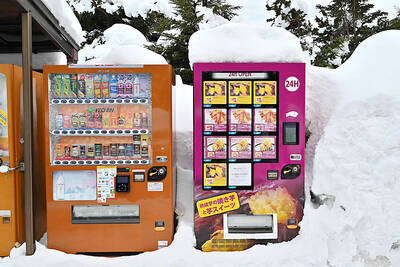
From post offices and parks to stations and even the summit of Mount Fuji, Japan’s vending machines are ubiquitous, but with the rapid pace of inflation cooling demand for their drinks, operators are being forced to rethink the business. Last month beverage giant DyDo Group Holdings announced it would remove about 20,000 vending machines — about 7 percent of their stock nationwide — by January next year, to “reconstruct a profitable network.” Pokka Sapporo Food & Beverage, based in Nagoya, also said last month it would sell its 40,000-machine operation to Osaka-based Lifedrink Co. “The strength of the vending machine


 RSS
RSS