


Japanese Prime Minister Sanae Takaichi’s comments regarding Taiwan were “reckless” and cross-strait issues should not be subject to outside intervention, former president Ma Ying-jeou (馬英九) said yesterday.
Takaichi last week said that if China used force against Taiwan, it might constitute a “survival-threatening situation” for Japan, allowing it to mobilize its armed forces.
Ma wrote on Facebook yesterday that he was greatly concerned about the comment and that it might lead to a revival of right-wing militarism in Japan.
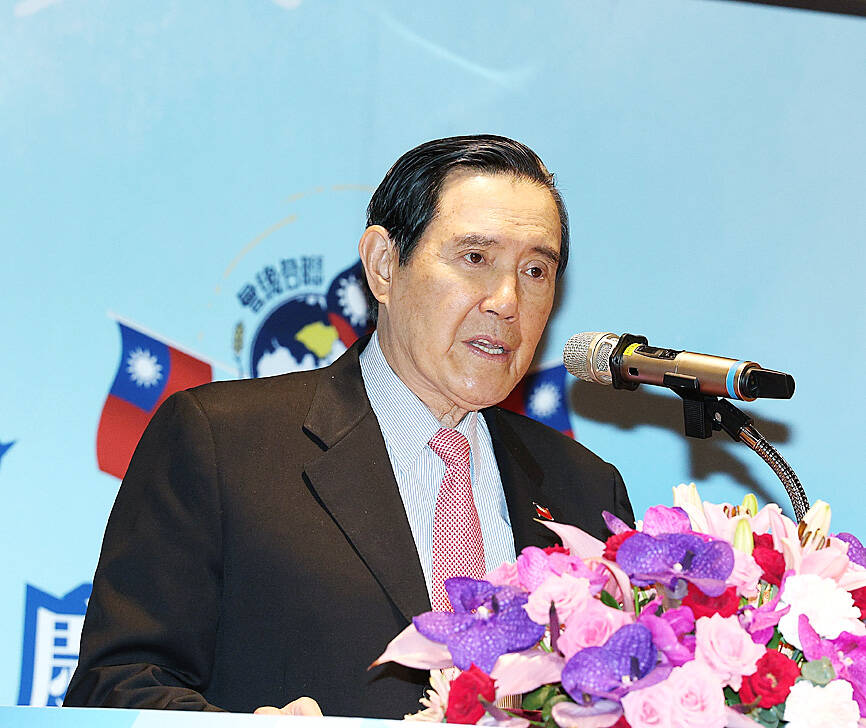
Photo: CNA
Ma urged Japanese leaders to be cautious regarding their words and actions about the situation in the Taiwan Strait.
Ma said while he supports friendly Taiwan-Japan ties, outsiders should not intervene in cross-strait affairs, which should be left to the two sides of the Strait.
Takaichi’s comments were a departure from the caution past Japanese prime ministers showed on the Taiwan issue, Ma said.
Even the hint that Japan might consider armed intervention is drawing criticism, even at home, he added.
Takaichi might not be aware that Tokyo must seek Washington’s approval in a situation justifying military action by Japan, Ma said, adding that the US was evidently not informed ahead of her remarks.
He said he was confident that wisdom would prevail on both sides of the Taiwan Strait and that a peaceful solution would be reached.
Regardless of the circumstances, the Taiwan Strait must remain stable so that a “survival-threatening situation” does not arise, he said.
Separately, former KMT chairwoman Hung Hsiu-chu (洪秀柱) said that Takaichi was “overreaching” with her comment.
She put Taiwan in a dangerous position, and it must be made clear that “Taiwan is no longer a Japanese colony,” Hung said.
The Taiwan issue is an “internal matter stemming from the Chinese Civil War” and foreign politicians are not in a position to comment on cross-strait affairs, she said.
Democratic Progressive Party Legislator Chen Kuan-ting (陳冠廷) said that Ma’s comments were from Beijing’s perspective and ignored that China has not renounced the use of force as a means to resolve the Taiwan issue.
Ma aligns with the Chinese narrative in many instances, even using “strong reactions from the Chinese side” as a standard for judgement, Chen said.
Taiwan’s security and interests cannot be centered around China’s emotional reactions, and Beijing should not be allowed to determine how Taiwan interacts with the international community, he said.
“The reason the situation in the Taiwan Strait has become tense in the past few years has always been very clear: Chinese military aircraft and warships continue to harass Taiwan, and crossing the median line [of the Taiwan Strait] has become the new normal,” Chen said, adding that China’s “gray zone” actions and escalating threats are real and present security challenges.
“However, Ma focuses on Japan and avoids discussing the increasing military pressure from China,” he said. “This not only misses the point, but also could lead to international misunderstandings.”
Japan’s concerns about regional security are based on its own national security realities and assessments of the situation in the Indo-Pacific region, not on what Ma claims is “stirring up the Taiwan Strait,” Chen said.
Taiwan and Japan in the past few years have formed solid connections in areas such as democracy, humanitarian efforts, economics and security, he said.
This normal cooperation is not a “return to militarism,” but a necessary collaboration between democratic nations in the face of authoritarian expansion, he said.
While Taiwan seeks peace, it does not want peace at the price of bending the knee, he said, adding that the nation’s future should not and cannot be dictated by China.

NATIONAL SECURITY: Authorities are working to confirm the identities of the military personnel involved and investigating possible illegal conduct and regulatory violations Authorities are probing possible national security implications after Kinmen police and immigration officers on Sunday found a Chinese woman allegedly posing as a tourist while engaging in prostitution involving more than 10 military personnel. The woman, surnamed Chen (陳), has since been deported, authorities said, adding that investigators are still working to confirm the identities of those implicated, as the records only listed code names and aliases. The case stemmed from a report received by the Kinmen District Prosecutors’ Office on Friday last week from the Jinhu Precinct of the Kinmen County Police Bureau. On Sunday, police, along with the National Immigration

GLOBALGIVING: ‘ Caving to external pressure is not acceptable for an organization that has cultivated justice reform and human rights for 30 years,’ one NGO said A slew of non-government organizations (NGOs) have withdrawn from the GlobalGiving fundraising platform after it announced it would use “Chinese Taipei” instead of “Taiwan” from next month. The Taiwan Good Rice Association wrote on Facebook on Friday that it was informed on April 28 via a teleconference call of the change, which was made because the platform wanted to operate in China. Taiwan Good Rice is to terminate all cooperative relationships with GlobalGiving in response to the platform’s “unilateral and non-negotiable” decision to remove references to Taiwan, the NGO said. “Taiwan is in the official name of Taiwan Good Rice Association and the

HEAVY WEATHER: Typhoon Jangmi is due to crash straight into the Ryukyus as airlines look to shift flights to larger aircraft or cancel flights to Okinawa entirely Taiwan’s international air carriers announced flight adjustments over the weekend as Typhoon Jangmi is forecast to hit the Ryukyu Islands today and tomorrow. The Central Weather Administration (CWA) upgraded Jangmi from a tropical storm to a typhoon at 8am yesterday, with the eye located 580km south of Naha city. It was moving north at 19kph. Today, China Airlines’ CI-120, CI-121, CI-122 and CI-123 flights between Taoyuan and Naha, Okinawa, have been canceled as well as CI-132 and CI-133 between Kaohsiung and Naha. EVA Air’s BR-112, BR-113, BR-186 and BR-185 flights between Taoyuan and Naha are also canceled. Low-cost carrier Tigerair Taiwan canceled IT-230,

Chinese Nationalist Party (KMT) Chairwoman Cheng Li-wun (鄭麗文) yesterday briefed her party’s Central Standing Committee regarding her scheduled visit to the US between Monday next week and June 16, saying that her purpose would be to persuade the US that the Republic of China (ROC) Constitution was a “one China” constitution that would foster stable and peaceful cross-strait relations. The ROC Constitution is the most important defense for all Taiwanese citizens, as it upholds our democracy and has contributed to our robust economy, which aligns with international and US interests, she said. “We would not be troublemakers and drag the US under,”


 RSS
RSS