


Several local academics yesterday affirmed that Minister of Foreign Affairs Lin Chia-lung’s (林佳龍) remark that the Treaty of San Francisco replaced the Cairo Declaration and Potsdam Declaration was beneficial in highlighting Taiwan’s sovereign status.
Lin had said that following the end of World War II, the Treaty of San Francisco, which is legally binding under international law, replaced the Cairo Declaration and the Potsdam Declaration, which were only political statements.
The People’s Republic of China (PRC) has never governed Taiwan, and the page about “Taiwan’s legal status” on the Ministry of Foreign Affairs’ Web site replaced the content highlighting the Cairo Declaration with one that underlines the Treaty of San Francisco, he said.
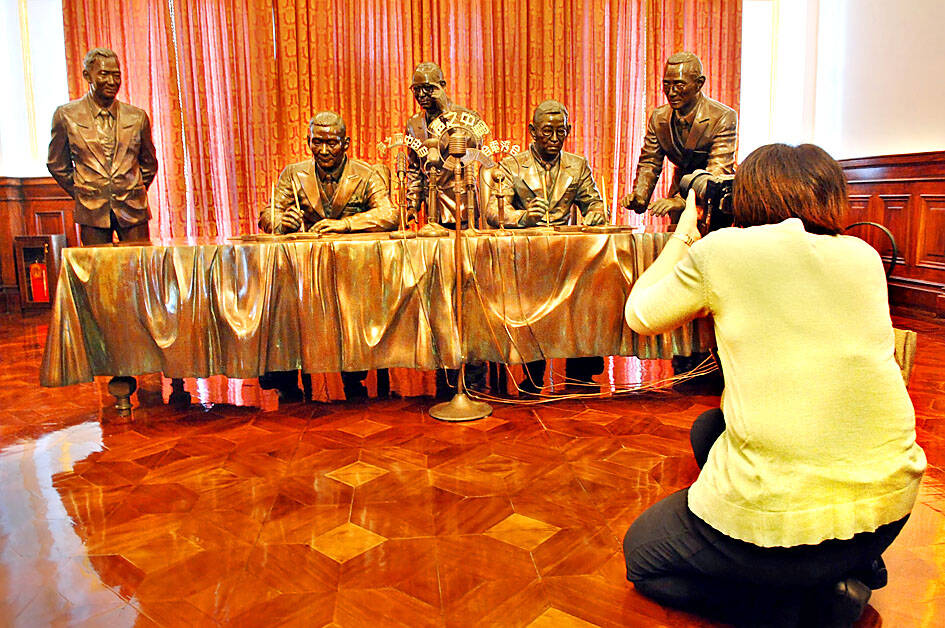
Photo: CNA
At a forum held by the Taiwan Nation Alliance in Taipei yesterday, National Taiwan University law professor Chiang Huang-chih (姜皇池) said that even if the Cairo Declaration is deemed valid, it was only a statement of intent saying that territories seized by Japan “should be returned,” and it needed to be realized through a peace treaty after the war ended.
The Treaty of San Francisco and the Sino-Japanese Peace Treaty, better known as the Taipei Treaty, have legal validity, he said, adding that historical practice has time and again proven that changes in territory need to be confirmed through treaties, and that unilateral declarations do not constitute a transfer of sovereignty.
The San Francisco treaty, signed in 1951, six years after Japan’s surrender and the end of its half-a-century rule of Taiwan, states that the Japanese government renounces sovereignty over Taiwan and Penghu, but does not specify to whom that sovereignty was to be transferred.
The Taipei Treaty affirms the 1951 pact, reiterating that the Japanese government renounces any claim to Taiwan, Penghu, the Spratly Islands (Nansha Islands, 南沙群島) and the Paracel Islands (Xisha Islands, 西沙群島).
Putting the focus back on those two treaties could reduce the risks that Taiwan faces under international law, Chiang said.
Prospect Foundation president Lai I-chung (賴怡忠) praised Lin for amending the content about Taiwan’s legal status on the ministry’s Web site.
As the US over the past few years has repeatedly refuted China’s distortion of UN Resolution 2758, saying that it is not equivalent to the “one China” principle and does not exclude Taiwan from the UN, Taipei should capitalize on this argument and strive for more international support, especially from members of the G7 and the EU, as well as friendly countries in the Asia-Pacific region, he said.
China has long refused to recognize the Treaty of San Francisco and continues to cite the Cairo and Potsdam declarations to claim Taiwan, Lai said, adding that Taiwan must come up with concrete response strategies to face the issue.
Taiwan must first firmly assert that “only treaties have legal effect” and focus on the Treaty of San Francisco; second, use the “gray zone” in international laws to avoid a “black-and-white situation;” third, push for support in the US’ stance on UN Resolution 2758; and fourth, create “wartime deterrence” that shows China that if it invades Taiwan, other countries would recognize the nation, and cause political cost and economic sanctions, he said.
National Cheng Kung University associate professor of law Chen Yi-kai (陳怡凱) also praised Lin’s amendment of the Web site content.
China’s claim over Taiwan based on the Cairo Declaration and UN Resolution 2758 lacks support from international law, he said.
The ministry once said that the Cairo Declaration had handed Taiwan to the Republic of China (ROC), which was not accepted by international society, Chen said.
Amending the discourse to highlight the Treaty of San Francisco not only responds to the international law community’s questions, but also removed the confusion that “the ROC equals to China,” and shows the reality that “China and Taiwan are not subordinate to the other,” he said.

NATIONAL SECURITY: Authorities are working to confirm the identities of the military personnel involved and investigating possible illegal conduct and regulatory violations Authorities are probing possible national security implications after Kinmen police and immigration officers on Sunday found a Chinese woman allegedly posing as a tourist while engaging in prostitution involving more than 10 military personnel. The woman, surnamed Chen (陳), has since been deported, authorities said, adding that investigators are still working to confirm the identities of those implicated, as the records only listed code names and aliases. The case stemmed from a report received by the Kinmen District Prosecutors’ Office on Friday last week from the Jinhu Precinct of the Kinmen County Police Bureau. On Sunday, police, along with the National Immigration

GLOBALGIVING: ‘ Caving to external pressure is not acceptable for an organization that has cultivated justice reform and human rights for 30 years,’ one NGO said A slew of non-government organizations (NGOs) have withdrawn from the GlobalGiving fundraising platform after it announced it would use “Chinese Taipei” instead of “Taiwan” from next month. The Taiwan Good Rice Association wrote on Facebook on Friday that it was informed on April 28 via a teleconference call of the change, which was made because the platform wanted to operate in China. Taiwan Good Rice is to terminate all cooperative relationships with GlobalGiving in response to the platform’s “unilateral and non-negotiable” decision to remove references to Taiwan, the NGO said. “Taiwan is in the official name of Taiwan Good Rice Association and the

HEAVY WEATHER: Typhoon Jangmi is due to crash straight into the Ryukyus as airlines look to shift flights to larger aircraft or cancel flights to Okinawa entirely Taiwan’s international air carriers announced flight adjustments over the weekend as Typhoon Jangmi is forecast to hit the Ryukyu Islands today and tomorrow. The Central Weather Administration (CWA) upgraded Jangmi from a tropical storm to a typhoon at 8am yesterday, with the eye located 580km south of Naha city. It was moving north at 19kph. Today, China Airlines’ CI-120, CI-121, CI-122 and CI-123 flights between Taoyuan and Naha, Okinawa, have been canceled as well as CI-132 and CI-133 between Kaohsiung and Naha. EVA Air’s BR-112, BR-113, BR-186 and BR-185 flights between Taoyuan and Naha are also canceled. Low-cost carrier Tigerair Taiwan canceled IT-230,

REASONS FOR TRAVEL: An assistant professor said that proposed amendments to penalize drivers if they used drugs overseas would not deter people from traveling People who operate a motor vehicle under the influence of marijuana would have their driver’s license revoked, even if they used the substance while overseas, the Ministry of Transportation and Communications said yesterday, citing proposed amendments to the Road Traffic Management and Penalty Act (道路交通管理處罰條例). The amendments would also authorize the government to revoke the licenses of people determined to have used Category 1 or Category 2 narcotics, even if they were not operating a vehicle while under the influence of drugs, as well as ban them from taking the license test for three years, the ministry said. People aged 18 or


 RSS
RSS