


A career-changing choice turned military pilot Chang Wei-jan (張威然) into a farmer who manages Taiwan’s largest cinnamon plantation.
Chang attributes his successful growth of 5,000 cinnamon trees at a plantation in Nantou County to his love for tilling farmland and insistence on using organic farming methods, he said.
Cultivating trees requires skill, Chang said, adding that he has introduced new technology to extract essential oils to produce marketable goods.
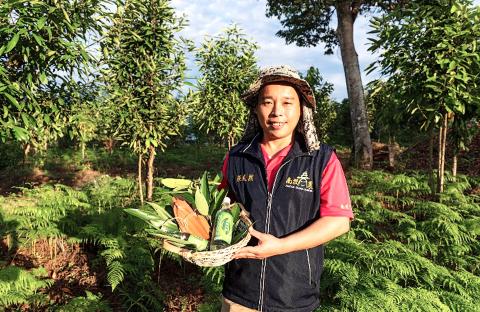
Photo provided by Chang Wei-jan
He also started teaching classes on environmentally friendly farming techniques, he said.
Last year, the Ministry of Foreign Affairs and the Council of Agriculture chose Chang as one of 30 “agricultural ambassadors” to represent Taiwan in exchanges to India and Thailand.
“My plantation covers 5 hectares, at a plot near Puli Township (埔里). Originally it was just wild growth with trees and bushes,” he said. “No one had cultivated this land for at least 30 years, so its soil and natural ecology were well preserved.”
“It would seem a waste of good land to use fertilizers and pesticides when planting our first trees, so I took up organic farming to conserve all of its natural vitality. We also use trees of varying height to allow space for cultivating cinnamon seedlings,” he said.
Fate led Chang to cultivating cinnamon, when his father developed a stomach problem and traditional medicine indicated the spice could help, he said.
Traditional medicine often uses Cinnamomum cassia, also known as Chinese cinnamon, in tonics for treating digestive tract ailments, Chang said.
Planting the trees did not go smoothly at first, as they started in Changhua County, where the cinnamon did not grow well, he said, adding that they later learned that slopes at not too high an altitude were good for growing the trees.
“At that time, we had just obtained this land in Puli, and we followed the advice of Forestry Bureau officers for conditions and proper spacing for planting the seedlings,” Chang said. “Now we have about 1,500 trees per hectare, and they are growing very well with the favorable hills, good soil and clean water of Puli.”
Chang said he has always loved the outdoors, which led him to serve as a pilot in the military, where he often flew Chinook helicopters, transporting people and goods for relief work during natural disasters.
During his military career, Chang witnessed from above how soil and rock was churned up by the 921 Earthquake in Nantou County’s Jiji Township (集集) on Sept. 21, 1999, which left a deep impression on him, and underscored the importance of water and soil conservation, he said.
Just before the military was to promote him to lieutenant colonel, Chang’s family obtained the plot of land in Puli, and needed more family members to help on the plantation, which led him to a crossroads, he said.
“It was a choice between operating a helicopter and a mower. Most people would choose the helicopter, but I chose the mower, because I had great expectations for making strides in Taiwan’s agriculture,” he said.
Chang retired from the military and returned home to manage the plantation with his elder brother.
“I could have retired after serving 20 years, but our family’s land cannot be tended later on. So it came down to a personal decision, and also that he had the dream of making it with agriculture in Taiwan,” Chang said.
“I believe in our generation of young farmers. We can recreate Taiwan’s agricultural miracle, because everyone is willing to learn and share,” he said.
“In Taiwan, we are mostly small farmers, and we need to organize and network, and collectively elevate our knowledge and skills. When we do that, we can produce agricultural products on a large scale for the market,” he said, adding that his philosophy is to share his knowledge and his creative energy with other farmers.
“For cinnamon used in traditional medicine and in food preparation, the ingredients require cinnamon tree branches and bark. However, Taiwan lags in the cinnamon industry and has to rely on imports,” he said. “If someone has suitable land, and they have the interest, I will pass on the cultivation techniques and skills to them.”
Chang said he hopes to work with more young farmers who have the same aspiration and goals.
“I believe Taiwan can develop its own cinnamon industry, and I expect this will happen,” he said.
Additional reporting by Jason Pan

NATIONAL SECURITY: Authorities are working to confirm the identities of the military personnel involved and investigating possible illegal conduct and regulatory violations Authorities are probing possible national security implications after Kinmen police and immigration officers on Sunday found a Chinese woman allegedly posing as a tourist while engaging in prostitution involving more than 10 military personnel. The woman, surnamed Chen (陳), has since been deported, authorities said, adding that investigators are still working to confirm the identities of those implicated, as the records only listed code names and aliases. The case stemmed from a report received by the Kinmen District Prosecutors’ Office on Friday last week from the Jinhu Precinct of the Kinmen County Police Bureau. On Sunday, police, along with the National Immigration

GLOBALGIVING: ‘ Caving to external pressure is not acceptable for an organization that has cultivated justice reform and human rights for 30 years,’ one NGO said A slew of non-government organizations (NGOs) have withdrawn from the GlobalGiving fundraising platform after it announced it would use “Chinese Taipei” instead of “Taiwan” from next month. The Taiwan Good Rice Association wrote on Facebook on Friday that it was informed on April 28 via a teleconference call of the change, which was made because the platform wanted to operate in China. Taiwan Good Rice is to terminate all cooperative relationships with GlobalGiving in response to the platform’s “unilateral and non-negotiable” decision to remove references to Taiwan, the NGO said. “Taiwan is in the official name of Taiwan Good Rice Association and the

HEAVY WEATHER: Typhoon Jangmi is due to crash straight into the Ryukyus as airlines look to shift flights to larger aircraft or cancel flights to Okinawa entirely Taiwan’s international air carriers announced flight adjustments over the weekend as Typhoon Jangmi is forecast to hit the Ryukyu Islands today and tomorrow. The Central Weather Administration (CWA) upgraded Jangmi from a tropical storm to a typhoon at 8am yesterday, with the eye located 580km south of Naha city. It was moving north at 19kph. Today, China Airlines’ CI-120, CI-121, CI-122 and CI-123 flights between Taoyuan and Naha, Okinawa, have been canceled as well as CI-132 and CI-133 between Kaohsiung and Naha. EVA Air’s BR-112, BR-113, BR-186 and BR-185 flights between Taoyuan and Naha are also canceled. Low-cost carrier Tigerair Taiwan canceled IT-230,
REASONS FOR TRAVEL: An assistant professor said that proposed amendments to penalize drivers if they used drugs overseas would not deter people from traveling People who operate a motor vehicle under the influence of marijuana would have their driver’s license revoked, even if they used the substance while overseas, the Ministry of Transportation and Communications said yesterday, citing proposed amendments to the Road Traffic Management and Penalty Act (道路交通管理處罰條例). The amendments would also authorize the government to revoke the licenses of people determined to have used Category 1 or Category 2 narcotics, even if they were not operating a vehicle while under the influence of drugs, as well as ban them from taking the license test for three years, the ministry said. People aged 18 or


 RSS
RSS