


Thousands of people wearing yellow vests yesterday rallied in front of the Presidential Office in Taipei to demand that the government reform tax laws and return what they say were unfairly levied taxes.
The tax system is “unfair and lacks transparency,” said the Tax and Legal Reform League, which organized the rally.
To improve the system, the government should convene a national congress to discuss tax reform and establish a committee to help people who have been erroneously taxed, it said in a statement.
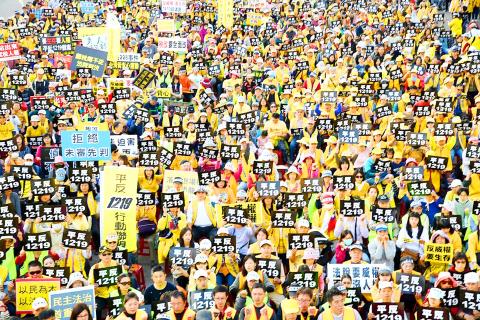
Photo courtesy of the Tax and Legal Reform League
The system makes it extremely difficult for victims of erroneous or illegal taxation to recover their money, said Wu Ching-chin (吳景欽), an associate professor in Aletheia University’s Department of Law and one of the league’s founding members.
When someone files an administrative appeal over illegal or erroneous taxation, they still have to pay half of the taxes levied while the case is ongoing, he said.
“This means that if you have been illegally asked to pay NT$10 million [US$324,538], you would have to pay NT$5 million first,” Wu said.
Moreover, the appeal process usually takes 10 years and the chance of winning such a case is only 6 percent, he added.
“Even if you win, the court ruling is useless,” Wu said, adding that the National Taxation Bureau could continue to levy the tax deemed illegal by the court due to a legislative flaw that grants it the authority to “recheck” its own tax decisions.
Tax bureaus continue to levy illegal and erroneous taxes, because admitting mistakes would prevent officials from receiving performance-based bonuses, he said, adding that tax bureaus have more performance-based bonuses than any other government agency.
“To lessen people’s pain, the bureau should stop requiring the same tax to be paid once an administrative court has ruled it to be illegal,” Wu said.
The unfair tax system not only causes unnecessary suffering, but pushes foreign investors away, he said.
The rally is “people’s protest against this undemocratic system and demand for a better life,” he added.
League members began protesting unfair taxes in yellow vests on Dec. 18, 2016, well before the “yellow vest” protests began in France, said another founding member of the league, Chen Chih-lung (陳志龍), a retired National Taiwan University law professor.
“As with the French ‘yellow vest’ protesters, we are against government bullying. We are opposed to the government doing whatever it wants, believing it is the boss,” he said.
“This is a human rights movement,” Chen said, adding that similar protests are happening in Belgium and Hungary.

The Centers for Disease Control (CDC) yesterday reported the first case of a new COVID-19 subvariant — BA.3.2 — in a 10-year-old Singaporean girl who had a fever upon arrival in Taiwan and tested positive for the disease. The girl left Taiwan on March 20 and the case did not have a direct impact on the local community, it said. The WHO added the BA.3.2 strain to its list of Variants Under Monitoring in December last year, but this was the first imported case of the COVID-19 variant in Taiwan, CDC Deputy Director-General Lin Ming-cheng (林明誠) said. The girl arrived in Taiwan on

South Korea is planning to revise its controversial electronic arrival card, a step Taiwanese officials said prompted them to hold off on planned retaliatory measures, a South Korean media report said yesterday. A Yonhap News Agency report said that the South Korean Ministry of Foreign Affairs is planning to remove the “previous departure place” and “next destination” fields from its e-arrival card system. The plan, reached after interagency consultations, is under review and aims to simplify entry procedures and align the electronic form with the paper version, a South Korean ministry official said. The fields — which appeared only on the electronic form

The Ministry of Foreign Affairs (MOFA) is suspending retaliation measures against South Korea that were set to take effect tomorrow, after Seoul said it is updating its e-arrival system, MOFA said today. The measures were to be a new round of retaliation after Taiwan on March 1 changed South Korea's designation on government-issued alien resident certificates held by South Korean nationals to "South Korea” from the "Republic of Korea," the country’s official name. The move came after months of protests to Seoul over its listing of Taiwan as "China (Taiwan)" in dropdown menus on its new online immigration entry system. MOFA last week

A bipartisan group of US senators has introduced a bill to enhance cooperation with Taiwan on drone development and to reduce reliance on supply chains linked to China. The proposed Blue Skies for Taiwan Act of 2026 was introduced by Republican US senators Ted Cruz and John Curtis, and Democratic US senators Jeff Merkley and Andy Kim. The legislation seeks to ease constraints on Taiwan-US cooperation in uncrewed aerial systems (UAS), including dependence on China-sourced components, limited access to capital and regulatory barriers under US export controls, a news release issued by Cruz on Wednesday said. The bill would establish a "Blue UAS


 RSS
RSS