


Although a government program to provide free human papilloma virus (HPV) vaccinations to seventh-grade girls nationwide is scheduled to begin this month, a survey published by the Formosa Cancer Foundation showed that only about 30 percent of respondents knew about the program.
Government-funded HPV shots are to be provided at schools from the middle of this month, with the Ministry of Health and Welfare saying that girls in seventh grade and their parents would be informed about the vaccination and allowed to decide whether to receive it.
The ministry has bought bivalent vaccines that protect against HPV types 16 and 18, which are linked to about 70 percent of all cervical cancers.
The foundation collected more than 10,000 responses through an online survey between Oct. 26 and Nov. 30 and published the results on Monday last week.
It found that 68.9 percent of respondents knew that HPV infection of the cervix is the most common cause of cervical cancer, but only 54.5 percent knew that HPV infection can increase the likelihood of other diseases, such as genital warts.
About 79.1 percent of parents with children aged nine to 18 surveyed knew about the relationship between HPV infection and cervical cancer, the foundation said.
However, only about 30 percent of all respondents knew that free vaccines would be provided to seventh-grade girls from this month, it said.
Taiwan Immunization Vision and Strategy director-general Lee Ping-ying (李秉穎), a pediatrician at National Taiwan University Hospital, said that cervical cancer is among the 10 most commonly diagnosed cancers among women in Taiwan.
In addition to practicing safe sex and getting regular Pap smear tests, getting vaccinated is another effective method of protection, Lee said.
Nearly 90 countries have publicly funded HPV vaccination programs, and the WHO has prequalified HPV vaccines as safe and effective in preventing infection, he said, adding that parents should not worry about the vaccination.
Boys can also get vaccinated at their own expense to prevent genital warts, Lee added.
Eleven municipalities in Taiwan already provide free HPV vaccines, of which four have purchased quadrivalent vaccines and four have purchased nonavalent vaccines, which protect against more HPV types, he said.
That means parents can consult a doctor if they want their children to instead receive quadrivalent or nonavalent vaccines, but they would not be covered by the national program, Lee said.

In a historic first, Taiwanese officials participated in this year’s Riga Strategic Communications Dialogue in Latvia from Wednesday to Friday last week, which debuted a breakout session focused on Taiwan The event organizer, the NATO Strategic Communications Center of Excellence, displayed Taiwan’s national flag and the officials’ formal titles on their Web site. Taiwanese attendees included National Security Council (NSC) Deputy Secretary-General Lin Fei-fan (林飛帆) and deputy head of the Taipei Representative Office in the UK, Chiang Ya-chi (江雅綺). In addition to the session discussing Taiwan titled “Taiwan: Navigating Strategic Communication in a Tense Environment,” the dialogue also included sessions
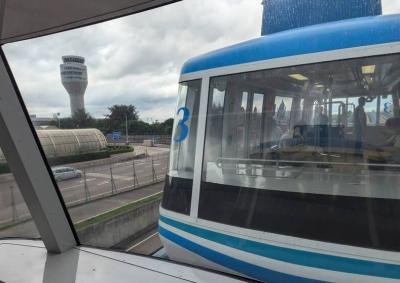
Taiwan Taoyuan International Airport is to suspend its automated Skytrain service connecting Terminal 1 and Terminal 2 starting on July 1 to facilitate connection works for the upcoming Terminal 3, the airport operator said today. Passengers and staff who need to travel between the two terminals after the suspension can instead use the Taoyuan MRT or the airport's 24-hour shuttle bus service, Taoyuan International Airport Corp said. The Taoyuan MRT Airport Line directly links the two terminals, while the shuttle buses are to operate around the clock, the company added. The Skytrain provides free transportation between the airport’s two terminals for travelers and
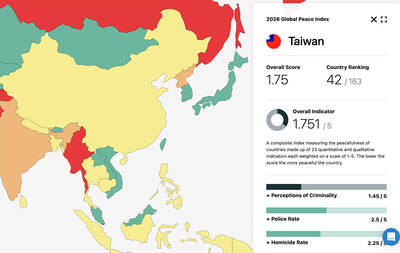
Taiwan ranked 42nd in terms of peacefulness among 163 countries, down five places from last year, according to this year’s Global Peace Index. With an overall score of 1.751, Taiwan dropped from 37th last year, the report published by the global Institute for Economics and Peace showed. The overall score measures a country’s level of peacefulness using 23 quantitative and qualitative indicators across three domains — ongoing domestic and international conflict, societal safety and security, and militarization. While Taiwan ranked 42nd worldwide, it was listed in ninth place among the 19 Asian-Pacific countries in the report, after New Zealand, Singapore, Japan, Malaysia,

TOKYO-MANILA DELIMITATION TALKS: Beijing is attempting to use this opportunity to normalize patrols and law enforcement in the waters east of Taiwan, MOFA said China has no law enforcement authority over the waters east of Taiwan, the Ministry of Foreign Affairs (MOFA) said yesterday, accusing China of undermining regional peace and stability. The Chinese Ministry of Transport on Saturday evening announced that it had launched a “special maritime law enforcement operation” in the waters east of Taiwan, dispatching coast guard vessels to engage in illegal enforcement activities, the ministry said. State-run Xinhua news agency said the operation was “a necessary action taken in response to Japan and the Philippines unilaterally announcing the initiation of maritime boundary delimitation negotiations in the waters east of China’s Taiwan island,


 RSS
RSS