


The Central Election Commission yesterday announced that the number of petition forms for the two referendum proposals launched by the Coalition for the Happiness of Our Next Generation had passed the legal threshold, with each garnering more than 550,000 signatures.
As the number of signatures for the referendum petitions had exceeded the legal minimum, the commission said it would convene a meeting on Tuesday to decide whether the proposals are valid and to be included in the voting on Nov. 24.
For a referendum proposal to be established, its initiator has to collect at least 281,745 signatures, or 1.5 percent of the number of the total electors in the most recent presidential and vice presidential election, as stipulated by Article 12 of the Referendum Act (公民投票法).

Photo: Liu Hsin-de, Taipei Times
Launched by the alliance’s referendum convener, Yu Hsin-yi (游信義), one of the proposals asks: “Do you agree that marriage should be strictly defined as between a man and a woman in the Civil Code (民法)?”
According to the commission, the proposal garnered 565,676 valid petitions and 112,296 invalid ones — the latter included 42,025 without a proper signature; 35,566 with no residential address or an incorrect one; 11,254 with an incorrect identification number; 11,253 with a repeated signature; 4,376 with forged information; and 612 signed in the name of a deceased person.
The other proposal submitted by alliance president Tseng Hsien-ying (曾獻瑩) asks: “Do you agree that provisions in the Enforcement Rules for Gender Equity Education Act (性別平等教育法施行細則) concerning homosexuality education should not be implemented at the elementary and junior-high school levels?”
The commission said that the proposal collected 556,366 valid petitions and 113,802 invalid ones — the latter included more than 41,000 forms without a signature or stamp; 37,378 with an incorrect residential address; 12,509 with an incorrect or unclear identification number; 10,741 with a repeated signature; and 535 signed in the name of a dead person.
More than 83 percent of the petitions for the two referendum proposals were valid, while the percentage of forms signed in the name of a dead person was only 0.09 percent, which was lower than the nation’s death rate of 0.73 percent last year, the alliance said in a statement later yesterday, citing data by the Ministry of the Interior.
As for the alliance’s third referendum proposal on establishing a specific law for same-sex marriage, local household registration agencies yesterday said they forwarded the results of their examination of the petition forms’ signatories to the commission, with the results to be announced as soon as the commission completes necessary paperwork.
Meanwhile, the commission said that because petitions for two referendum proposals tendered by same-sex marriage supporters were submitted later than the others, local agencies might not be able to finish checking the validity of the petition forms’ signatories until Wednesday.
The commission has scheduled an additional meeting on Tuesday to examine the petitions and announce the results, commission Vice Chairman Chen Chao-chien (陳朝建) said.

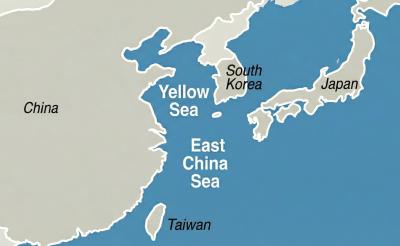
China has reserved offshore airspace in the Yellow Sea and East China Sea from March 27 to May 6, issuing alerts usually used to warn of military exercises, although no such exercises have been announced, the Wall Street Journal (WSJ) reported yesterday. Reserving such a large area for 40 days without explanation is an “unusual step,” as military exercises normally only last a few days, the paper said. These alerts, known as Notice to Air Missions (Notams), “are intended to inform pilots and aviation authorities of temporary airspace hazards or restrictions,” the article said. The airspace reserved in the alert is

More than 6,000 Taiwanese students have participated in exchange programs in China over the past two years, despite the Mainland Affairs Council’s (MAC) “orange light” travel advisory, government records showed. The MAC’s publicly available registry showed that Taiwanese college and university students who went on exchange programs across the Strait numbered 3,592 and 2,966 people respectively. The National Immigration Agency data revealed that 2,296 and 2,551 Chinese students visited Taiwan for study in the same two years. A review of the Web sites of publicly-run universities and colleges showed that Taiwanese higher education institutions continued to recruit students for Chinese educational programs without

NAMING SPAT: The foreign ministry called on Denmark to propose an acceptable solution to the erroneous nationality used for Taiwanese on residence permits Taiwan has revoked some privileges for Danish diplomatic staff over a Danish permit that lists “Taiwan” as “China,” Eric Huang (黃鈞耀), head of the Ministry of Foreign Affairs’ Department of European Affairs, told a news conference in Taipei yesterday. Reporters asked Huang whether the Danish government had responded to the ministry’s request that it correct the nationality on Danish residence permits of Taiwanese, which has been listed as “China” since 2024. Taiwan’s representative office in Denmark continues to communicate with the Danish government, and the ministry has revoked some privileges previously granted to Danish representatives in Taiwan and would continue to review

A bipartisan group of US senators has introduced a bill to enhance cooperation with Taiwan on drone development and to reduce reliance on supply chains linked to China. The proposed Blue Skies for Taiwan Act of 2026 was introduced by Republican US senators Ted Cruz and John Curtis, and Democratic US senators Jeff Merkley and Andy Kim. The legislation seeks to ease constraints on Taiwan-US cooperation in uncrewed aerial systems (UAS), including dependence on China-sourced components, limited access to capital and regulatory barriers under US export controls, a news release issued by Cruz on Wednesday said. The bill would establish a "Blue UAS


 RSS
RSS