


Religious groups and members of civic organizations advocating “traditional family values” yesterday rallied outside the Judicial Yuan in Taipei, a rally that became a protest after the Council of Grand Justices in the afternoon issued a constitutional interpretation in favor of the legalization of same-sex marriage.
The protesters included members of the Happiness of the Next Generation Alliance, the Association for Taiwan Social Stability, the Alliance of Religious Groups for the Love of Families Taiwan and other groups that have vehemently opposed marriage equality for lesbian, gay, bisexual, and transgender (LGBT) people.
At the initially boisterous rally, demonstrators accompanied their chants with drums and other musical instruments, while many people held up banners or placards with slogans such as “We do not welcome same-sex marriage in Taiwan,” “Defend the traditional family,” “The judicial process is unfair” and “Justice is dead and buried.”
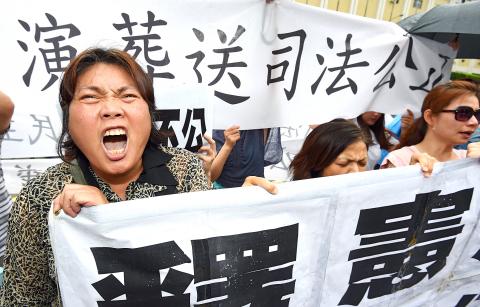
Photo: Liu Hsin-te, Taipei Times
After the grand justices’ interpretation was announced, many of the demonstrators reacted angrily or broke into tears.
They denounced the Council of Grand Justices and ripped up paper to symbolize their disbelief in the justices’ explanations for the ruling.
The chants turned to “Shame on the judiciary,” “We want a referendum,” “Down with the Judicial Yuan president” and “Down with President Tsai Ing-wen (蔡英文).”
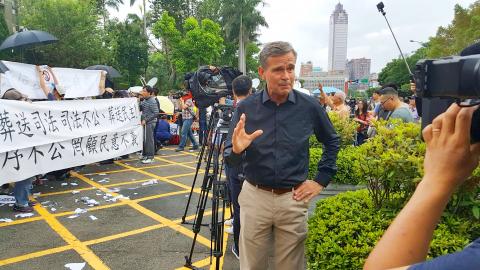
Photo: Wen Yu-te, Taipei Times
The interpretation represents “the elite of the nation’s judiciary system bullying the majority opinion of the public,” alliance convener Yu Hsin-yi (游信義) said, adding that it is wrong for the “lawmaking body to interfere with justice.”
“We are very disappointed with the ruling and plan to continue to fighting against it with all our might,” Yu told an improptu news conference at the rally site. “We plan to request that the Control Yuan conduct a probe into the grand justices.”
He said the grand justices had “rigged the process” by calling expert witnesses to testify, none of whom stood for traditional family values or the protection of the sacred institution of marriage.
Yu vowed to push for a national referendum so that the public could have their say on the issue, and also to redouble efforts with a signature campaign to recall legislators he said had failed to listen to their constituents on the issue.
Alliance lawyer Yeh Kuang-chou (葉光洲) said the constitutional interpretation puts Taiwan on the map as the first to allow same-sex marriage in Asia, “but we might lose many things in the future, and I am afraid to find out.”
“The grand justices should not become spokespeople for movements that advocate social causes. The ruling shows our justice system is biased toward certain groups,” Yeh said.

Considering that most countries issue more than five denominations of banknotes, the central bank has decided to redesign all five denominations, the bank said as it prepares for the first major overhaul of the banknotes in more than 24 years. Central bank Governor Yang Chin-lung (楊金龍) is expected to report to the Legislative Yuan today on the bank’s operations and the redesign’s progress. The bank in a report sent to the legislature ahead of today’s meeting said it had commissioned a survey on the public’s preferences. Survey results showed that NT$100 and NT$1,000 banknotes are the most commonly used, while NT$200 and NT$2,000

The Centers for Disease Control (CDC) yesterday reported the first case of a new COVID-19 subvariant — BA.3.2 — in a 10-year-old Singaporean girl who had a fever upon arrival in Taiwan and tested positive for the disease. The girl left Taiwan on March 20 and the case did not have a direct impact on the local community, it said. The WHO added the BA.3.2 strain to its list of Variants Under Monitoring in December last year, but this was the first imported case of the COVID-19 variant in Taiwan, CDC Deputy Director-General Lin Ming-cheng (林明誠) said. The girl arrived in Taiwan on

South Korea is planning to revise its controversial electronic arrival card, a step Taiwanese officials said prompted them to hold off on planned retaliatory measures, a South Korean media report said yesterday. A Yonhap News Agency report said that the South Korean Ministry of Foreign Affairs is planning to remove the “previous departure place” and “next destination” fields from its e-arrival card system. The plan, reached after interagency consultations, is under review and aims to simplify entry procedures and align the electronic form with the paper version, a South Korean ministry official said. The fields — which appeared only on the electronic form

The Ministry of Foreign Affairs (MOFA) is suspending retaliation measures against South Korea that were set to take effect tomorrow, after Seoul said it is updating its e-arrival system, MOFA said today. The measures were to be a new round of retaliation after Taiwan on March 1 changed South Korea's designation on government-issued alien resident certificates held by South Korean nationals to "South Korea” from the "Republic of Korea," the country’s official name. The move came after months of protests to Seoul over its listing of Taiwan as "China (Taiwan)" in dropdown menus on its new online immigration entry system. MOFA last week


 RSS
RSS