


Aborigine hunters prosecuted in terms of the Wildlife Conservation Act (野生動物保育法) in 2014 are to file for a constitutional interpretation on the ruling, saying that the ruling conflicted with Article 19 of the Indigenous Peoples Basic Act (原住民族基本法) as well as constitutionally protected rights.
Bunun Aborigne Tama Talum, 56, was sentenced to three-and-a-half years in prison for violating the Wildlife Conservation Act and the Act Governing the Control of Guns, Ammunition and Knives (槍砲彈藥刀械管制條例), for hunting a Formosan Reeve’s muntjac and a goat in 2013 to provide fresh meat for his 94-year-old mother.
Supreme Prosecutors’ Office Prosecutor-General Yen Ta-ho (顏大和) filed an extraordinary appeal against a jail sentence on grounds of suspected discrimination against Aboriginal culture in December last year.
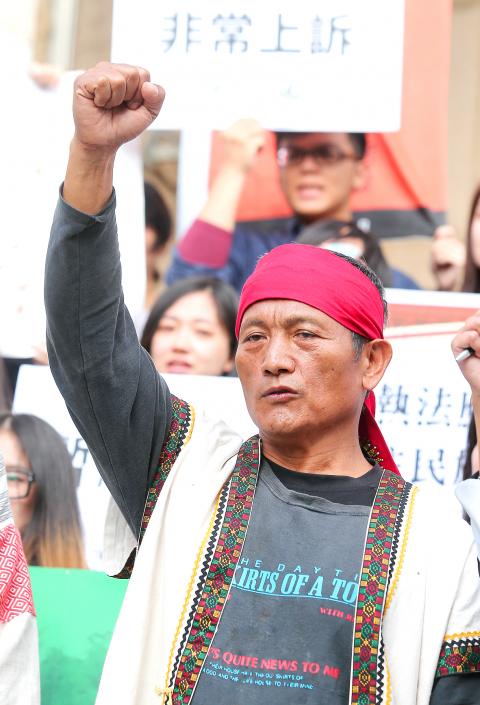
Photo: CNA
Talum and lawyers on Friday last week filed an 80-page application for a constitutional interpretation.
Puyuma Aborigine Pan Chih-chiang (潘志強), who was arrested on similar charges, said in tears that they hoped Aborigines’ mandate to continue their hunting culture would be placed on an equal footing with the conservation of the culture of the Han people.
Talum said that hunting was intricately tied to the life of an Aborigine and has been a constant, even under Japanese colonial rule, adding that they hoped the result of the constitutional interpretation would allow their people to hunt openly without fear of slander and recrimination.
Lawyer Wen Chih-jung (文志榮) said that Article 21 of the Wildlife Conservation Act states that necessary hunting by Aborigines due to traditional culture or for rites should not fall under the regulation of the act.
The ruling against Talum was due to the judge’s interpretation that the hunt was carried out for personal reasons and was not a cultural or ceremonial act, Wen said, adding that Article 19 of the Indigenous Peoples Basic Act states that hunting is permitted for all three occasions as long as it is not conducted for profit.
Deputy Minister of the Council of Indigenous Peoples Tunkan Tansikian said the council hopes that the results of the interpretation would help conserve Aboriginal culture without overt violation of ecological conservation.
Tansikian said Taiwan could consider methods used by other nations that cap the number of animals allowed to be hunted, with hunters reporting catches so a government agency can keep track of changes to the wildlife population, adding that bans could be imposed if set limits are not adhered to.
Forestry Bureau Deputy Director-General Yang Hung-chih (楊宏志) said the government had offered to enact the same plan, but it was turned down by Aboriginal rights groups, who believe that the spoils of a hunt are granted by their ancestors.

AGING: While Japan has 22 submarines, Taiwan only operates four, two of which were commissioned by the US in 1945 and 1946, and transferred to Taiwan in 1973 Taiwan would need at least 12 submarines to reach modern fleet capabilities, CSBC Corp, Taiwan chairman Chen Cheng-hung (陳政宏) said in an interview broadcast on Friday, citing a US assessment. CSBC is testing the nation’s first indigenous defense submarine, the Hai Kun (海鯤, Narwhal), which is scheduled to be delivered to the navy next month or in July. The Hai Kun has completed torpedo-firing tests and is scheduled to undergo overnight sea trials, Chen said on an SET TV military affairs program. Taiwan would require at least 12 submarines to establish a modern submarine force after assessing the nation’s operational environment and defense

Yangmingshan National Park authorities yesterday urged visitors to respect public spaces and obey the law after a couple was caught on a camera livestream having sex at the park’s Qingtiangang (擎天崗) earlier in the day. The Shilin Police Precinct in Taipei said it has identified a suspect and his vehicle registration number, and would summon him for questioning. The case would be handled in accordance with public indecency charges, it added. The couple entered the park at about 11pm on Thursday and began fooling around by 1am yesterday, the police said, adding that the two were unaware of the park’s all-day live
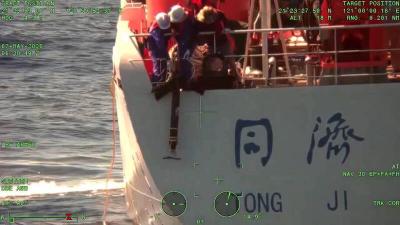
The coast guard today said that it had disrupted "illegal" operations by a Chinese research ship in waters close to the nation and driven it away, part of what Taipei sees a provocative pattern of China's stepped up maritime activities. The coast guard said that it on Thursday last week detected the Chinese ship Tongji (同濟號), which was commissioned only last year, 29 nautical miles (54km) southeast of the southern tip of Taiwan, although just outside restricted waters. The ship was observed lowering ropes into the water, suspected to be the deployment of scientific instruments for "illegal" survey operations, and the coast

A former soldier and an active-duty army officer were yesterday indicted for allegedly selling classified military training materials to a Chinese intelligence operative for a total of NT$79,440. The Taipei District Prosecutors’ Office indicted Chen Tai-yin (陳泰尹) and Lee Chun-ta (李俊達) for contravening the National Security Act (國家安全法) and the Anti-Corruption Act (貪污治罪條例). Chen left the military in September 2013 after serving alongside then-staff sergeant Lee, now an army lieutenant, at the 21st Artillery Command of the army’s Sixth Corps from 2011 to 2013, according to the indictment. Chen met a Chinese intelligence operative identified as “Wang” (王) through a friend in November


 RSS
RSS