


The Supreme Prosecutors’ Office on Tuesday said that Prosecutor-General Yen Da-ho (顏大和) would file an extraordinary appeal against a jail sentence given to a Bunun Aborigine for hunting protected animals to feed his sick mother.
The news so delighted Wang Kuang-lu (王光祿) — who was supposed to begin a three-and-a-half-year prison sentence the same day — that he hugged his 92-year-old mother without telling her why, and thanked “all those who have helped me through the legal entanglements.”
Wang, 56, said he used a gun he found in the mountains to kill a goat and a Formosan Reeves’ muntjac two years ago because his sick mother wanted to eat lean meat that is “not as fatty” as the produce sold in the “plains peoples ‘market.”
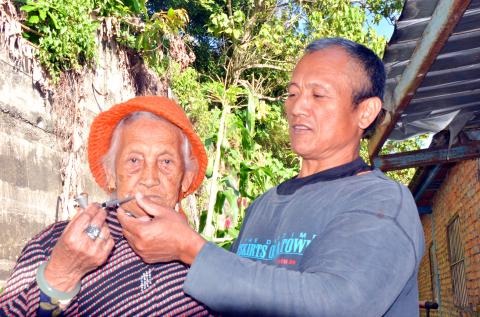
Photo: CNA
He was charged with breaches of the Controlling Guns, Knives and Ammunition Act (槍砲彈藥刀械管制條例) and the Wildlife Conservation Act (野生動物保育法), for which he was given sentences of three years and two months, and seven months respectively.
The verdicts sparked protests from Wang and the Bunun community, who said the law was too harsh on Taiwan’s “real native” Aborigines for whom hunting wild animals is part of their traditional way of life.
Many civic groups voiced support for Wang and called on the Ministry of Justice to appeal the sentence on the grounds that Wang was showing filial piety toward his elders by providing wild meat for his mother.
With the support of the Bunun community, Wang decided not to report to jail to begin his sentence, although he had told his mother he would be away for a period of time.
“All of my community told me I am not guilty and that there is no need for me to be locked up for hunting wild animals,” he told reporters in Taitung. “So I will not voluntarily put myself behind bars. Rather, I would prefer to spend my time keeping my mother company.”
“If they want to lock me up, they can come and get me,” Wang added.
It was at this juncture that the Supreme Prosecutors’ Office announced its plan to appeal his sentence.
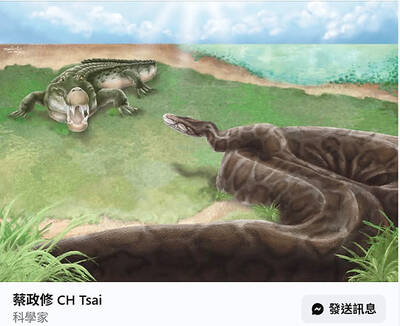
Taiwanese paleontologists have discovered fossil evidence that pythons up to 4m long inhabited Taiwan during the Pleistocene epoch, reporting their findings in the international scientific journal Historical Biology. National Taiwan University (NTU) Institute of Ecology and Evolutionary Biology associate professor Tsai Cheng-hsiu (蔡政修) led the team that discovered the largest snake fossil ever found in Taiwan. The single trunk vertebra was discovered in Tainan at the Chiting Formation, dated to between 400,000 and 800,000 years ago in the Middle Pleistocene, the paper said. The area also produced Taiwan’s first avian fossil, as well as crocodile, mammoth, saber-toothed cat and rhinoceros fossils, it said. Discoveries

WATCH FOR HITCHHIKERS: The CDC warned those returning home from Japan to be alert for any contagious diseases that might have come back with them People who have returned from Japan following the World Baseball Classic (WBC) games during the weekend are recommended to watch for symptoms of infectious gastroenteritis, flu and measles for two weeks, the Centers for Disease Control (CDC) said. Flu viruses remain the most common respiratory pathogen in Taiwan in the past four weeks and the influenza B virus accounted for 55.7 percent of the tested cases, exceeding the percentage of influenza A (H3N2) infections and becoming the local dominant strain, CDC Epidemic Intelligence Center Deputy Director Lee Chia-lin (李佳琳) said at a news conference on Tuesday. There were 82,187 hospital visits for

Alumni from Japan’s Kyoto Tachibana Senior High School marching band, widely known as the “Orange Devils,” staged a flash mob performance at the Grand Hotel in Taipei yesterday to thank Taiwan for its support after the Great East Japan Earthquake. The show, performed on the earthquake’s 15th anniversary, drew more than 100 spectators, some of whom arrived two hours before the show to secure a good viewing spot. The 26-member group played selections from “High School Musical,” “Beauty and the Beast,” and their signature piece “Sing Sing Sing” and shouted “I love
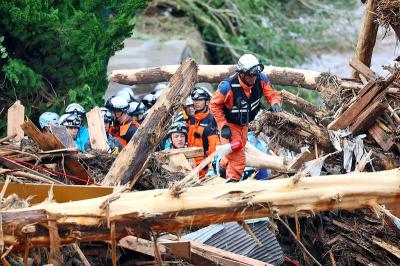
President William Lai (賴清德) today called for greater mutual aid between Taiwan and Japan in a post commemorating the 15th anniversary of the 2011 Tohoku earthquake and tsunami, saying that “true friendship reveals itself in hardship.” The magnitude 9 earthquake, the largest ever recorded in Japan, and the ensuing tsunami left 18,500 people dead or unaccounted for, and caused a meltdown at the Fukushima Dai-ichi nuclear power plant. It was the world's worst nuclear disaster since the 1986 Chernobyl accident. Japan and Taiwan share a close bond built on mutual aid and trust, Lai said on Facebook, adding that he hopes they would


 RSS
RSS