


The medical team formed to assess jailed former president Chen Shui-bian’s (陳水扁) health scheduled a third round of re-evaluation of Chen’s condition for Monday after visiting Chen yesterday without concluding a report for the Ministry of Justice’s Agen++cy of Correction.
Chen, on charges of corruption, has been imprisoned since late 2008 and his health is steadily worsening.
Former Vice President Annette Lu (呂秀蓮),who served as vice president under Chen’s administration from 2000 to 2008, said yesterday that she would launch a hunger strike beginning tomorrow at 4pm if the government does not release Chen on medical parole by tonight and would continue until Chen’s release for medical treatment is approved.

Photo: CNA
Lu visited Greater Kaohsiung to congratulate new Council Speaker Kang Yu-cheng (康裕成) and called for city councilors from her party, the Democratic Progressive Party (DPP), to join her planned hunger strike.
Lu requested that the city council set up a designated location for councilors to participate in the strike, suggesting that they rotate on six-hour shifts.
According to previous medical examinations, Chen was diagnosed with serious sleep apnea, major depressive disorder, prostatitis, delusional disorder and a stammer. Chen’s previous medical team suggested that he be released for home care, but the ministry turned down the suggestion and allegedly postponed appropriate treatment for Chen.
Lu cited Article 58 of the Prison Act (監獄行刑法) for legal basis of Chen’s release on medical parole, adding that she believed there were more prisoners who were not receiving adequate healthcare.
The ministry has neglected its duty, Lu said in a statement, adding a call for the Control Yuan to conduct further investigations.
Article 58 of the Prison Act says: “If inmates suffering from diseases cannot receive appropriate treatment in prison, it may be taken into account to release them on bail for medical treatment, transferring them to relevant prisons or hospitals with the permission of a supervisory authority.”
Lu called on the government to adhere to both the International Covenant on Civil and Political Rights and the Standard Minimum Rules for the Treatment of Prisoners, both of which call for humane treatment to protect prisoners’ human rights. Taiwan’s Legislative Yuan had ratified the former in 2009, while the latter is still being pushed for ratification.
The hunger strike hopes to help secure the release of Chen for appropriate medical treatment and to reconcile the pan blue-pan green political standoff, Lu said.
Meanwhile, the Agency of Correction said that Chen had undergone X-ray examinations and blood tests, as well as undergoing MRI scans at the Greater Taichung General Veteran’s Hospital on Wednesday, while having a sleep apnea risk assessment on Thursday.
The re-evaluation was headed by the hospital’s deputy director Hsu Hui-heng (徐惠恒) and was concluded, but the results are unknown, the agency said.
Additional reporting by Yang Cheng-chun
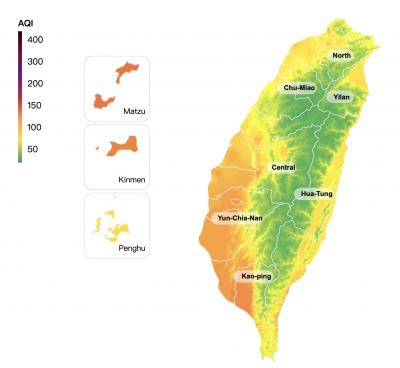
As of 4pm this afternoon, 27 monitoring stations across Taiwan had issued an orange rating for air quality, mostly concentrated in the central and southern regions, the Ministry of Environment (MOENV) Web site showed. An orange warning indicates air quality that is “unhealthy for sensitive groups.” None of the monitoring stations nationwide reported a “green” air quality rating, with all other stations recording yellow for “moderate” air quality. The ministry advised those sensitive to pollution, such as the elderly, children and those with weaker immune systems, to reduce strenuous outdoor activities and wear masks for protection. Northeasterly winds could carry
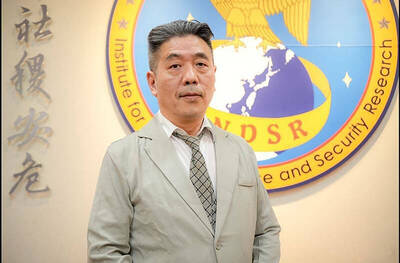
The year 2027 is regarded as the year China would likely gain the capability to invade Taiwan, not the year it would launch an invasion, Taiwanese defense experts said yesterday. The experts made the remarks after President William Lai (賴清德) told a news conference on Wednesday that his administration would introduce a NT$1.25 trillion (US$39.8 billion) special defense budget bill to boost Taiwan’s overall defense posture over the next eight years. Lai said that Beijing aims for military unification of Taiwan by 2027. The Presidential Office later clarified that what Lai meant was that China’s goal is to “prepare for military unification

HOW RUDE: Joe Biden’s Indo-Pacific defense chief condemned China’s response to Takaichi’s remarks as inappropriate and heavy-handed, while praising Japan’s nerve A former US defense official under former US president Joe Biden has voiced support for Japanese Prime Minister Sanae Takaichi for her remarks suggesting that Japan could help defend Taiwan, while describing Beijing’s response as “inappropriate.” Ely Ratner, who served as assistant secretary of defense for Indo-Pacific security affairs from 2021 to this year, said in a CNA interview that Takaichi’s comments on Taiwan simply reflected Japan’s position and stance on Taiwan. On Nov. 7, the Japanese prime minister commented in a parliamentary session that a Chinese attack on Taiwan could constitute “a situation threatening Japan’s survival” that could trigger a military
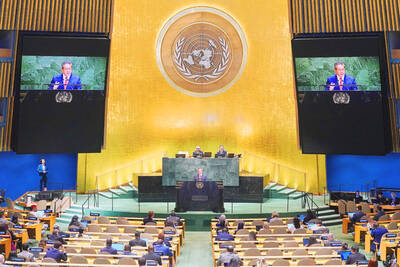
In the roughly three weeks since Japanese Prime Minister Sanae Takaichi commented on a possible Taiwan contingency in the Japanese Diet, China has unleashed economic reprisals, nationalist barbs and a diplomatic offensive to show its displeasure. Now, Chinese President Xi Jinping’s (習近平) government is escalating the dispute with an appeal to the UN, a move aimed at pressuring countries to side with China’s stance on a potential conflict over Taiwan — or stay out of its way. In a letter to UN Secretary-General Antonio Guterres on Friday last week, Chinese Permanent Representative to the UN Fu Cong (傅聰) accused Takaichi of contravening


 RSS
RSS