


Several artists conveyed their opposition to nuclear power and the Miramar Resort Hotel in Taitung’s Shanyuan Bay (杉原灣) during the 24th Golden Melody Awards ceremony on Saturday night.
Several celebrities expressed their views through the outfits they wore on the red carpet at the Taipei Arena.
Veteran hip-hop artists and social activists Kou Chou Ching (拷秋勤) wore customized black-and-white suits printed with the message “What is happiness? Zero nuclear power,” as well as anti-nuclear stickers on their face.
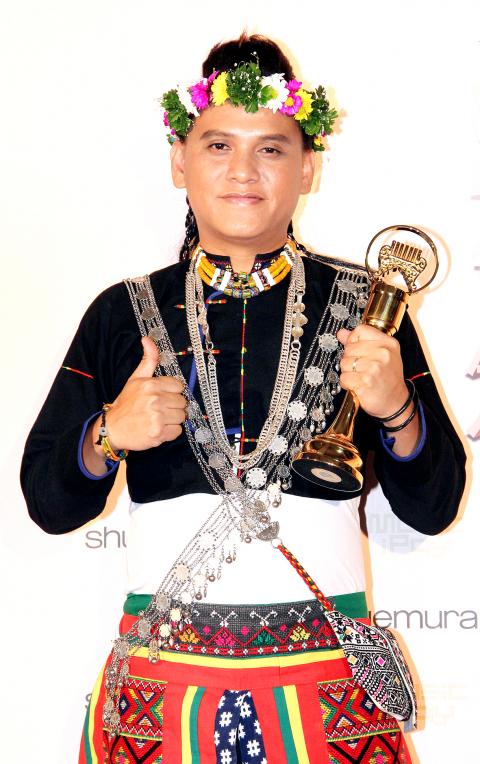
Photo: CNA
Post-rock band Sorry Youth (拍謝少年) walked the red carpet while holding an anti-nuclear flag.
A group led by Aboriginal musician Dakanow (達卡鬧) arrived holding a towel that read: “Tear down the Miramar Resort Hotel,” which was made by civic groups that have long been fighting the controversial construction plan and used in many social movements against the project.
“We make music that is like social activism, we must act like warriors, becoming braver in each battle,” Hakka musicians Liu Shao-hsi (劉劭希) and Lo Sirong (羅思容) said as they presented the award for best Hakka musician.
While receiving the Best Instrumental Album Award, Baby C (鍾興民) also showed his opposition to nuclear power by saying: “I am a human being, I am against nuclear power.”
Best Aboriginal Singer Award winner Sangpuy (盧皆興) asked other nominees to join him on stage with hand-held signs bearing messages such as “Protect the eastern coastline,” “Against nuclear power and nuclear waste” and “Refuse illegal development.”
The musicians’ declarations on these issues received mixed responses from the audience, with some saying they did not appreciate political messages at an entertainment event, while others praised the musicians for caring about public issues.

Considering that most countries issue more than five denominations of banknotes, the central bank has decided to redesign all five denominations, the bank said as it prepares for the first major overhaul of the banknotes in more than 24 years. Central bank Governor Yang Chin-lung (楊金龍) is expected to report to the Legislative Yuan today on the bank’s operations and the redesign’s progress. The bank in a report sent to the legislature ahead of today’s meeting said it had commissioned a survey on the public’s preferences. Survey results showed that NT$100 and NT$1,000 banknotes are the most commonly used, while NT$200 and NT$2,000

The Centers for Disease Control (CDC) yesterday reported the first case of a new COVID-19 subvariant — BA.3.2 — in a 10-year-old Singaporean girl who had a fever upon arrival in Taiwan and tested positive for the disease. The girl left Taiwan on March 20 and the case did not have a direct impact on the local community, it said. The WHO added the BA.3.2 strain to its list of Variants Under Monitoring in December last year, but this was the first imported case of the COVID-19 variant in Taiwan, CDC Deputy Director-General Lin Ming-cheng (林明誠) said. The girl arrived in Taiwan on

South Korea is planning to revise its controversial electronic arrival card, a step Taiwanese officials said prompted them to hold off on planned retaliatory measures, a South Korean media report said yesterday. A Yonhap News Agency report said that the South Korean Ministry of Foreign Affairs is planning to remove the “previous departure place” and “next destination” fields from its e-arrival card system. The plan, reached after interagency consultations, is under review and aims to simplify entry procedures and align the electronic form with the paper version, a South Korean ministry official said. The fields — which appeared only on the electronic form

The Ministry of Foreign Affairs (MOFA) is suspending retaliation measures against South Korea that were set to take effect tomorrow, after Seoul said it is updating its e-arrival system, MOFA said today. The measures were to be a new round of retaliation after Taiwan on March 1 changed South Korea's designation on government-issued alien resident certificates held by South Korean nationals to "South Korea” from the "Republic of Korea," the country’s official name. The move came after months of protests to Seoul over its listing of Taiwan as "China (Taiwan)" in dropdown menus on its new online immigration entry system. MOFA last week


 RSS
RSS