


Responding to concerns that Pyongyang might launch a missile that could hit Taiwan, Minister of National Defense Kao Hua-chu (高華柱) said yesterday that the military is capable of intercepting a North Korean missile.
“It does not pose a threat to us,” he told legislators on the Foreign and National Defense Committee.
Kao said the chances of Taiwan being accidentally hit by a North Korean missile are low.
Asked whether the military could intercept a missile if one should come toward Taiwan by accident, he said “yes,” without elaborating.
At the center of attention was an air force long-range radar installation in Hsinchu County, which detected a North Korean launch in December last year minutes earlier than systems in Japan.
Kao said that each detection situation is different and it largely depends on the launch location, the type of rocket being launched and the direction in which it travels.
Taiwan was able to detect the December launch within a minute because the rocket was flying in the general direction of the Philippines, he said. Taiwan would be able to detect missiles aimed in other directions by drawing upon different intelligence sources, he added.
Ministry of National Defense officials also said that amid the continued saber-rattling by Pyongyang, there were major maneuvers in North Korea on Wednesday.
China flew a reconnaissance flight over the Yellow Sea, while the US sent five surveillance aircraft over waters west of the Korean Peninsula, the officials said.
In related news, the Ministry of Foreign Affairs has advised Taiwanese to defer trips to South Korea, but its travel advisory for South Korea remains at “gray,” the lowest-level advisory.
The four-level advisory system goes from gray to yellow, orange and red, which is the strongest warning.
Taiwanese have been advised to avoid non-essential travel to North Korea, for which the foreign ministry has issued an orange travel alert.
In a statement issued late on Wednesday night, the foreign ministry suggested that Taiwanese defer plans to visit South Korea for business, travel or study.
The Tourism Bureau said about 40 percent of scheduled group tours to South Korea had been cancelled as of Wednesday.
About 1,400 Taiwanese tourists are currently traveling in South Korea, and local travel agencies have been instructed to advise their clients to delay trips there or switch to other locations, the bureau said.
Additional reporting by Shih Hsiu-chuan and AFP
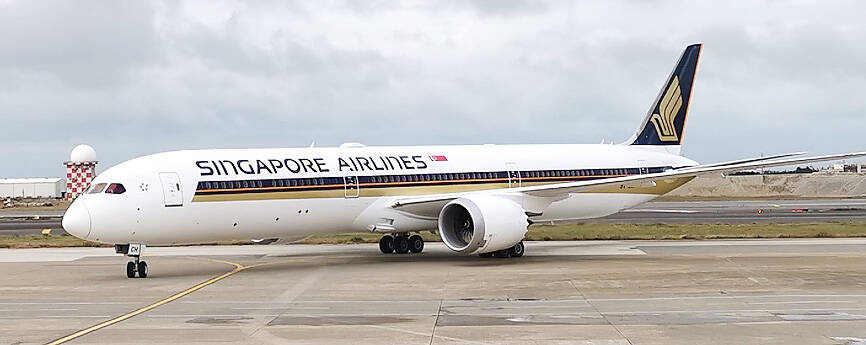
INCREASED CAPACITY: The flights on Mondays, Wednesdays, Fridays and Sundays would leave Singapore in the morning and Taipei in the afternoon Singapore Airlines is adding four supplementary flights to Taipei per week until May to meet increased tourist and business travel demand, the carrier said on Friday. The addition would raise the number of weekly flights it operates to Taipei to 18, Singapore Airlines Taiwan general manager Timothy Ouyang (歐陽漢源) said. The airline has recorded a steady rise in tourist and business travel to and from Taipei, and aims to provide more flexible travel arrangements for passengers, said Ouyang, who assumed the post in July last year. From now until Saturday next week, four additional flights would depart from Singapore on Monday, Wednesday, Friday
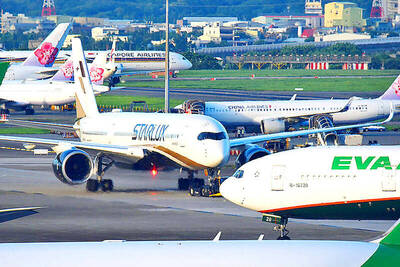
Taiwan’s three major international carriers are increasing booking fees, with EVA Airways having already increased the charge to US$28 per flight segment from US$25, while China Airlines (CAL) and Starlux Airlines are set to follow suit. Booking fees are charged by airlines through a global distribution system (GDS) and passed on to passengers. Carriers that apply the fees include CAL, EVA, Starlux and Tigerair Taiwan. A GDS is a computerized network operated by a company that connects airlines with travel agents and ticketing platforms, allowing reservations to be made and processed in real time. Major players include Amadeus, Sabre and Travelport. EVA Air began
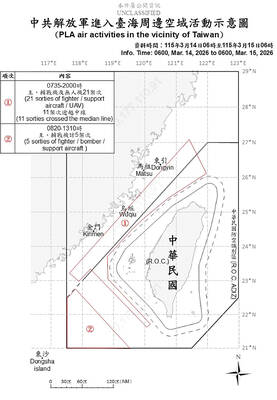
The Ministry of National Defense yesterday reported the return of large-scale Chinese air force activities after their unexplained absence for more than two weeks, which had prompted speculation regarding Beijing’s motives. China usually sends fighter jets, drones and other military aircraft around the nation on a daily basis. Interruptions to such routine are generally caused by bad weather. The Ministry of National Defense said it had detected 26 Chinese military aircraft in the Taiwan Strait over the previous 24 hours. It last reported that many aircraft on Feb. 25, when it spotted 30 aircraft, saying Beijing was carrying out another “joint combat
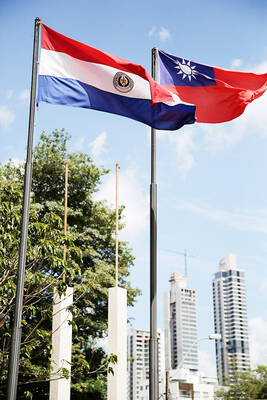
When Paraguayan opposition lawmaker Leidy Galeano returned from an all-expenses-paid tour of six Chinese cities late last year, she was convinced Paraguay risked missing out on major economic gains by sticking with longtime ally Taipei over Beijing — a message that participants on the trip heard repeatedly from Chinese officials. “Everything I saw there, I wanted for my country,” said Galeano, a member of the newly-formed Yo Creo party whose senior figures have spoken favorably about China. This trip and others like it — which people familiar with the visits said were at the invitation of the Chinese consulate in Sao Paulo


 RSS
RSS