


President Ma Ying-jeou (馬英九) yesterday renewed his pledge to uncover the truth behind the 228 Massacre and promised to promote human rights as a universal value that is emphasized by the historical tragedy.
Ma, delivering a speech in Hoklo (also known as Taiwanese) at a ceremony in front of the 228 Monument at the 228 Peace Memorial Park in Taipei, apologized to victims and their families for the then-Chinese Nationalist Party (KMT) regime’s bloody crackdown on civilians, and said he expected continued efforts to uncover the truth to transform the tragedy into an asset for later generations.
“The history was once gloomy with fears casting shadows above us, but democracy will illuminate the dust-laden files and the truth will be uncovered and written one day,” he said before bowing to the crowd.
He attributed the massacre to civilians’ uprising against a corrupt government and promised to build a clean government that promotes freedom, human rights and democracy.
Families of the massacre victims who attended the memorial called for more emphasis on human rights from the government and said their pain would not be eased unless the truth is uncovered and the importance of human rights is stressed.
“The economy can have ups and downs, but not human rights. There should be no limits on the development of human rights,” said Pan Ying-ren (潘英仁), whose father was shot dead during the massacre.
Ma said the government has evaluated more than 8 million pages of related files and documents as part of efforts to uncover the truth of the 228 Incident and ensuing massacre, and that the work of seeking delayed justice for all political victims would continue.
He then returned personal letters and documents from four massacre victims to their family members at the end of the ceremony.
Taipei Mayor Hau Lung-bin (郝龍斌), son of former premier Hau Pei-tsun (郝柏村), was the focus of the ceremony in light of recent protests against his father’s comments about the death toll from the massacre.
In an opinion piece in the Chinese-language United Daily News on Tuesday last week, Hau Pei-tsun challenged the content of a history textbook that stated that more than 10,000 people were killed during the massacre and said that only a little more than 500 people were killed in the crackdown.
His piece drew a strong reaction from victims’ families, who criticized the former premier for what they said was distorting the truth.
When asked yesterday by the press for comments on his father’s claims, Hau Lung-bin called for recognition of the historical tragedy and continuous promotion of human rights and democracy.

LOUD AND PROUD Taiwan might have taken a drubbing against Australia and Japan, but you might not know it from the enthusiasm and numbers of the fans Taiwan might not be expected to win the World Baseball Classic (WBC) but their fans are making their presence felt in Tokyo, with tens of thousands decked out in the team’s blue, blowing horns and singing songs. Taiwanese fans have packed out the Tokyo Dome for all three of their games so far and even threatened to drown out home team supporters when their team played Japan on Friday. They blew trumpets, chanted for their favorite players and had their own cheerleading squad who dance on a stage during the game. The team struggled to match that exuberance on the field, with
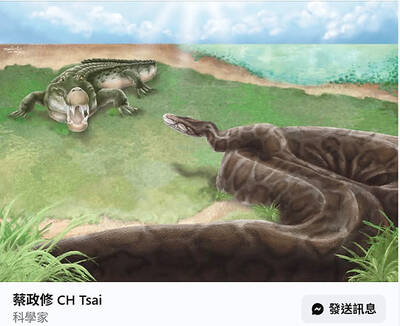
Taiwanese paleontologists have discovered fossil evidence that pythons up to 4m long inhabited Taiwan during the Pleistocene epoch, reporting their findings in the international scientific journal Historical Biology. National Taiwan University (NTU) Institute of Ecology and Evolutionary Biology associate professor Tsai Cheng-hsiu (蔡政修) led the team that discovered the largest snake fossil ever found in Taiwan. The single trunk vertebra was discovered in Tainan at the Chiting Formation, dated to between 400,000 and 800,000 years ago in the Middle Pleistocene, the paper said. The area also produced Taiwan’s first avian fossil, as well as crocodile, mammoth, saber-toothed cat and rhinoceros fossils, it said. Discoveries

Taiwanese paleontologists have discovered fossil evidence that pythons up to 4m long inhabited Taiwan during the Pleistocene epoch, reporting their findings in the international scientific journal Historical Biology. National Taiwan University (NTU) Institute of Ecology and Evolutionary Biology associate professor Tsai Cheng-hsiu (蔡政修) led the team that discovered the largest snake fossil ever found in Taiwan. A single trunk vertebra was discovered in Tainan at the Chiting Formation, dated to between 800,000 to 400,000 years ago in the Middle Pleistocene, the paper said. The area also produced Taiwan’s first avian fossil, as well as crocodile, mammoth, sabre-toothed cat and rhinoceros fossils, it said. Discoveries
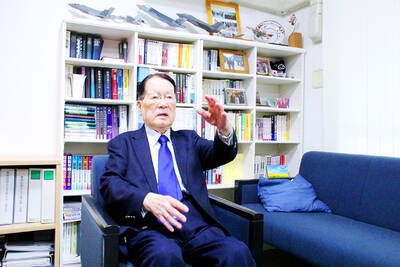
Whether Japan would help defend Taiwan in case of a cross-strait conflict would depend on the US and the extent to which Japan would be allowed to act under the US-Japan Security Treaty, former Japanese minister of defense Satoshi Morimoto said. As China has not given up on the idea of invading Taiwan by force, to what extent Japan could support US military action would hinge on Washington’s intention and its negotiation with Tokyo, Morimoto said in an interview with the Liberty Times (sister paper of the Taipei Times) yesterday. There has to be sufficient mutual recognition of how Japan could provide


 RSS
RSS